
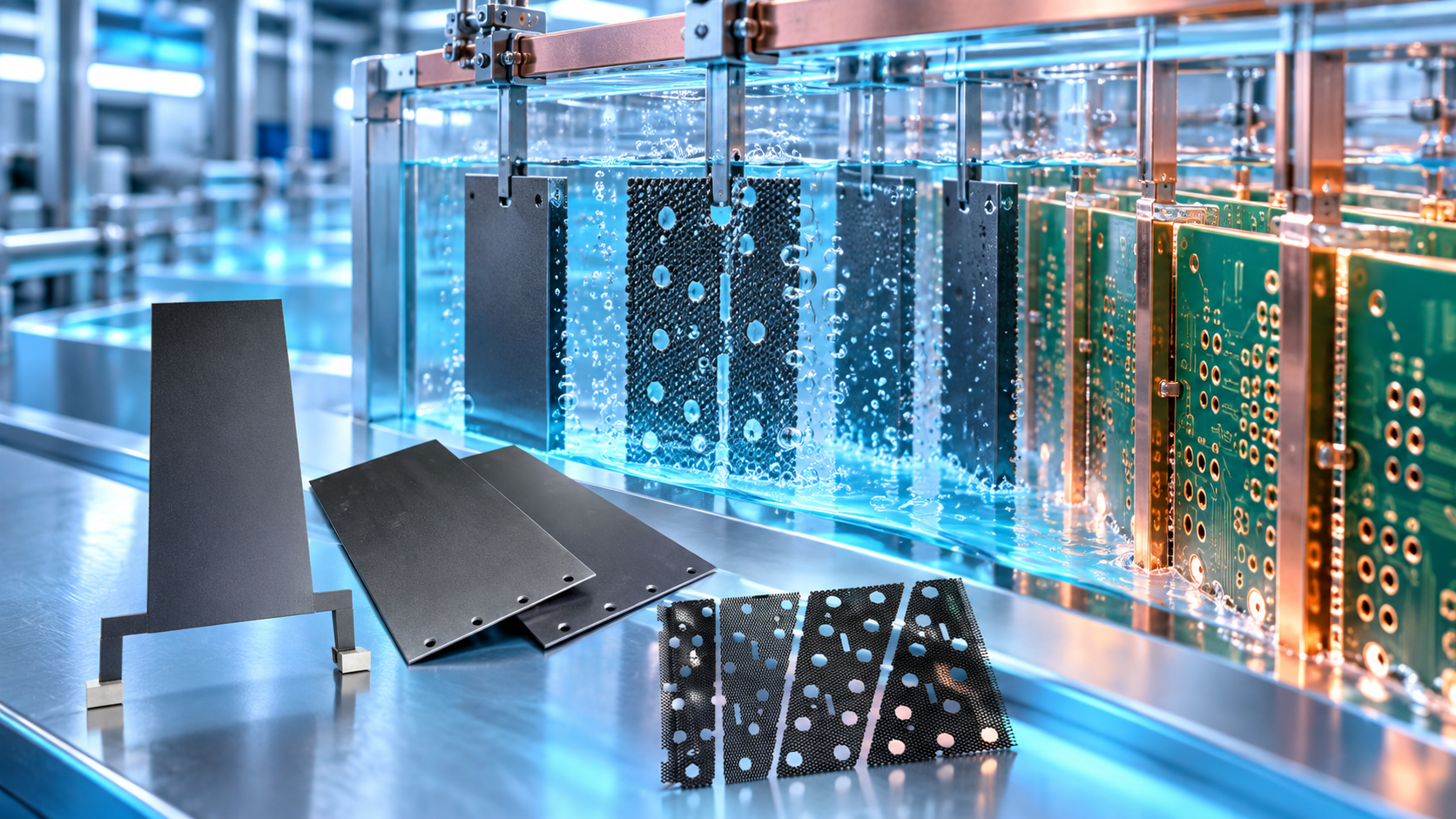
Titanium anodes are particularly suitable for electrochemical wastewater treatment when the wastewater is difficult to biodegrade, highly saline, strongly colored, toxic, or contains refractory organic pollutants that conventional biological processes struggle to remove. Through direct anodic oxidation and indirect oxidation by electrochemically generated oxidants, coated titanium anodes can help break down persistent pollutants, reduce color, support ammonia removal and disinfection, and treat challenging industrial effluents such as pharmaceutical wastewater, textile wastewater, metal-finishing wastewater, oilfield wastewater and RO concentrate. However, treatment efficiency and operating cost depend strongly on wastewater conductivity, ion composition, current density, electrode coating, mass transfer and treatment targets. This article explains how titanium anodes work in wastewater treatment, where they are most suitable, what affects energy consumption and cost, and how to select the right titanium anode for a specific wastewater application.

Introduction
Wastewater is not always difficult to treat because it contains a large amount of pollutants.
In many industrial applications, the real challenge is that the pollutants are chemically stable, toxic to microorganisms, highly colored, strongly complexed, highly saline, or poorly biodegradable.
This is where conventional biological treatment may encounter limitations.
Pharmaceutical wastewater may contain persistent organic molecules that microorganisms cannot easily degrade. Textile wastewater may retain color after conventional treatment. Metal-finishing wastewater may contain complexing agents and metal ions. Reverse-osmosis concentrate may contain salts together with concentrated refractory organic compounds.
For these wastewater streams, electrochemical oxidation, also called electrocatalytic oxidation or anodic oxidation, can provide another treatment route.
Instead of relying primarily on microorganisms or adding large quantities of external oxidizing chemicals, an electrochemical reactor uses electrical energy and electrode reactions to generate oxidation conditions capable of transforming pollutants.
The anode is therefore one of the most important components of the system.
Titanium is widely used as the substrate for industrial electrochemical electrodes because of its corrosion resistance, mechanical properties and ability to support catalytic coatings. By applying suitable noble-metal or metal-oxide catalytic coatings to the titanium substrate, the electrode surface can be designed for different electrochemical reactions.
However, this does not mean that one titanium anode is suitable for every wastewater.
The correct electrode depends on:
- wastewater composition;
- chloride and other ion concentrations;
- conductivity;
- COD and target COD removal;
- target pollutants;
- pH;
- temperature;
- current density;
- cell voltage;
- electrode spacing;
- required treatment time;
- desired oxidation pathway;
- required electrode lifetime.
Understanding these factors is essential before selecting a titanium anode for wastewater treatment.
This guide explains how titanium anodes work in electrochemical wastewater treatment, how direct and indirect oxidation differ, what determines electrical energy consumption, which wastewater streams are particularly suitable for electrochemical treatment, and what information should be provided when selecting an industrial titanium anode.
1. How Does a Titanium Anode Treat Wastewater?
The fundamental principle is electrochemical oxidation.
When direct current is applied to an electrochemical cell, oxidation reactions occur at the anode while reduction reactions occur at the cathode.
Pollutants can consequently be transformed through reactions occurring directly at the anode surface or through oxidizing species generated electrochemically.
For practical wastewater treatment, these mechanisms are generally described as:
Direct oxidation
and
Indirect oxidation.
They are not necessarily two completely separate processes. Depending on the electrode coating, wastewater composition and operating conditions, both mechanisms may contribute to pollutant removal simultaneously.
Understanding their difference is important because it explains why the same titanium anode may perform very differently in two wastewater streams.

1.1 Direct Electrochemical Oxidation
Direct oxidation occurs at or very close to the anode surface.
When an organic pollutant reaches the electrode interface, it may participate in direct electron-transfer reactions with the anodic surface.
In simplified terms:
Pollutant → oxidized products + electrons
Water can also interact with catalytic sites on the anode and form adsorbed reactive oxygen species.
A simplified representation is:
M + H₂O → M(•OH) + H⁺ + e⁻
where M represents an active site on the electrode surface.
The surface-associated hydroxyl species can react with organic molecules arriving at the electrode interface.
Complex organic compounds may first be transformed into smaller intermediates. Continued oxidation can further break chemical bonds and, under appropriate operating conditions, may ultimately convert part of the organic carbon toward simpler products such as carbon dioxide and water.
The actual pathway depends strongly on the pollutant and the anode material.
Why Mass Transfer Matters
Direct oxidation occurs mainly at the electrode–solution interface.
The pollutant therefore has to reach the active surface before it can react efficiently.
This makes mass transfer extremely important.
If wastewater circulation is poor, the reactor contains stagnant zones, or the electrode geometry prevents effective flow across the active surface, increasing electrical current does not necessarily produce a proportional increase in pollutant removal.
Instead, more current may be consumed by competing reactions such as oxygen evolution.
This is one reason why an industrial electrochemical reactor cannot be designed simply by installing a larger power supply.
The relationship among:
electrode area + current density + hydraulic flow + electrode spacing + pollutant concentration
must be considered together.
When Direct Oxidation Is Particularly Important
Direct anodic oxidation can be useful when treating refractory organic pollutants that can be effectively transferred to and oxidized at the electrode interface.
Examples may include certain:
- phenolic compounds;
- dyes;
- pharmaceutical residues;
- pesticide-related organic compounds;
- aromatic compounds;
- refractory COD components.
The effectiveness depends on the specific wastewater chemistry and electrode system.
2. Indirect Electrochemical Oxidation
Indirect oxidation follows a different pathway.
Instead of requiring every pollutant molecule to be oxidized directly on the electrode surface, the electrochemical reaction generates oxidizing species, which subsequently react with pollutants.
This greatly expands the effective reaction zone.
The anode effectively becomes an electrochemical generator of oxidants.
Several indirect oxidation pathways are possible depending on the ions already present in the wastewater.
2.1 Chloride-Mediated Oxidation
One of the most important industrial examples occurs when wastewater contains chloride ions.
At the anode:
2Cl⁻ → Cl₂ + 2e⁻
The generated chlorine can react with water:
Cl₂ + H₂O ⇌ HOCl + H⁺ + Cl⁻
Hypochlorous acid can then dissociate depending on pH:
HOCl ⇌ H⁺ + OCl⁻
The resulting active-chlorine species can participate in oxidation and disinfection reactions throughout the liquid phase.
This mechanism is especially important for conductive saline wastewater.
Instead of requiring pollutants to diffuse exclusively to the electrode surface, electrochemically generated oxidants can interact with contaminants in the bulk solution.
This can improve treatment efficiency for suitable wastewater.
However, chloride is not simply “the more, the better.”
When chloride-containing wastewater is electrochemically oxidized, reaction conditions must be controlled carefully because undesirable chlorinated oxidation products may also form.
For this reason, wastewater composition and treatment objectives should be evaluated before selecting the electrode and operating parameters.
2.2 Reactive Oxygen Species
Depending on the anode material and operating potential, electrochemical systems may also involve reactive oxygen species.
These can participate in oxidation of organic contaminants.
The extent to which these species contribute to treatment depends strongly on:
- catalytic coating;
- anode potential;
- current density;
- electrolyte composition;
- pH;
- pollutant characteristics;
- reactor configuration.
It is therefore inaccurate to evaluate an electrochemical wastewater system only by asking whether the electrode “can generate hydroxyl radicals.”
The more important engineering question is:
Which oxidation pathway dominates under the actual wastewater conditions, and does that pathway efficiently remove the target pollutant?
2.3 Other Electrochemically Generated Oxidants
Wastewater containing other ions may support additional oxidation pathways.
For example, sulfate-containing electrolytes can participate in electrochemical reactions associated with reactive sulfur-containing oxidants under suitable conditions.
Different electrochemical systems may also involve peroxide-related or other reactive species.
These mechanisms are more dependent on electrode chemistry and operating conditions and should therefore be evaluated case by case.
This is one reason why wastewater ion composition is essential information when selecting a titanium anode.
3. Direct Oxidation vs. Indirect Oxidation
The two mechanisms can be summarized as follows.
| Factor | Direct Oxidation | Indirect Oxidation |
|---|---|---|
| Main reaction zone | Electrode surface/interface | Electrode generation followed by reactions in solution |
| Basic mechanism | Direct electron transfer and surface-associated oxidation | Electrogenerated oxidants attack pollutants |
| Dependence on mass transfer to electrode | High | Generally lower for bulk-phase reactions |
| Important parameters | Electrode surface, catalytic coating, current density, flow | Wastewater ion composition, pH, current, electrode coating |
| Typical oxidizing pathway | Surface oxidation / reactive oxygen species | Active chlorine and other electrogenerated oxidants |
| Suitable pollutants | Pollutants capable of reaching and reacting at the electrode interface | Pollutants responsive to generated oxidants |
| Main engineering concern | Mass-transfer limitation and side reactions | Oxidant utilization and unwanted by-products |
In a real electrochemical wastewater reactor, these pathways frequently coexist.
The purpose of selecting the correct titanium anode coating is therefore not simply to create the “strongest possible oxidation.”
A properly designed electrode should promote the useful electrochemical pathway while controlling unwanted side reactions and maintaining acceptable energy efficiency and electrode lifetime.
4. Energy Consumption and Operating Cost of Electrochemical Wastewater Treatment
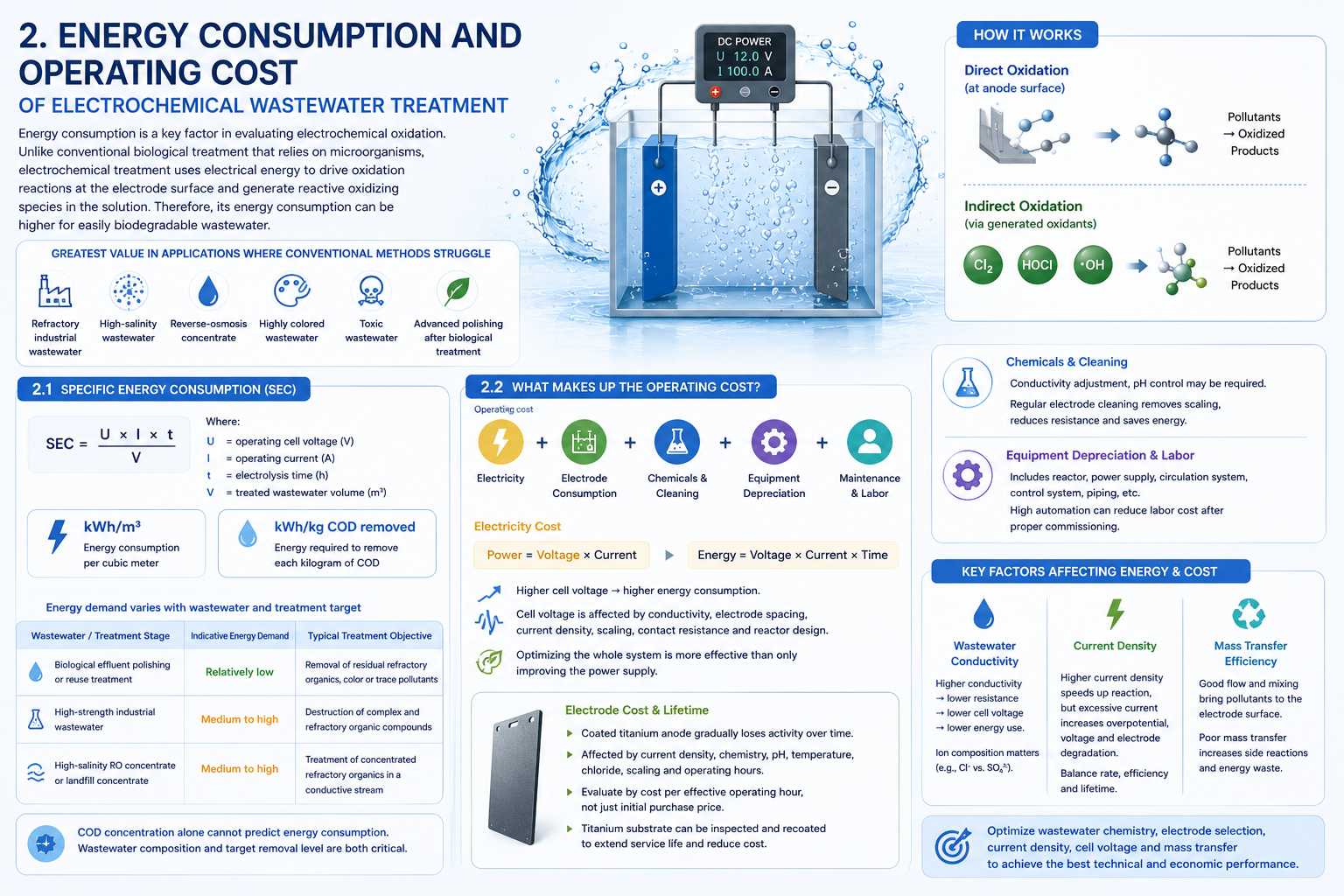
Energy consumption is one of the most important considerations when evaluating electrochemical oxidation for wastewater treatment.
Unlike conventional biological treatment, which primarily relies on microorganisms to degrade organic pollutants, electrochemical treatment uses electrical energy to drive oxidation reactions at the electrode surface and to generate reactive oxidizing species in the solution. As a result, its energy consumption can be higher than that of biological treatment for wastewater that is already readily biodegradable.
For this reason, electrochemical oxidation is generally not intended to replace biological treatment for every wastewater stream. Its greatest value is usually found in applications where conventional methods become inefficient, such as refractory industrial wastewater, high-salinity wastewater, reverse-osmosis concentrate, highly colored wastewater, toxic wastewater, or advanced polishing after biological treatment.
From an engineering perspective, the important question is therefore not simply whether electrochemical treatment consumes a large amount of electricity, but whether the electrical energy is being efficiently converted into useful pollutant removal.
4.1 Specific Energy Consumption
The electrical energy required for electrochemical wastewater treatment varies significantly according to the wastewater composition and treatment target.
A common engineering indicator is specific energy consumption, or SEC, which can be expressed as electricity consumption per cubic meter of treated wastewater:
SEC = U × I × t / V
where:
- U is the operating cell voltage;
- I is the operating current;
- t is the electrolysis time;
- V is the volume of wastewater treated.
SEC is normally expressed in:
kWh/m³
Another useful indicator is the electrical energy required to remove a certain amount of COD:
kWh/kg COD removed
This second indicator can be particularly useful when comparing different electrode systems or operating conditions because two systems may consume similar electricity per cubic meter while achieving very different COD-removal performance.
The required energy consumption depends heavily on both the initial pollutant concentration and the final treatment target.
For example, relatively low-COD wastewater requiring only polishing, color removal or improvement before reuse may require substantially less electrochemical treatment than highly concentrated chemical or pharmaceutical wastewater containing refractory organic compounds.
As an engineering reference, different wastewater applications may therefore show very different energy requirements:
| Wastewater / Treatment Stage | Indicative Energy Demand | Typical Treatment Objective |
|---|---|---|
| Biological effluent polishing or reuse treatment | Relatively low | Removal of residual refractory organics, color or trace pollutants |
| High-strength industrial wastewater | Medium to high | Destruction of complex and refractory organic compounds |
| High-salinity RO concentrate or landfill concentrate | Medium to high | Treatment of concentrated refractory organics in a conductive stream |
Actual SEC should always be determined according to wastewater testing or pilot-scale operating data rather than using a single universal value.
This is particularly important because COD concentration alone cannot predict electrochemical energy consumption.
Two wastewater streams may both have a COD of 1,000 mg/L, but one may contain relatively easy-to-oxidize compounds while the other contains stable aromatic, heterocyclic or highly complex organic molecules. Their actual electrical requirements can therefore be very different.
Similarly, achieving a partial COD reduction to improve biodegradability usually requires less electrical energy than attempting complete mineralization.
This is why electrochemical oxidation is often more economical when it is used at the correct stage of a combined wastewater-treatment process, rather than being required to remove every pollutant by electrolysis alone.

4.2 What Makes Up the Operating Cost?
The operating cost of an electrochemical wastewater-treatment system is not determined by electricity alone.
A more realistic calculation should include:
Electricity + electrode consumption + chemicals and cleaning + equipment depreciation + maintenance and labor
Among these factors, electricity and electrode lifetime normally have the greatest influence on long-term operating economics.
Electricity Cost
Electrical power is fundamentally determined by:
Power = Voltage × Current
Therefore:
Energy Consumption = Voltage × Current × Operating Time
This relationship explains why reducing unnecessary cell voltage is extremely important.
If two electrochemical reactors operate at the same current and achieve the same treatment result, but one requires significantly higher voltage, that system will consume more electricity.
Cell voltage can be affected by wastewater conductivity, electrode spacing, current density, scaling, electrical contact resistance and reactor configuration.
For OEM wastewater-treatment equipment manufacturers, energy optimization therefore should not focus only on the power-supply efficiency. The complete electrochemical cell must be considered.
Titanium Anode Consumption and Replacement
The second important long-term cost is the electrode.
A coated titanium anode consists of a corrosion-resistant titanium substrate and an electrochemically active coating containing noble-metal or mixed-metal-oxide components.
The titanium substrate itself can remain mechanically stable for a long period under suitable conditions, but the catalytic coating continuously operates under anodic polarization.
During extended operation, the electrochemically active coating can gradually lose activity depending on operating conditions.
The degradation rate can be strongly affected by:
- current density;
- wastewater composition;
- chloride concentration;
- pH;
- operating temperature;
- cell voltage;
- scale formation;
- operating hours;
- polarity mode.
Excessive current density or operation outside the intended electrochemical conditions can accelerate coating degradation and shorten electrode lifetime.
This is why purchasing the lowest-cost titanium anode does not necessarily produce the lowest wastewater-treatment cost.
A more meaningful evaluation is:
electrode purchase cost ÷ effective operating lifetime
combined with the influence of the electrode on cell voltage and current efficiency.
Another advantage of coated titanium electrodes is that, when the titanium substrate remains suitable after service, the substrate may be inspected, surface-treated and recoated instead of completely replaced.
This can help reduce long-term electrode replacement costs.
Chemicals, Cleaning and Auxiliary Costs
Although electrochemical oxidation can generate oxidizing species directly inside the reactor, some projects still require auxiliary chemicals.
Low-conductivity wastewater may require conductivity adjustment. Some processes require pH control because pH influences oxidation chemistry, pollutant speciation and active-chlorine distribution.
Electrode cleaning must also be considered.
Wastewater containing calcium, magnesium, carbonate or other scale-forming components can gradually produce deposits on electrode surfaces. Scaling may reduce effective active area, restrict mass transfer and increase electrical resistance.
As resistance increases, the power supply must provide higher voltage to maintain the same current, increasing energy consumption.
Periodic electrode cleaning is therefore not only a maintenance issue; it is also an energy-management issue.
Equipment Depreciation and Labor
An electrochemical wastewater-treatment system normally includes the electrochemical reactor, titanium anodes, cathodes, DC rectifier, circulation system, control system, piping and auxiliary equipment.
The initial equipment investment can be higher than that of some simple chemical-treatment processes.
However, electrochemical systems can also offer relatively high levels of automation.
Current, voltage, flow, treatment time and dosing conditions can be controlled automatically, which can reduce continuous manual intervention once the process has been properly commissioned.
For industrial projects, the final economic evaluation should therefore be based on the complete lifecycle cost rather than only on the purchase price of the electrolysis cell.
4.3 What Factors Have the Greatest Impact on Energy Consumption and Cost?
Three factors are particularly important when evaluating the economics of a titanium-anode electrochemical wastewater-treatment system:
wastewater conductivity, current density and mass-transfer efficiency.
Wastewater Conductivity
Conductivity directly affects the resistance of the liquid between the anode and cathode.
When wastewater conductivity is too low, the electrical resistance of the electrolyte increases. A higher cell voltage is then required to maintain the desired current.
Higher voltage means higher power consumption.
This is one reason electrochemical treatment can be particularly attractive for high-salinity industrial wastewater.
High salt concentration can create difficulties for biological treatment because microorganisms may be inhibited by high osmotic pressure. In an electrochemical system, however, dissolved ions can improve conductivity and reduce ohmic resistance.
Therefore, some high-salinity and high-organic-load wastewater streams provide conditions that are naturally favorable for electrochemical treatment.
However, conductivity should never be considered alone.
The type of dissolved ions is equally important.
Chloride-rich wastewater may support active-chlorine-mediated indirect oxidation, while sulfate-dominated wastewater follows different electrochemical pathways.
For electrode selection, both conductivity and ionic composition should therefore be provided.
Current Density
Current density represents the amount of current applied to a given effective electrode area.
It is commonly expressed as: A/m²
Increasing current density can accelerate electrochemical reactions and shorten treatment time. It can also allow a reactor to achieve a given treatment capacity with a smaller electrode area.
However, higher current density does not automatically mean higher treatment efficiency.
When the current density becomes excessive, a greater portion of electrical energy may be consumed by competing reactions such as oxygen evolution instead of pollutant oxidation.
At the same time:
- electrode overpotential may increase;
- cell voltage may rise;
- energy consumption may increase;
- electrode temperature and electrochemical stress may increase;
- catalytic coating degradation may accelerate.
For this reason, the objective of industrial reactor design should not be to achieve the highest possible current density.
The objective is to find an appropriate balance among:
treatment rate + current efficiency + energy consumption + electrode lifetime
This is also why current density is one of the most important parameters Ehisen needs when evaluating a titanium anode for a wastewater-treatment project.
Mass-Transfer Efficiency
Mass transfer is especially important for direct electrochemical oxidation.
Pollutants in the bulk wastewater must reach the active anode surface before surface oxidation can occur effectively.
If reactor circulation is poor or the electrode arrangement creates stagnant regions, the electrical system may continue consuming power even though pollutants are not being efficiently transported to the active electrode area.
Under these conditions, more electrical energy can be diverted toward side reactions such as water electrolysis, oxygen evolution or hydrogen evolution.
This reduces current efficiency.
Mass-transfer performance is affected by:
- wastewater flow velocity;
- electrode spacing;
- electrode geometry;
- turbulence;
- reactor circulation;
- effective coated area;
- gas removal;
- hydraulic dead zones.
This is why a high-performance titanium anode alone cannot guarantee an energy-efficient wastewater-treatment system.
The electrode, electrical parameters and reactor hydraulics need to be designed as a complete electrochemical system.
Ultimately, reducing electrochemical wastewater-treatment cost is not simply a matter of purchasing a lower-cost electrode or reducing operating current.
The more effective strategy is to optimize the entire relationship between:
wastewater chemistry → electrode coating → current density → cell voltage → mass transfer → treatment target
When these parameters are properly matched, electrical energy can be directed more efficiently toward useful oxidation reactions, helping improve treatment performance while controlling both energy consumption and electrode operating cost.

5. Typical Industrial Wastewater Sources for Titanium Anode Electrochemical Treatment
Electrochemical oxidation using coated titanium anodes is particularly valuable for industrial wastewater that is highly concentrated, toxic, saline, strongly colored, or difficult to biodegrade.
Unlike conventional biological treatment, electrochemical treatment does not rely entirely on microorganisms to break down pollutants. Oxidation reactions can occur directly at the anode surface, while electrochemically generated oxidants can also attack contaminants in the bulk solution.
For this reason, titanium-anode electrochemical systems are often considered for wastewater streams where conventional biological treatment alone cannot efficiently achieve the required treatment target.
Among the most representative applications are pharmaceutical and fine-chemical wastewater, textile and dyeing wastewater, and electroplating and metal-finishing wastewater.
5.1 Pharmaceutical and Fine-Chemical Wastewater
Pharmaceutical and fine-chemical production can generate some of the most difficult industrial wastewater to treat.
Depending on the manufacturing process, the wastewater may contain high concentrations of organic pollutants together with antibiotic residues, pharmaceutical intermediates, aromatic compounds, heterocyclic compounds, solvents, salts and other biologically inhibitory substances.
The challenge is not simply high COD. Many of these organic molecules have stable chemical structures and poor biodegradability, while some may also inhibit the microorganisms used in conventional biological treatment.
In this type of wastewater, electrochemical oxidation using coated titanium anodes can be used to attack refractory organic structures through direct anodic oxidation and electrochemically generated oxidants.
Complex organic molecules may undergo ring opening, bond breaking and molecular transformation, converting part of the high-molecular-weight or biologically inhibitory organic matter into smaller and potentially more biodegradable compounds.
For this reason, electrochemical oxidation does not always need to completely mineralize all organic pollutants into CO₂ and H₂O.
In many industrial systems, a more practical approach is:
Electrochemical Pretreatment → Biological Treatment
The electrochemical stage is used to reduce toxicity and destroy the most refractory molecular structures, while the downstream biological process removes the remaining biodegradable organic matter.
This approach can make better use of electrical energy than attempting to achieve complete COD removal through electrochemical oxidation alone.
Because pharmaceutical and fine-chemical wastewater can contain high concentrations of refractory organic pollutants, its electrochemical treatment may require relatively high current input and treatment time. Pilot testing is therefore especially important before determining electrode area, current density and expected energy consumption.
5.2 Textile and Dyeing Wastewater
Textile and dyeing wastewater presents a different treatment challenge: high color and persistent dye molecules.
Typical wastewater may contain synthetic dyes such as azo dyes, reactive dyes and disperse dyes, together with surfactants, salts and various textile-processing auxiliaries.
Many dye molecules contain stable chromophoric structures responsible for their intense color. Even after conventional biological treatment, residual color and refractory COD may remain in the effluent.
Electrochemical oxidation can attack these chromophoric structures and break chemical bonds associated with color formation.
For example, oxidation of azo-related structures can destroy the conjugated molecular system responsible for visible color, resulting in rapid decolorization under suitable electrochemical conditions.
When chloride ions are present in the wastewater, indirect oxidation can also become important.
Chloride can be electrochemically oxidized at the titanium anode, generating active-chlorine species such as hypochlorous acid. These oxidants can diffuse into the wastewater and participate in the oxidation of dyes and other organic contaminants.
Therefore, both:
direct anodic oxidation + indirect oxidation
may contribute to textile wastewater treatment.
Electrochemical oxidation can be particularly useful as an advanced polishing process after conventional biological treatment, targeting residual color and refractory organic pollutants that remain in the treated effluent.
However, decolorization should not automatically be considered equivalent to complete COD removal. Dye molecules may lose their visible color after the chromophoric structure is destroyed while organic intermediates remain in the wastewater.
For this reason, actual treatment performance should be evaluated using COD, TOC or other relevant water-quality indicators together with color removal.
5.3 Electroplating and Metal-Finishing Wastewater
Electroplating and metal-finishing wastewater is particularly interesting for electrochemical treatment because it commonly combines high conductivity, dissolved metals and chemically stable complexing agents.
Depending on the production process, the wastewater may contain metal ions such as copper, nickel, zinc or chromium species, together with cyanide-related compounds, EDTA and other complexing agents.
The relatively high concentration of dissolved ions generally provides good electrical conductivity. This can reduce electrolyte resistance and help control the voltage required to maintain a given current compared with low-conductivity wastewater.
More importantly, electrochemical treatment can potentially use both sides of the electrochemical cell.
At the titanium anode, oxidation reactions can help destroy certain organic complexing agents and oxidizable contaminants. Breaking metal–organic complexes can also make subsequent metal separation easier.
At the cathode, suitable dissolved metal ions may accept electrons and be reduced:
Mⁿ⁺ + ne⁻ → M
Under appropriate conditions, this makes it possible to combine:
Anodic Pollutant Oxidation + Cathodic Metal Recovery
within the same electrochemical treatment concept.
For wastewater containing cyanide-related pollutants, anodic oxidation may also be used as part of a treatment strategy to transform cyanide under carefully controlled conditions.
However, metal-finishing wastewater varies considerably between processes. Free metal ions, complexed metals, cyanide-containing wastewater, acidic rinse water and concentrated plating solutions cannot be treated as one identical wastewater stream.
The electrode coating, current density, pH, reactor configuration and treatment sequence should therefore be selected according to the actual wastewater composition.
From an energy perspective, the relatively high conductivity of many electroplating wastewater streams can be advantageous because lower solution resistance can reduce unnecessary voltage losses. Nevertheless, actual operating cost still depends on pollutant concentration, treatment target, current density, electrode spacing and required treatment time.
These three wastewater categories demonstrate why titanium-anode electrochemical treatment should not be evaluated simply according to COD concentration.
Pharmaceutical wastewater may benefit from electrochemical oxidation because of its toxicity and poor biodegradability.
Textile wastewater may benefit because electrochemical oxidation can destroy refractory chromophoric structures and remove residual color.
Electroplating wastewater may benefit from its high conductivity and the possibility of combining anodic oxidation with cathodic metal recovery.
The key question is therefore not simply:
“Is the COD high?”
but rather:
“What pollutants are present, why are conventional treatment methods having difficulty removing them, and which electrochemical reaction can be used to solve that specific problem?”
This is the basis for determining whether a coated titanium anode is suitable for a particular industrial wastewater-treatment system.

6. When Is Titanium Anode Electrochemical Treatment Suitable for Wastewater?
Titanium-anode electrochemical treatment is particularly suitable for wastewater that is difficult to biodegrade, chemically complex, highly saline, strongly colored, toxic to microorganisms, or difficult to treat effectively by conventional biological processes alone.
Its main advantage is that pollutant removal does not depend entirely on microbial metabolism. Through direct anodic oxidation and indirect oxidation by electrochemically generated oxidants, refractory organic compounds, color-forming structures, ammonia-related pollutants and microorganisms can be transformed or removed under suitable operating conditions.
However, titanium-anode electrochemical treatment is not automatically the best solution for every wastewater stream. Its value becomes more obvious when the wastewater has one or more characteristics that make conventional treatment difficult.

6.1 Refractory and High-Strength Organic Wastewater
High-strength organic wastewater from chemical, pesticide, pharmaceutical, food-processing and other industrial processes may contain large amounts of organic compounds that are difficult for microorganisms to degrade.
The challenge is often not simply high COD, but the chemical stability, toxicity and poor biodegradability of the organic pollutants.
Electrochemical oxidation can attack these molecules through direct oxidation at the anode surface or through reactive oxidizing species generated during electrolysis.
Large and complex organic molecules may undergo:
bond breaking → ring opening → formation of smaller intermediates → further oxidation
In many applications, the objective is not necessarily to completely mineralize all organic matter. Electrochemical oxidation can instead be used as a pretreatment step to reduce toxicity and improve biodegradability before the wastewater enters a biological treatment process.
This makes coated titanium anodes particularly relevant for wastewater where conventional biological treatment suffers from low removal efficiency or microbial inhibition.

6.2 High-Color Wastewater and Refractory Dye Effluent
Wastewater with high color is another important application.
Textile, dyeing, printing and certain chemical-production processes can discharge wastewater containing stable dye molecules and chromophoric structures that are difficult to remove biologically.
Electrochemical oxidation can destroy these color-forming molecular structures.
When chloride is present, electrochemically generated active-chlorine species can also participate in indirect oxidation and further promote decolorization and organic degradation.
Titanium-anode electrochemical treatment can therefore be considered for:
- high-color dyeing wastewater;
- refractory textile effluent;
- biological-treatment effluent with residual color;
- wastewater-reuse polishing.
In these applications, electrochemical treatment is often more valuable as a targeted polishing technology than as the sole treatment process for the entire wastewater flow.

6.3 Oilfield, Refinery and RO Concentrate
Oilfield and refinery wastewater may contain hydrocarbons, phenolic compounds, alcohols, aldehydes, ethers, organic acids, salts and other difficult-to-degrade contaminants.
These wastewater streams can become challenging when high salinity or toxic organic components reduce the effectiveness of biological treatment.
Electrochemical oxidation may be used to treat refractory organic contaminants directly or as part of a combined treatment process.
It is also particularly relevant to reverse-osmosis concentrate.
RO membranes do not destroy pollutants. Instead, they separate water from contaminants and concentrate salts and refractory organic compounds into a smaller reject stream.
This concentrated stream may have:
- higher conductivity;
- higher salt concentration;
- more concentrated refractory COD;
- smaller treatment volume than the original wastewater.
These characteristics can make RO concentrate a more practical target for electrochemical treatment than applying electrolysis to the entire upstream wastewater flow.

6.4 High-Ammonia, Hospital and Disinfection-Related Wastewater
Electrochemical treatment can also be considered when ammonia removal or disinfection is an important treatment objective.
In chloride-containing wastewater, active-chlorine species generated at the titanium anode can react with ammonia-containing compounds and participate in nitrogen transformation.
The actual removal pathway depends strongly on:
- chloride concentration;
- pH;
- ammonia concentration;
- current density;
- competing organic matter;
- treatment time.
For this reason, operating conditions must be optimized rather than simply increasing current.
Electrochemical treatment can also provide a disinfection function.
Electrochemically generated oxidizing species can contribute to microorganism inactivation while organic contaminants are being oxidized.
This can be useful for selected:
- hospital wastewater;
- decentralized wastewater treatment;
- reuse-water polishing;
- wastewater requiring simultaneous oxidation and disinfection.
For hospital and similar wastewater, electrochemical oxidation should be designed around the actual water chemistry and treatment target rather than treated simply as a general sterilization process.

6.5 High-Salinity Industrial Wastewater
High-salinity wastewater is one of the application conditions in which titanium-anode electrochemical treatment can offer a particularly useful process advantage.
High salt concentrations may inhibit microorganisms and make biological treatment more difficult.
For an electrochemical system, however, dissolved ions increase wastewater conductivity.
Higher conductivity generally means lower solution resistance, which can reduce the cell voltage required to maintain a given current.
This can improve electrical efficiency.
Potential applications include saline wastewater from:
- chemical manufacturing;
- pharmaceutical production;
- textile processing;
- metal finishing;
- oilfield operations;
- desalination and membrane concentrate treatment.
However, high salinity does not automatically mean that every wastewater is suitable for the same electrode coating.
The specific ion composition remains important.
For example, chloride-rich wastewater can support active-chlorine-mediated indirect oxidation, while sulfate-rich wastewater may follow different electrochemical reaction pathways.
Therefore, both conductivity and detailed ionic composition should be evaluated before selecting a titanium-anode coating.
Overall, titanium-anode electrochemical treatment is most attractive when wastewater has one or more of the following characteristics:
poor biodegradability + high salinity + refractory organic pollutants + strong color + toxic compounds + ammonia contamination + need for advanced oxidation or disinfection.
The technology becomes especially valuable when conventional biological or physicochemical treatment cannot efficiently reach the required discharge or reuse target.
For practical engineering design, the question should not simply be:
“Can a titanium anode treat this wastewater?”
A more useful question is:
“Which pollutants are difficult to remove, which electrochemical reaction can target them, and at which treatment stage can electrochemistry provide the greatest technical and economic value?”
7.What Information Should You Send to a Titanium-Anode Manufacturer?
If you are developing an electrochemical wastewater-treatment reactor, providing complete operating information can significantly improve electrode selection.
Instead of sending only:
“We need a 300 × 500 mm titanium anode.”
provide as much of the following information as possible:
Application
What type of wastewater is being treated?
Water Chemistry
COD, conductivity, chloride, sulfate, pH, temperature, TDS, hardness and major contaminants.
Treatment Target
Required COD reduction, color removal, ammonia removal, disinfection or other objectives.
Electrical Conditions
Current, voltage, current density and effective electrode area.
Reactor Configuration
Electrode dimensions, quantity, spacing, flow rate and operating mode.
Expected Lifetime
Required operating hours and daily duty cycle.
With these parameters, the titanium substrate, coating system, coating loading, electrode geometry and manufacturing method can be evaluated much more accurately.
8.A Practical Decision Guide: Is a Titanium Anode Suitable for Your Wastewater?
Electrochemical oxidation using coated titanium anodes deserves particular consideration when one or more of the following conditions exist:
The wastewater is difficult to biodegrade.
Persistent organic compounds remain after conventional treatment.
The wastewater is highly saline.
High conductivity can be advantageous for electrochemical treatment while creating difficulties for biological processes.
The wastewater contains high color.
Electrochemical oxidation can destroy chromophoric structures in suitable dye-containing wastewater.
The wastewater contains toxic compounds that inhibit microorganisms.
Electrochemical pretreatment may reduce toxicity or transform refractory molecules.
You are treating RO concentrate.
The smaller concentrated stream may be more suitable for advanced electrochemical treatment than the entire original flow.
Disinfection is also required.
Electrochemically generated oxidants can contribute to microbial inactivation.
The process requires compact, automated treatment equipment.
Electrochemical reactors can be designed as modular systems controlled by current, voltage, flow and treatment time.
On the other hand, if the wastewater is easily biodegradable, low in salinity and readily treated biologically, electrochemical oxidation may not be the most economical primary treatment process.
Final Perspective
Titanium anodes are not simply metal plates that conduct electricity.
In an electrochemical wastewater-treatment reactor, the coated titanium anode is the surface where electrical energy is converted into useful electrochemical reactions.
Pollutants can be removed through direct anodic oxidation, through indirect oxidation by electrochemically generated oxidants, or through a combination of both mechanisms.
The performance of the system depends not only on the electrode coating but also on:
wastewater chemistry, conductivity, chloride concentration, pH, current density, cell voltage, electrode spacing, hydraulic design, treatment target and operating time.
This is why electrochemical oxidation is particularly attractive for challenging wastewater streams such as pharmaceutical and fine-chemical wastewater, textile wastewater, high-salinity industrial wastewater, metal-finishing wastewater, oilfield and petrochemical wastewater, RO concentrate, ammonia-containing wastewater and other refractory industrial effluents.
But it should not automatically replace biological treatment.
In many projects, the best solution is a hybrid process in which electrochemistry is used exactly where conventional treatment becomes inefficient.
For OEM equipment manufacturers and wastewater-treatment engineering companies, titanium-anode selection should therefore begin with the wastewater rather than with the electrode dimensions.
Looking for a Titanium Anode for Your Wastewater-Treatment System?
If you are designing or upgrading an electrochemical wastewater-treatment system, send Ehisen your operating conditions.
The most useful information includes:
wastewater type + COD + conductivity + chloride concentration + pH + temperature + treatment target + operating current + voltage + current density + electrode dimensions + reactor configuration + expected operating lifetime.
Based on these parameters, Ehisen can evaluate the appropriate titanium substrate, electrode structure and noble-metal coating system for your application.
Custom titanium anodes are available for OEM electrochemical wastewater-treatment equipment, pilot systems and industrial electrolysis projects.
Send us your wastewater parameters or electrode drawing to discuss a customized titanium-anode solution.
Contact Us

One Response
woh I enjoy your blog posts, saved to my bookmarks! .