
Cathodic protection is one of the most effective technologies used to control corrosion of metal structures exposed to soil, seawater, freshwater, concrete, and other electrolytic environments. By controlling the electrochemical potential of the protected metal, cathodic protection systems reduce corrosion reactions and extend the service life of critical infrastructure.
In modern impressed current cathodic protection (ICCP) systems, MMO coated titanium anodes are widely used as auxiliary electrodes because of their excellent corrosion resistance, stable electrochemical performance, and adaptability to harsh environments. Different MMO coatings, such as iridium-tantalum (Ir-Ta) and ruthenium-iridium (Ru-Ir), are selected according to environmental conditions and current requirements.
This article explains the basic principles of cathodic protection, how MMO titanium anodes work, why different coatings are required for different applications, and the main cathodic protection products including MMO tubes, flexible anodes, MMO tapes, probe anodes, and titanium anode wires.
1. What Is Cathodic Protection?
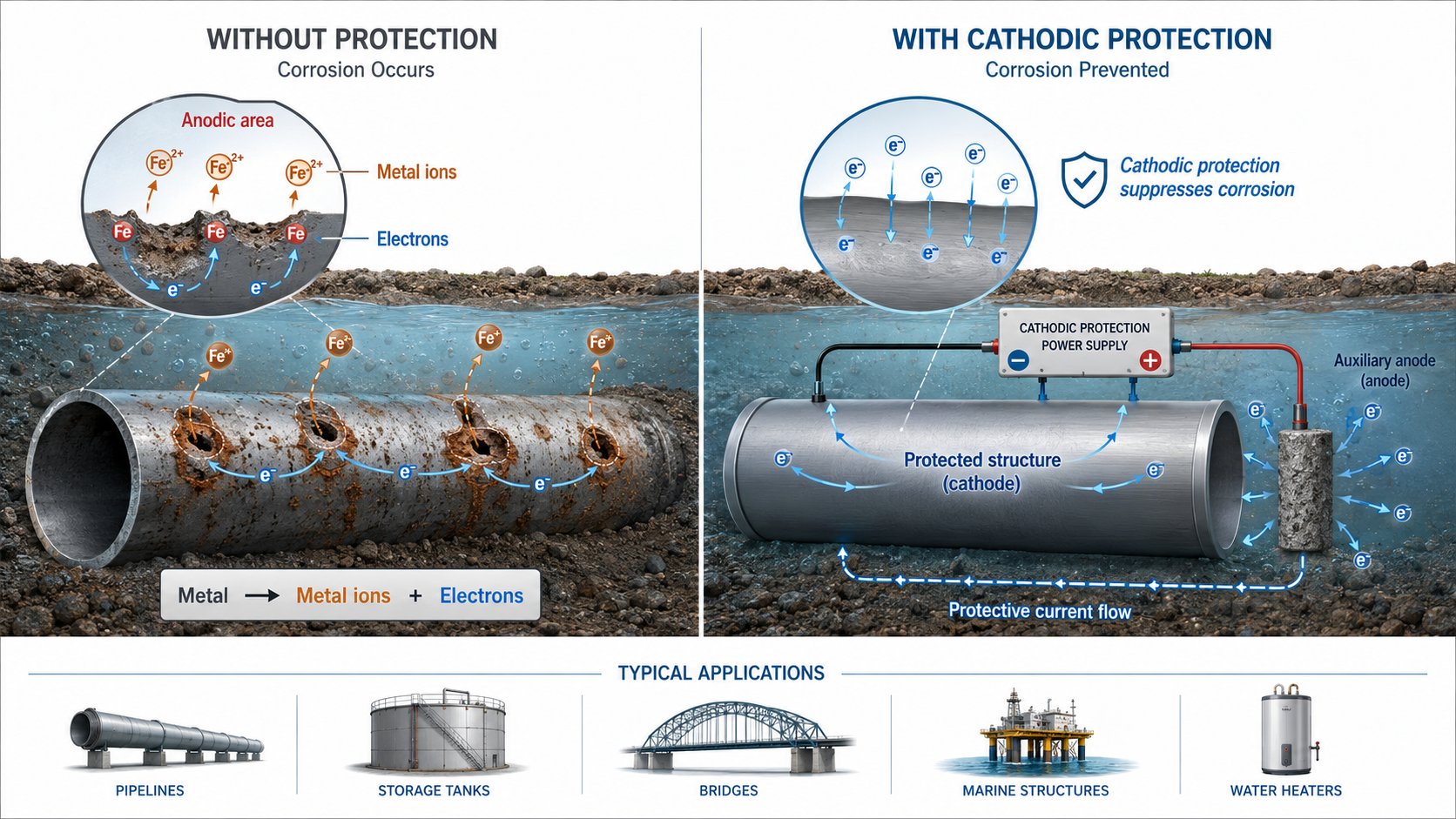
Metal corrosion is essentially an electrochemical process.
When a metal structure, such as steel pipelines, storage tanks, bridges, marine structures, or water heaters, contacts an electrolyte environment, tiny electrochemical cells naturally form on the metal surface.
Some areas become anodic areas, where metal atoms lose electrons and dissolve into the environment.
The basic corrosion process can be simplified as:
Metal → Metal ions + Electrons
The electrons flow through the metal structure, while ions enter the surrounding electrolyte. Over time, this continuous electrochemical reaction causes material loss, surface damage, and structural degradation.
Cathodic protection works by changing this electrochemical balance.
The basic principle is:
Make the protected metal structure become the cathode of an electrochemical cell, reducing its tendency to undergo oxidation and corrosion.
In other words, cathodic protection does not directly make the metal “stronger”. Instead, it changes the electrical condition of the metal surface so that corrosion reactions are suppressed.
2. Why Is It Called “Cathodic” Protection?
The terms anode and cathode describe the electrochemical roles of materials, not necessarily their physical appearance.
In a corrosion system:
- The anode is the area where oxidation occurs.
- The cathode is the area where reduction reactions occur.
Normally, corrosion happens at anodic locations because metal atoms lose electrons.
Cathodic protection aims to eliminate or minimize these anodic corrosion zones by forcing the protected structure to behave as a cathode.
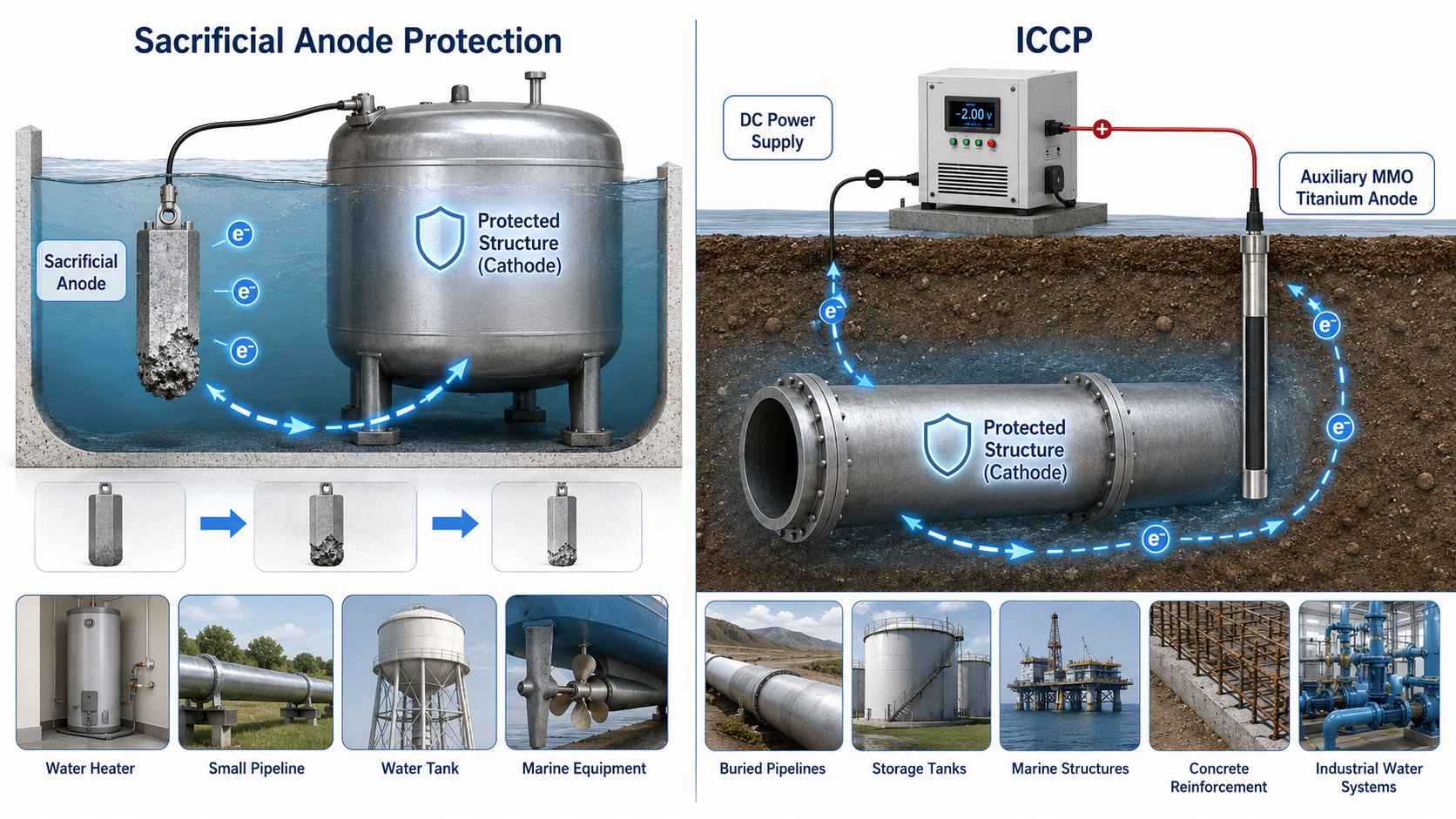
This is achieved through two main methods:
2.1 Sacrificial Anode Protection
The first method uses a more active metal, such as magnesium, zinc, or aluminum alloy, as a sacrificial anode.
The sacrificial material has a higher tendency to release electrons, so it corrodes preferentially instead of the protected structure.
Typical applications include:
- Small pipelines
- Water tanks
- Marine equipment
- Household water heaters
The disadvantage is that the sacrificial material is consumed over time and must eventually be replaced.
2.2 Impressed Current Cathodic Protection (ICCP)
For large structures or long-term protection systems, impressed current cathodic protection is commonly used.
In an ICCP system:
- A DC power supply provides protective current.
- The MMO titanium anode acts as the auxiliary electrode.
- The protected metal structure is connected as the cathode.
The current path is:
DC Power Supply → MMO Titanium Anode → Electrolyte → Protected Structure → Power Supply
The MMO titanium anode does not protect the structure by being consumed. Instead, it provides a stable electrochemical interface that transfers current into the electrolyte.
Typical applications include:
- Buried pipelines
- Storage tanks
- Marine structures
- Bridges
- Concrete reinforcement protection
- Industrial water systems
3. The Role of MMO Titanium Anodes in Cathodic Protection
Many people are confused by one point:
If the product is called an “anode”, why does it protect the cathode?
This is an important concept.
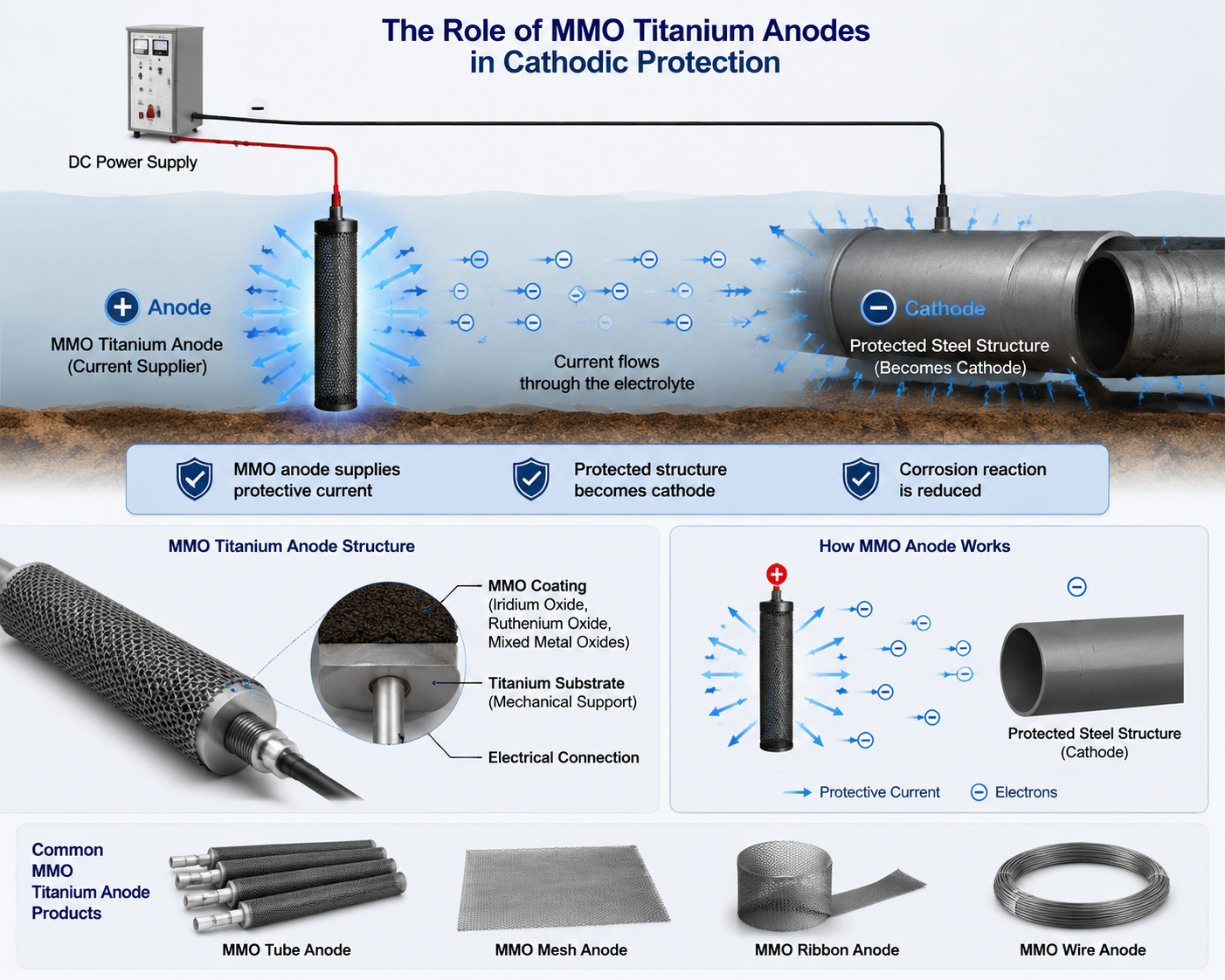
The MMO titanium anode itself is the anode in the electrochemical circuit.
However, the purpose of the system is to make the protected metal become the cathode.
The MMO anode supplies current into the electrolyte, and the protected structure receives this current.
Therefore:
- MMO titanium anode → electrochemical current supplier
- Protected steel structure → becomes cathode
- Corrosion reaction → reduced
The titanium substrate provides mechanical strength and dimensional stability.
The MMO coating provides the electrochemical activity.
Typical MMO coatings contain noble metal oxides, such as:
- Iridium oxide
- Ruthenium oxide
- Other mixed metal oxides
These coatings allow titanium substrates to operate as stable insoluble anodes under demanding conditions.
4. Why Are Different MMO Coatings Used for Different Environments?
Not all cathodic protection environments are the same.
The selection of MMO coating depends on:
- Electrolyte composition
- Chloride concentration
- Soil characteristics
- Water quality
- Required electrochemical performance
- Operating conditions
Choosing the correct coating system is essential for achieving stable and reliable operation.
5. Ir-Ta Coated Titanium Anodes: For Soil, Freshwater and Concrete Applications
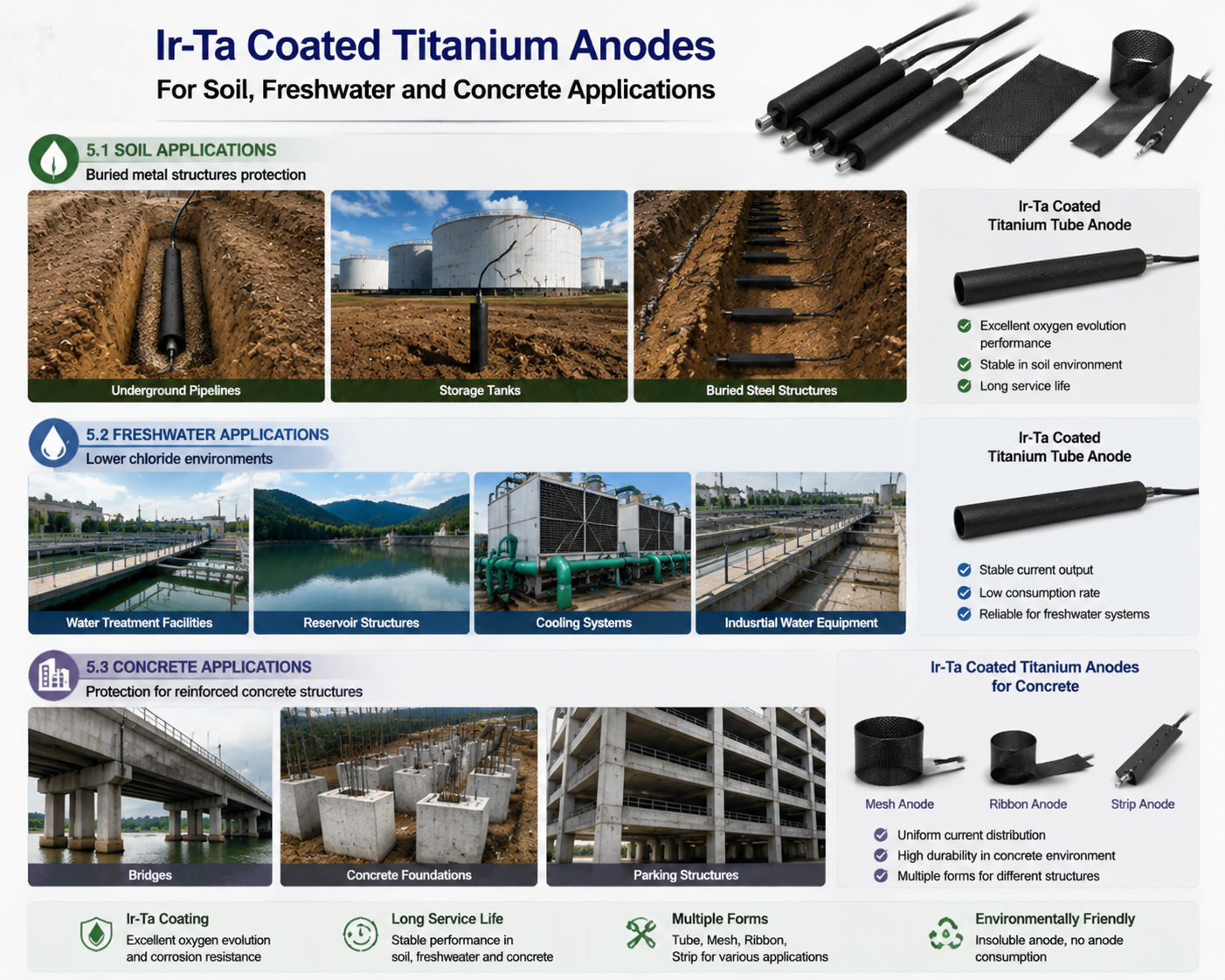
Iridium-tantalum coated titanium anodes are widely selected for environments where oxygen evolution performance and long-term stability are important.
Typical applications include:
- Soil cathodic protection
- Freshwater systems
- Fine sand environments
- Reinforced concrete structures
5.1 Soil Applications
Buried metal structures face corrosion risks because soil contains:
- Moisture
- Dissolved salts
- Different soil resistivity zones
- Micro-environmental differences
Common protected structures include:
- Underground pipelines
- Storage tanks
- Buried steel structures
In these environments, the anode must maintain stable performance while resisting soil chemical conditions.
Ir-Ta coatings are often selected because of their suitability for oxygen evolution environments and stable operation in many soil-based applications.
5.2 Freshwater Applications
Freshwater environments usually contain lower chloride concentration compared with seawater.
Applications include:
- Water treatment facilities
- Reservoir structures
- Cooling systems
- Industrial water equipment
The coating selection must consider water chemistry and required current output.
5.3 Concrete Cathodic Protection
Steel reinforcement inside concrete can corrode when moisture and aggressive ions penetrate the concrete structure.
Cathodic protection can be used to reduce corrosion risks of reinforced concrete structures.
Typical applications include:
- Bridges
- Concrete foundations
- Parking structures
- Industrial buildings
For these applications, MMO anodes may be designed in different forms, such as:
- Mesh anodes
- Ribbon anodes
- Strip anodes
6. Ru-Ir Coated Titanium Anodes: For Seawater, Pure Water and Acidic Soil
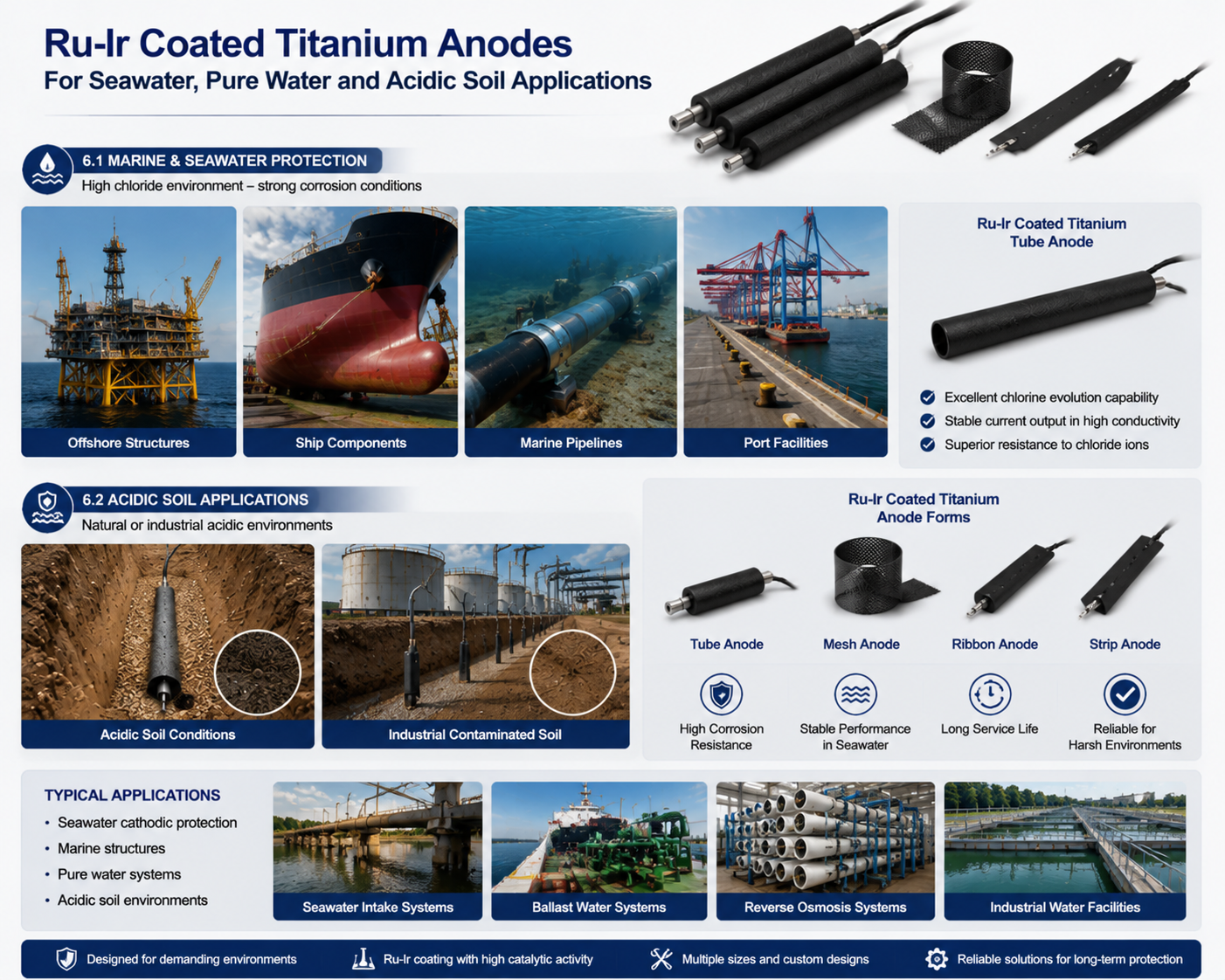
Ruthenium-iridium coated titanium anodes are commonly used in environments where chlorine evolution capability and high conductivity electrolytes are important.
Typical applications include:
- Seawater cathodic protection
- Marine structures
- Pure water systems
- Acidic soil environments
6.1 Marine and Seawater Protection
Seawater contains a high concentration of chloride ions, which creates strong corrosion conditions for steel structures.
Applications include:
- Offshore structures
- Ship components
- Marine pipelines
- Port facilities
In seawater environments, MMO anodes must provide stable current output while resisting chloride-related electrochemical reactions.
6.2 Acidic Soil Applications
Some underground environments contain acidic conditions caused by:
- Natural soil chemistry
- Industrial contamination
- Chemical exposure
Acidic environments require coatings with strong corrosion resistance and stable electrochemical behavior.
Ru-Ir coating systems can be considered for these demanding conditions depending on project requirements.
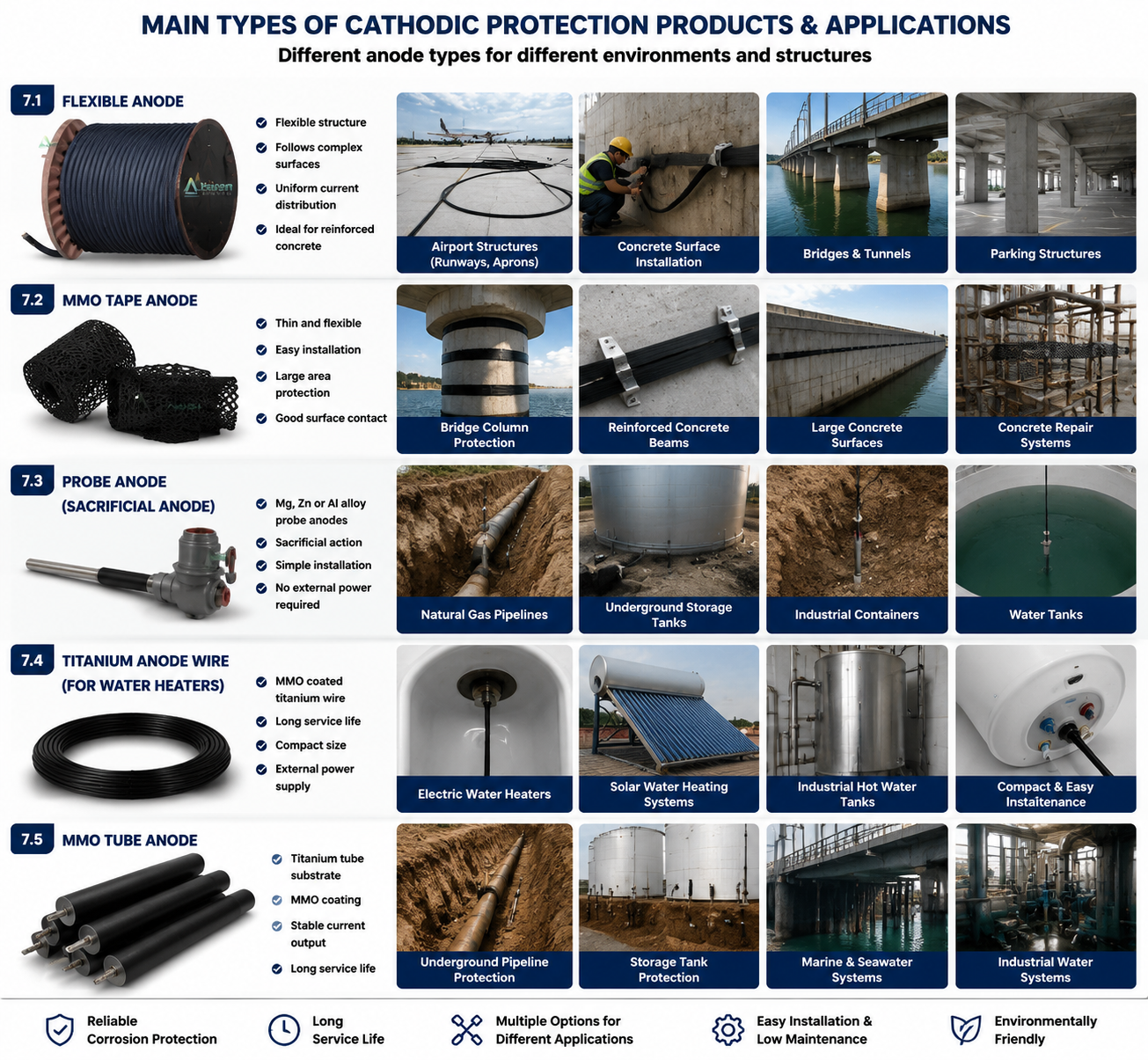
7. Main Types of Cathodic Protection Products and Their Applications
Cathodic protection systems are not based on a single standard electrode shape. According to different installation environments, protected structures, current distribution requirements, and construction methods, MMO titanium anodes can be manufactured into various forms.
The most common cathodic protection products include:
- MMO tube anodes
- Flexible anodes
- MMO tape anodes
- Probe anodes
- Titanium anode wires
Each product has its own application advantages.
Selecting the correct anode type is not only related to product shape, but also to current distribution, installation conditions, environmental resistance, and long-term system stability.
7.1 MMO Tube Anode: A Reliable Solution for Underground and Water-Based Cathodic Protection
MMO tube anodes are one of the most widely used forms of titanium-based anodes for impressed current cathodic protection systems.
The structure usually consists of:
- Titanium tube substrate
- MMO coating layer
- Electrical connection components
- Protective backfill or installation accessories depending on the application
The titanium substrate provides mechanical strength and corrosion resistance, while the MMO coating provides the electrochemical activity required for current output.
Unlike traditional consumable anodes, MMO titanium tube anodes are dimensionally stable during operation. The titanium substrate remains largely unchanged, while the MMO coating works as the active electrochemical layer.
Typical Applications of MMO Tube Anodes
Underground Pipeline Protection
Buried pipelines are continuously exposed to soil moisture and electrolytes, creating conditions where corrosion can occur.
MMO tube anodes can be installed along pipelines to provide protective current.
Typical applications include:
- Natural gas pipelines
- Oil pipelines
- Water transmission pipelines
- Industrial underground pipelines
The anode system works together with:
- DC power supply
- Reference electrodes
- Monitoring systems
to maintain the required protection potential of the pipeline.
Storage Tank Cathodic Protection
Steel storage tanks, especially those in contact with soil or water, require effective corrosion control.
MMO tube anodes can be installed around or beneath tanks to provide uniform current distribution.
Applications include:
- Fuel storage tanks
- Chemical storage tanks
- Industrial liquid storage systems
The selection of anode design depends on:
- Tank size
- Installation environment
- Soil conditions
- Required protection current
Marine and Water Systems
MMO tube anodes are also used in:
- Seawater cooling systems
- Marine structures
- Water intake systems
- Industrial water equipment
For seawater environments, Ru-Ir coating systems are often selected because of their suitability for chloride-containing environments.
For freshwater or oxygen evolution applications, Ir-Ta coating systems may be considered according to project requirements.
7.2 Flexible Anode: Designed for Large and Complex Structures
Flexible anodes are a special type of cathodic protection product.
Although the product is commonly called a “flexible anode”, its function is still to act as the current-producing electrode in an impressed current cathodic protection system, making the protected structure become the cathode.
The name describes the product form, not the electrochemical role of the protected object.
A flexible anode usually consists of:
- MMO coated titanium conductor
- Conductive polymer or carbon-based outer layer
- Flexible protective structure
Its main advantage is that it can follow complex installation surfaces where rigid anodes are difficult to install.
Flexible Anode Applications
Airport Structures
Large airport facilities often contain extensive reinforced concrete structures.
Examples include:
- Runways
- Aprons
- Parking areas
- Concrete foundations
Moisture penetration and chloride contamination can accelerate corrosion of internal steel reinforcement.
Flexible anodes can be installed along concrete surfaces or embedded within repair systems to provide distributed cathodic protection.
Reinforced Concrete Structures
Concrete naturally provides protection to embedded steel because of its alkaline environment.
However, over time, environmental factors may reduce this protection.
Potential causes include:
- Chloride penetration
- Carbonation
- Continuous moisture exposure
Flexible anode systems can provide uniform current distribution over large concrete areas.
Applications include:
- Bridges
- Tunnels
- Concrete buildings
- Industrial facilities
7.3 MMO Tape Anode: Suitable for Bridges and Linear Structures
MMO tape, also called MMO ribbon anode, is another commonly used cathodic protection product.
It has a thin and flexible structure, making it suitable for applications requiring:
- Wide surface coverage
- Uniform current distribution
- Easy installation
Typical structures include:
- Concrete bridge columns
- Reinforced concrete beams
- Large concrete surfaces
MMO Tape for Bridge Column Protection
Bridge columns are often exposed to:
- Rainwater
- Road salt
- Marine atmosphere
- Temperature changes
Over time, aggressive ions may penetrate concrete and reach steel reinforcement.
MMO tape can be installed around or along concrete structures to provide protective current.
Advantages include:
- Flexible installation
- Good surface contact
- Suitable for large-area protection
- Easy integration into repair systems
7.4 Probe Anode: Used for Pipelines and Storage Systems
Probe anodes are different from MMO coated titanium anodes used as auxiliary electrodes.
In many applications, probe-type sacrificial anodes themselves act as the anodic material in the electrochemical system.
Their purpose is to provide electrons by being consumed gradually, protecting the connected metal structure.
The most common examples include:
- Magnesium probe anodes
- Zinc probe anodes
- Aluminum alloy probe anodes
Probe Anode Applications
Natural Gas Pipelines
Underground natural gas pipelines require corrosion control because the steel surface is exposed to soil environments.
Probe anodes can be connected electrically to pipelines.
The anode material releases electrons and protects the pipeline by making it the cathode.
Storage Tanks
Probe anodes are also commonly used in:
- Underground tanks
- Water tanks
- Industrial containers
They are especially suitable where:
- External power supply is unavailable
- Protection requirements are relatively moderate
- Simple installation is preferred
Compared with impressed current systems, sacrificial anode systems have a simpler structure but limited operating life because the anode material is consumed.
7.5 Titanium Anode Wire: Replacing Traditional Magnesium Rods in Water Heaters
Traditional water heaters often use magnesium rods as sacrificial anodes.
The principle is simple:
The magnesium rod has a more active electrochemical potential than the steel tank, so it corrodes preferentially and protects the tank.
However, magnesium rods have several limitations:
- They are gradually consumed.
- They require periodic replacement.
- Their protection performance decreases as material is consumed.
- Maintenance is difficult after installation.
Titanium Anode Wire for Electronic Water Heater Protection
With modern electrochemical technology, titanium anode wires with MMO coating can provide an alternative solution.
The system uses an external power supply to generate protective current.
The titanium wire itself does not work as a sacrificial material. Instead, the MMO coating provides electrochemical activity.
Advantages include:
- Long service stability
- Reduced replacement frequency
- Compact installation size
- Suitable for modern smart water heaters
Applications include:
- Electric water heaters
- Solar water heating systems
- Industrial hot water tanks
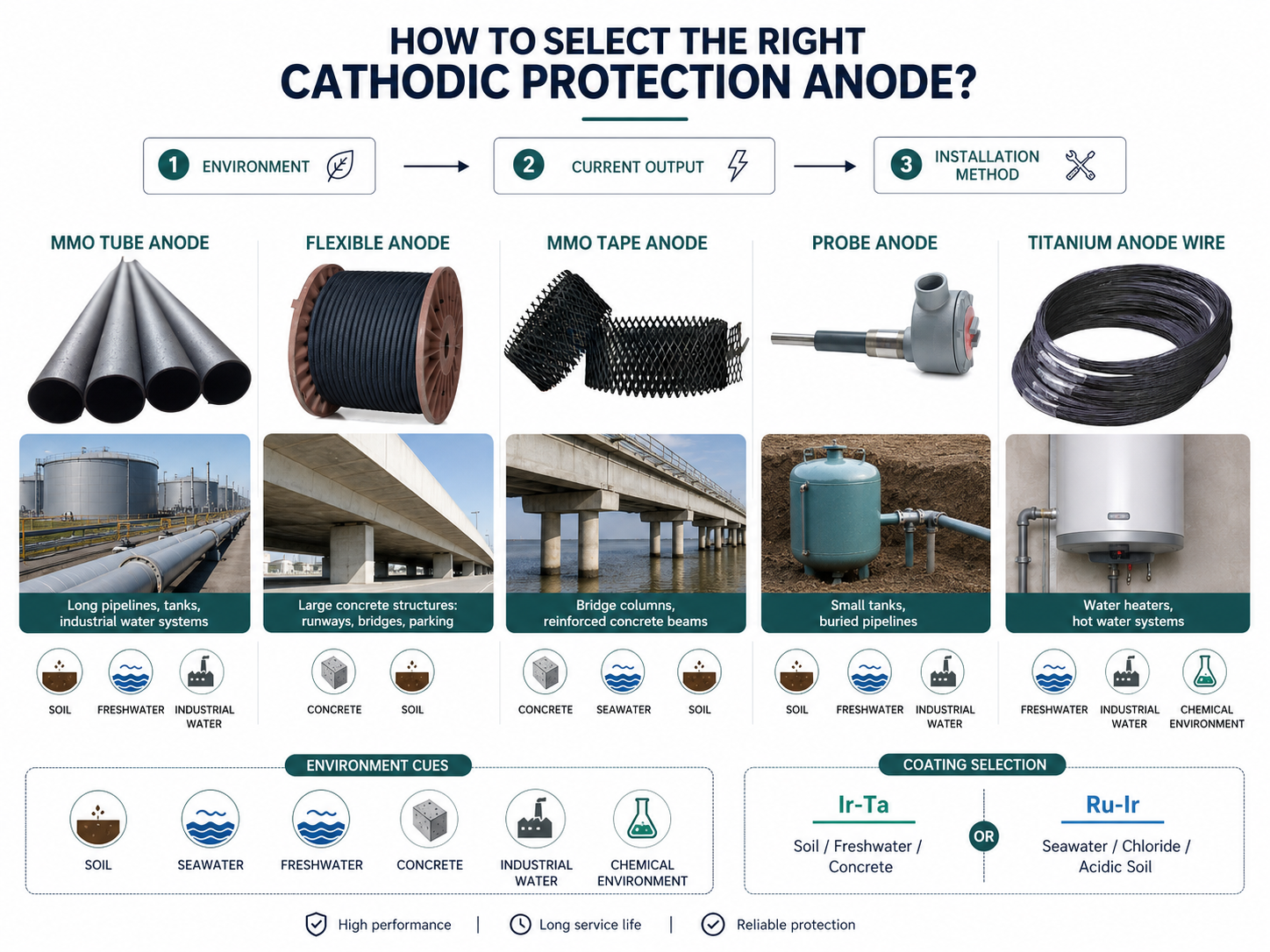
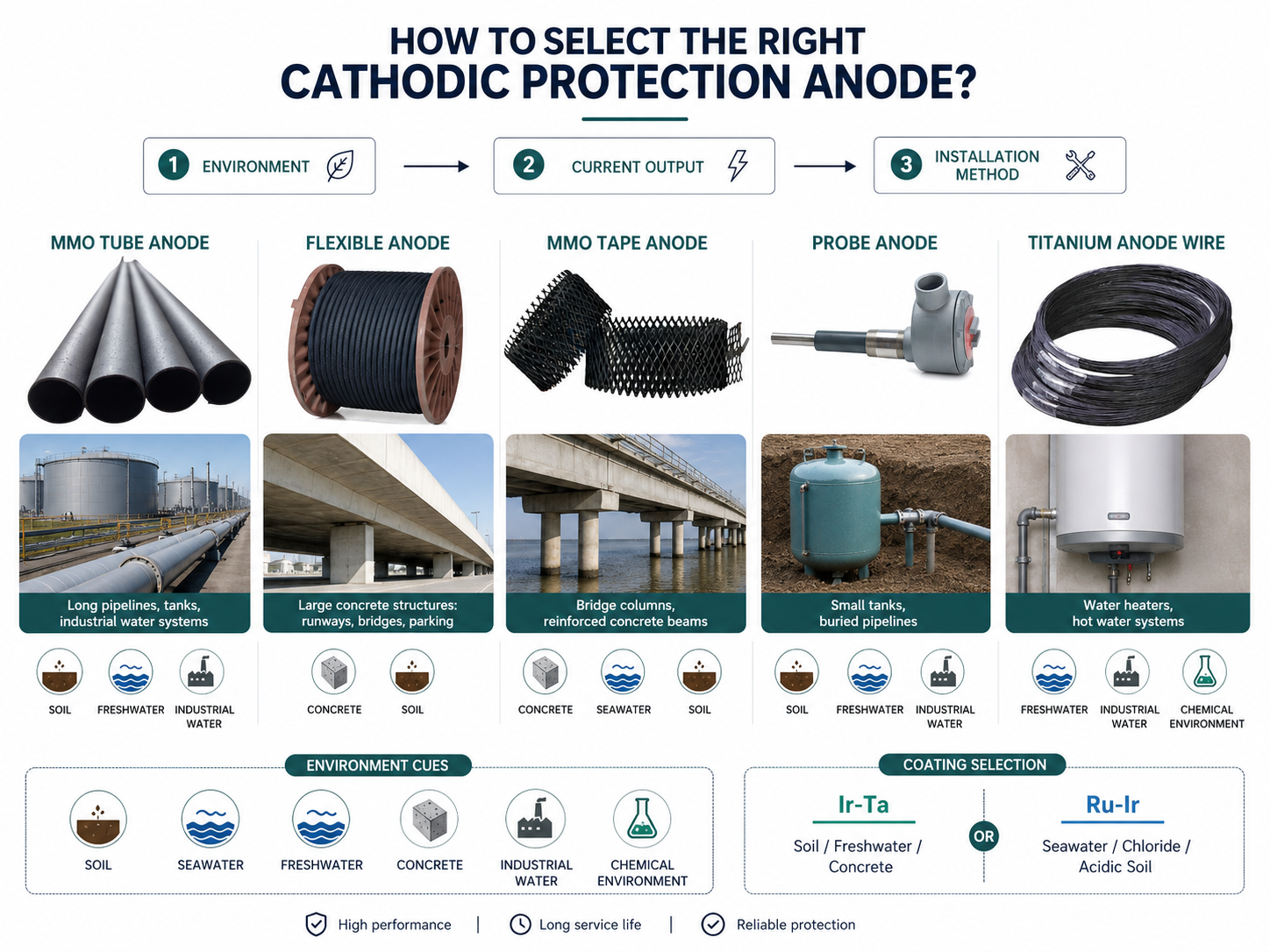
8. How to Select the Right Cathodic Protection Anode?
Choosing a cathodic protection anode requires more than selecting a product shape.
A professional supplier should evaluate the complete operating environment.
The following information is important:
8.1 Application Environment
First determine where the anode will be used:
- Soil
- Seawater
- Freshwater
- Concrete
- Industrial water
- Chemical environment
Different environments require different coating systems.
For example:
| Environment | Common Coating Consideration |
|---|---|
| Soil | Ir-Ta coating |
| Freshwater | Ir-Ta coating |
| Concrete structures | Ir-Ta coating |
| Seawater | Ru-Ir coating |
| Chloride-rich environments | Ru-Ir coating |
| Acidic soil | Ru-Ir coating depending on conditions |
The final selection should always be based on actual project conditions.
8.2 Required Current Output
The supplier needs to understand:
- Protected structure size
- Required protection current
- Operating voltage
- Power supply conditions
- Installation distance
Anode design is closely related to current distribution.
An improperly selected anode may result in:
- Uneven protection
- Insufficient protection current
- Excessive local current concentration
8.3 Installation Method
Different projects require different product forms.
Examples:
- Long underground pipelines → MMO tube anodes
- Large concrete structures → flexible anodes
- Bridge columns → MMO tape
- Small tanks → probe anodes
- Compact heating systems → titanium anode wires
The correct product design improves installation efficiency and system reliability.
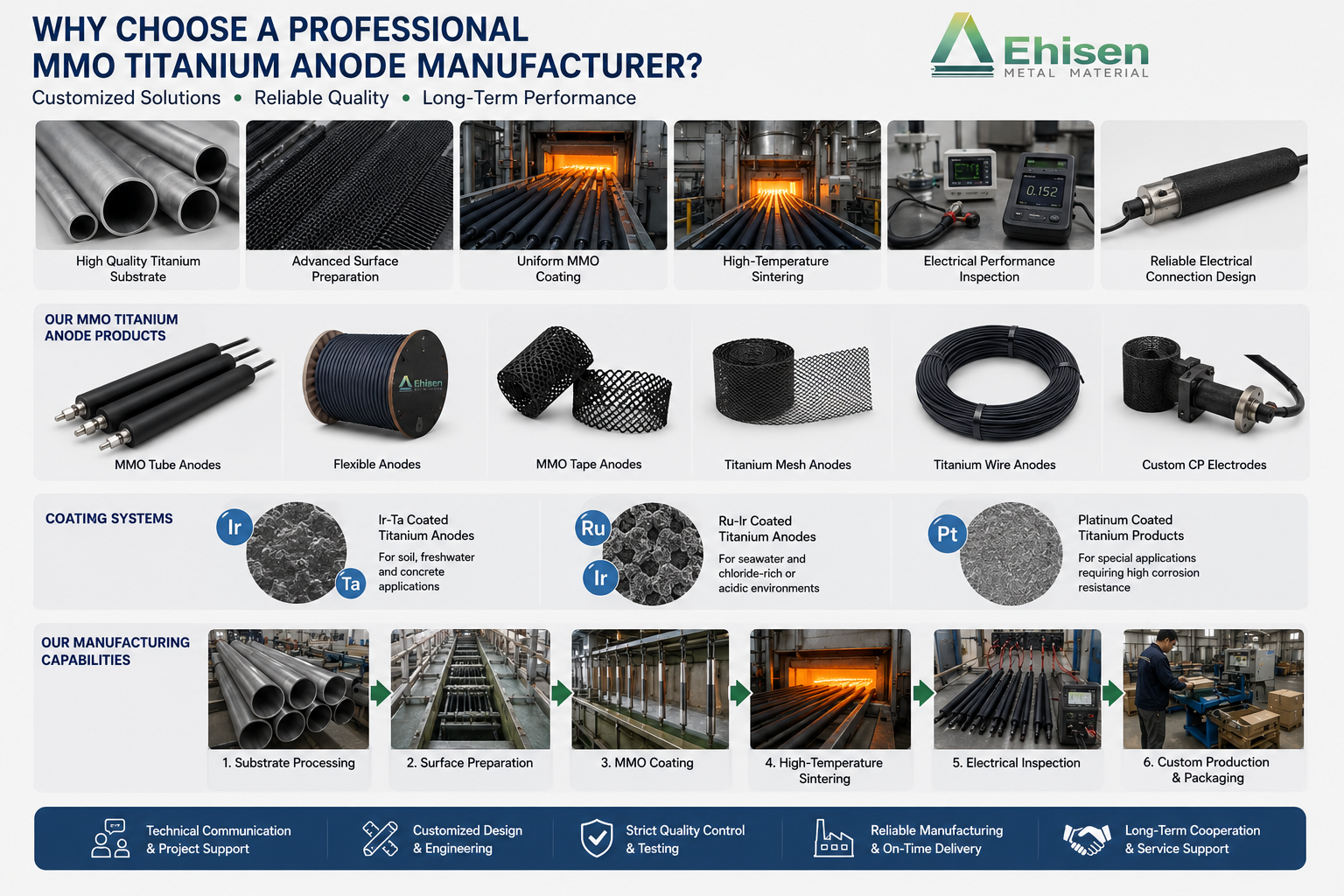
9. Why Choose a Professional MMO Titanium Anode Manufacturer?
Cathodic protection products operate in demanding environments.
The performance of an anode depends not only on the coating material but also on:
- Titanium substrate quality
- Surface preparation process
- Coating uniformity
- Thermal treatment process
- Electrical connection design
- Quality inspection
A professional manufacturer should be able to provide customized solutions instead of only supplying standard products.
Ehisen: Customized MMO Titanium Anode Solutions for Cathodic Protection
Ehisen specializes in the research, development, and manufacturing of precious metal oxide coated titanium anodes.
Our products include:
- MMO tube anodes
- Flexible anodes
- MMO tape anodes
- Titanium mesh anodes
- Titanium wire anodes
- Custom-designed cathodic protection electrodes
We provide coating systems including:
- Ir-Ta coated titanium anodes
- Ru-Ir coated titanium anodes
- Platinum coated titanium products
According to different project environments, we help customers select suitable substrate structures, coating systems, and product designs.
Our manufacturing capabilities include:
- Titanium substrate processing
- Surface preparation
- Precious metal oxide coating
- High-temperature sintering
- Electrical performance inspection
- Customized OEM production
From prototype samples to industrial production quantities, Ehisen supports customers with technical communication, product customization, and manufacturing solutions.
10. Conclusion: Understanding Cathodic Protection Helps You Choose the Right Anode
Cathodic protection is not simply about choosing an electrode.
It is a complete electrochemical protection system.
The key principle is:
The MMO anode provides protective current, forcing the protected metal structure to become the cathode and reducing corrosion reactions.
Different environments require different solutions:
- Ir-Ta coated titanium anodes are commonly considered for soil, freshwater, fine sand, and concrete applications.
- Ru-Ir coated titanium anodes are commonly considered for seawater, pure water, and chloride-rich environments.
- Flexible anodes provide distributed protection for large structures.
- MMO tapes are suitable for bridge and concrete applications.
- Probe anodes protect pipelines and tanks through sacrificial action.
- Titanium anode wires provide modern alternatives for water heater protection systems.
Selecting the right cathodic protection product requires understanding the environment, current requirements, and installation conditions.
As an experienced MMO titanium anode manufacturer, Ehisen provides customized cathodic protection solutions for global customers.
If you are looking for MMO tube anodes, flexible anodes, MMO tape, titanium anode wires, or customized cathodic protection electrodes, please contact Ehisen for technical consultation and quotation.