

A sodium hypochlorite generator can operate without reverse polarity under suitable conditions. However, when the feedwater contains calcium, magnesium, and other scale-forming substances, mineral deposits may gradually accumulate inside the electrolytic cell. These deposits can cover electrode surfaces, restrict liquid flow, interfere with gas release, increase electrical resistance, and cause the operating voltage to rise.
Introduction
Does a sodium hypochlorite generator need reverse polarity?
This is an important question for sodium hypochlorite generator manufacturers, water-treatment equipment companies, swimming-pool disinfection system suppliers, electrolysis engineers, and industrial buyers purchasing coated titanium electrodes.
The answer is not simply yes or no.
Reverse polarity is designed to control this problem.
During electrolysis, the electrical function of the two electrodes is periodically exchanged. The electrode operating as the cathode becomes the anode, while the electrode operating as the anode becomes the cathode. This change alters the local chemical environment on the electrode surfaces and can help loosen or remove mineral deposits.
The greatest value of reverse polarity is not that it directly produces more sodium hypochlorite. Its main value is that it reduces manual cleaning, minimizes equipment shutdowns, lowers maintenance labor, and supports more stable long-term operation.
However, reverse polarity is not only a timer function in the control cabinet. A reversible electrolytic cell requires suitable electrode coatings, coating coverage, titanium substrates, electrical connections, power-supply controls, flow conditions, and switching procedures.
Not every coated titanium anode is automatically suitable for repeated polarity reversal.
This guide explains why mineral scale forms, how it affects voltage and electrolysis efficiency, how reverse polarity removes scale, how frequently polarity should be changed, and what buyers should consider when selecting titanium electrodes for a reversible sodium hypochlorite generator.
1. How a Sodium Hypochlorite Generator Works
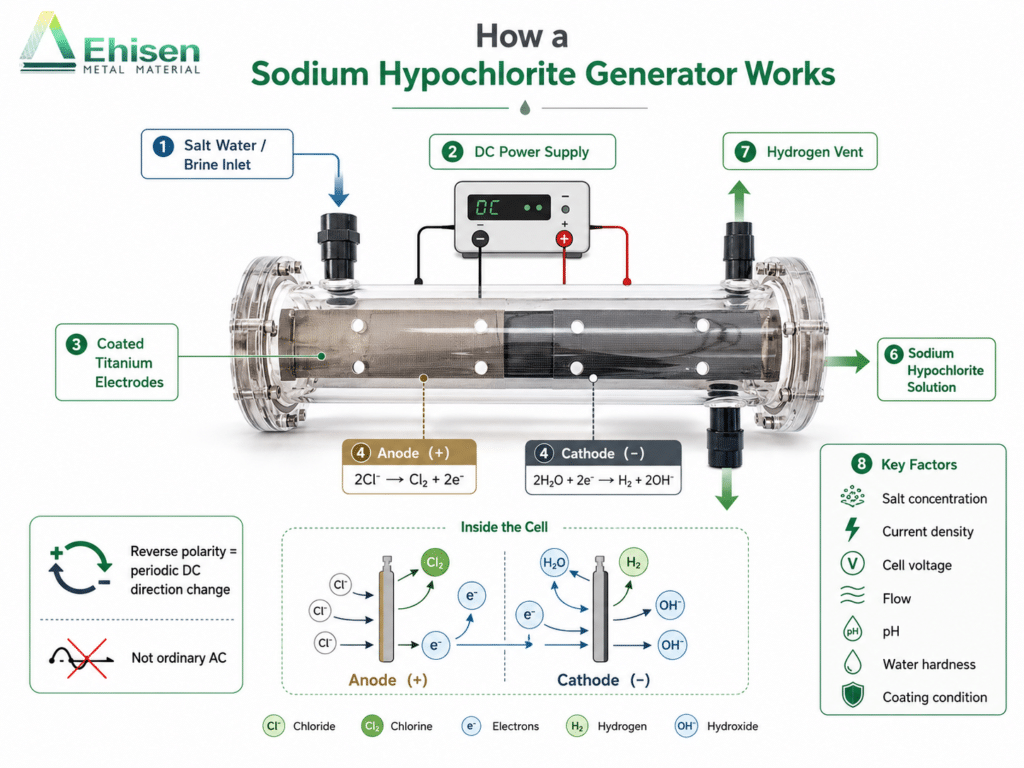
A sodium hypochlorite generator produces a disinfecting solution through the electrolysis of sodium chloride solution.
Depending on the equipment design, the feed solution may be prepared from softened water and industrial salt, diluted brine, seawater, or another chloride-containing water source.
A typical sodium hypochlorite generation system includes:
- A salt-dissolving or brine-preparation tank
- A water-treatment or softening unit
- A metering and flow-control system
- An electrolytic cell
- Coated titanium electrodes
- A direct-current power supply
- A control cabinet
- Hydrogen separation and ventilation equipment
- A sodium hypochlorite storage or dosing tank
- Cleaning or polarity-reversal controls
Inside the electrolytic cell, direct current passes through the chloride-containing solution.
At the anode, chloride ions lose electrons and are oxidized:
2Cl⁻ → Cl₂ + 2e⁻
At the cathode, water gains electrons and produces hydrogen gas and hydroxide ions:
2H₂O + 2e⁻ → H₂ + 2OH⁻
The chlorine species produced at the anode react with water and alkaline species in the solution, forming hypochlorous acid and hypochlorite. The relative amounts of chlorine, hypochlorous acid, and hypochlorite depend strongly on the solution pH and other operating conditions.
Electrochemical activation of chloride can generate chlorine, hypochlorous acid, and hypochlorite, with the distribution influenced by pH and electrode potential.
In practical equipment, the process is more complicated than simply applying current to saltwater.
System performance is affected by:
- Sodium chloride concentration
- Feedwater conductivity
- Operating current
- Current density
- Cell voltage
- Electrode spacing
- Electrode surface area
- Liquid temperature
- Flow velocity
- Residence time
- pH
- Gas removal
- Water hardness
- Electrode coating condition
Why coated titanium is used
Titanium is widely used as the substrate for dimensionally stable electrodes because it has good mechanical properties, corrosion resistance, and dimensional stability.
However, bare titanium is not normally used as an efficient long-term chlorine-evolution anode.
Titanium naturally forms a protective oxide film. This passive film is one of the reasons titanium has excellent corrosion resistance, but under anodic conditions it also creates a highly resistive barrier.
A bare titanium plate may initially carry current, but its surface can become passive. This may result in:
- High anodic polarization
- High cell voltage
- Low electrochemical efficiency
- Unstable chlorine production
- Localized heating
- Rapid loss of useful anodic performance
The noble-metal-oxide coating is therefore not merely a protective surface layer. It provides the catalytic activity required for the intended electrochemical reaction.
Titanium-supported ruthenium-, iridium-, and titanium-oxide coatings have been studied for chlorine-evolution applications because the catalytic coating can significantly improve electrochemical activity compared with an uncoated titanium surface.
For sodium hypochlorite generation, ruthenium-iridium-based mixed-metal-oxide coatings are commonly considered because they can support chlorine-related anodic reactions in chloride-containing electrolytes.
The final coating formulation should be selected according to:
- Chloride concentration
- Operating current density
- Solution temperature
- pH
- Required service life
- Reversal frequency
- Water impurities
- Electrode structure
- Expected chlorine output
Reverse polarity is not ordinary alternating current
Reverse-polarity operation normally means that the system operates with direct current in one direction for a set period and then changes to direct current in the opposite direction.
For example:
- Electrode A operates as the anode.
- Electrode B operates as the cathode.
- The system stops or reduces the current.
- The electrical connections are switched.
- Electrode A becomes the cathode.
- Electrode B becomes the anode.
This is different from supplying ordinary alternating current, which changes direction continuously and much more rapidly.
A reverse-polarity generator still operates mainly as a direct-current electrolysis system. The difference is that the direction of the direct current is periodically changed.
2. Why White Scale Forms Inside the Electrolytic Cell
One of the most visible maintenance problems in sodium hypochlorite generators is the formation of white or light-colored deposits inside the electrolytic cell.
These deposits are generally associated with hardness ions and other minerals in the feedwater.
Water may contain dissolved:
- Calcium ions
- Magnesium ions
- Bicarbonate
- Carbonate
- Sulfate
- Phosphate
- Silica
- Iron
- Manganese
- Suspended particles
Before electrolysis, many of these substances remain dissolved in the water and may not be visible.
During electrolysis, however, the chemical environment near the electrodes changes significantly.
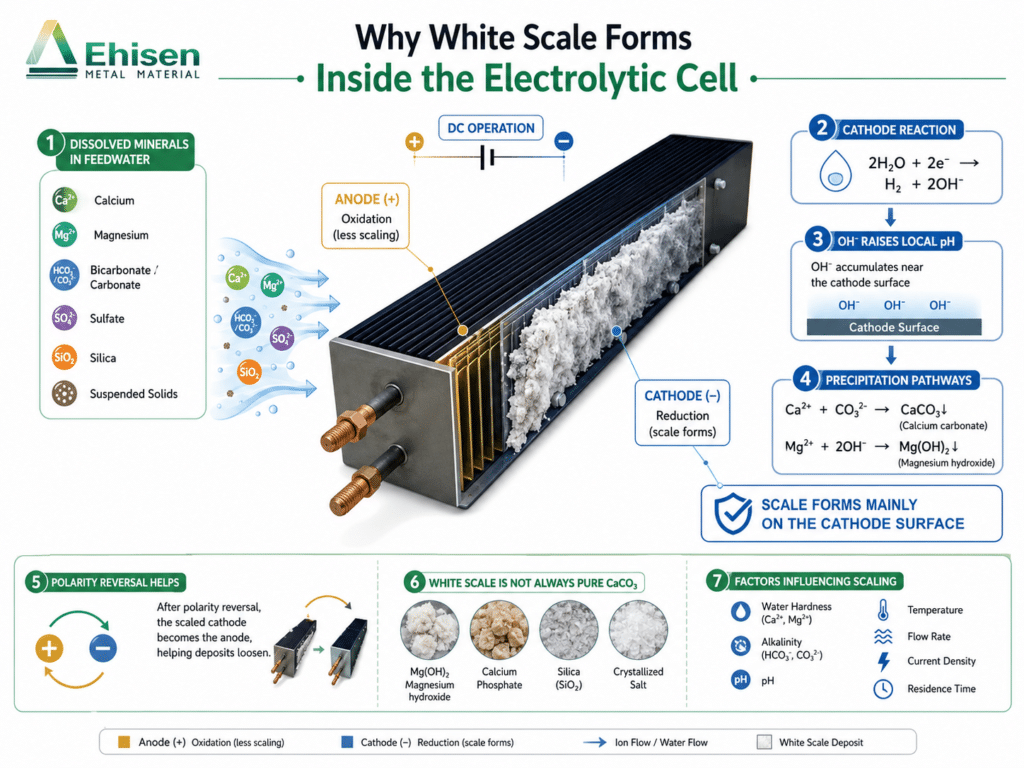
The cathode creates a locally alkaline environment
At the cathode, water is reduced and hydroxide ions are generated:
2H₂O + 2e⁻ → H₂ + 2OH⁻
This means that the pH immediately next to the cathode surface can become much higher than the pH of the bulk solution.
Electrochemical water-softening studies have repeatedly shown that hydroxide generation near the cathode raises the local pH and promotes the precipitation of hardness minerals.
As the local pH increases, bicarbonate can be converted into carbonate. Calcium ions can then combine with carbonate ions to form calcium carbonate:
Ca²⁺ + CO₃²⁻ → CaCO₃↓
Magnesium ions can react with hydroxide ions to form magnesium hydroxide:
Mg²⁺ + 2OH⁻ → Mg(OH)₂↓
Research on electrochemical hardness removal identifies calcium carbonate and magnesium-containing precipitates as typical cathodic deposits generated through hydroxide production.
Does scale form on the anode or cathode?
Under ordinary direct-current electrolysis conditions, mineral scale is generally more likely to form on or near the cathode.
This is an important point because the location of scale is often misunderstood.
A simplified but inaccurate explanation sometimes states that the anode becomes covered with calcium and magnesium deposits while the cathode remains clean.
The electrochemical mechanism normally indicates the opposite.
The cathode creates the high-pH environment that encourages calcium carbonate, magnesium hydroxide, and related minerals to precipitate.
Therefore, a more accurate explanation is:
During normal operation, hardness scale generally forms on the cathodic surface. After polarity reversal, the scaled cathode becomes the anode, changing the local chemical environment and helping the deposits loosen or dissolve.
The actual deposit distribution may still be affected by:
- Cell geometry
- Electrode orientation
- Flow direction
- Flow velocity
- Gas-bubble movement
- Electrode spacing
- Current distribution
- Water temperature
- Surface roughness
- Dead zones
- Previous polarity reversals
In a reversible system, both electrodes may show visible deposits at different times because each electrode alternates between anodic and cathodic operation.
White scale is not always pure calcium carbonate
The color of a deposit cannot confirm its composition.
A white deposit may contain a mixture of:
- Calcium carbonate
- Magnesium hydroxide
- Magnesium carbonate
- Calcium phosphate
- Silica-containing material
- Crystallized salt
- Suspended solids
A yellow, brown, or dark deposit may also contain iron, manganese, corrosion products from other components, or organic contamination.
When scaling is unusually rapid or difficult to remove, a water analysis and deposit analysis can be useful.
Why two water sources with the same hardness may scale differently
Total hardness is important, but it is not the only factor.
Scaling behavior also depends on:
- Calcium-to-magnesium ratio
- Alkalinity
- Bicarbonate content
- Initial pH
- Water temperature
- Conductivity
- Silica
- Phosphate
- Sulfate
- Dissolved carbon dioxide
- Residence time
- Current density
Studies of electrochemical water softening have shown that water composition influences both precipitation efficiency and the characteristics of the deposits formed.
This means that two customers using water with the same reported total hardness may experience very different scaling rates.
For reliable electrode and reversal-cycle selection, buyers should provide an actual water-analysis report whenever possible.
3. How Scale Affects Cell Efficiency and Operating Voltage
Mineral scale is not simply an appearance problem.
As it accumulates, it can change the electrical, hydraulic, and electrochemical conditions inside the cell.
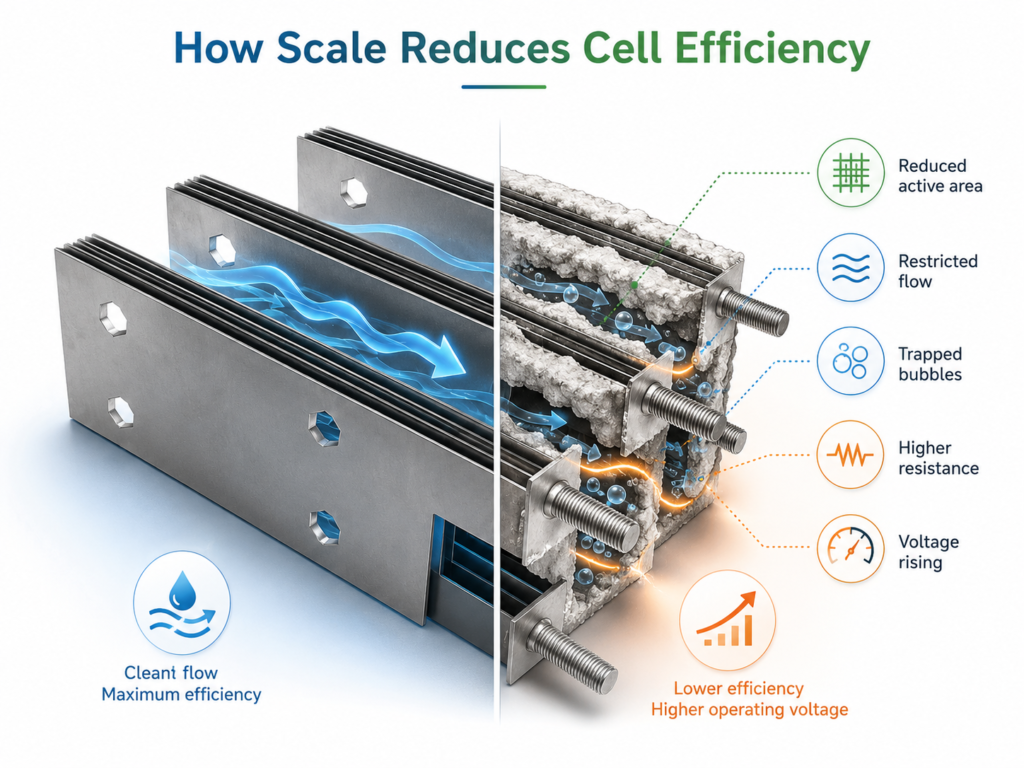
Scale reduces the effective reaction area
The total geometric area of an electrode does not change when scale forms, but the available working surface can be reduced.
A mineral layer can interfere with:
- Electrolyte contact
- Ion transport
- Gas-bubble release
- Local mass transfer
- Uniform current distribution
The covered area does not participate in the reaction as effectively as a clean catalytic surface.
As more of the electrode becomes covered, the remaining exposed regions may carry a larger proportion of the current.
This can create localized high current density and uneven operating conditions.
Scale increases electrical resistance
Calcium carbonate and many other mineral deposits are less electrically conductive than the electrolyte and coated titanium surface.
A thick or compact deposit creates additional resistance between the electrode and the electrolyte.
Once an insulating calcium carbonate layer covers a cathode surface, electrochemical performance can decline and cathode regeneration may be necessary.
To maintain the same operating current, the power supply may need to increase the voltage.
This is why a gradual rise in cell voltage is often one of the earliest signs of scaling.
Scale can restrict liquid flow
Many sodium hypochlorite generators use relatively narrow gaps between the electrodes.
Narrow spacing can reduce solution resistance, but it also leaves less space for scale growth and detached particles.
As deposits become thicker, they may:
- Reduce the flow cross-section
- Increase hydraulic resistance
- Create uneven flow distribution
- Form stagnant zones
- Restrict gas discharge
- Trap detached particles
- Increase the risk of bridging between plates
In severe cases, deposits can partially block the cell or create a path between adjacent electrodes.
Scale affects gas release
Hydrogen gas forms at the cathode.
Chlorine-related gases and dissolved chlorine species form near the anode.
These gases must leave the electrode surfaces efficiently.
A rough or heavily scaled surface can trap gas bubbles. A temporary gas layer reduces direct contact between the liquid and electrode surface.
This may cause:
- Voltage fluctuation
- Reduced effective area
- Unstable current
- Uneven reaction conditions
- Local heat accumulation
Scale creates uneven current distribution
If scale covers only part of an electrode, the current tends to concentrate on the remaining exposed regions.
This can lead to:
- Higher local current density
- More intense gas evolution
- Localized coating consumption
- Edge overheating
- Uneven electrode aging
- Reduced service life
Consequently, scale may eventually affect both energy efficiency and electrode durability.
Why does the cell voltage rise?
Cell voltage is influenced by several components:
- Anodic reaction potential
- Cathodic reaction potential
- Anodic overpotential
- Cathodic overpotential
- Electrolyte resistance
- Electrode gap
- Electrical contact resistance
- Cable losses
- Busbar losses
- Gas coverage
- Coating condition
- Scale thickness
When scale increases electrical resistance or reduces the effective reaction area, the power supply must provide more voltage to maintain the same current.
However, a high voltage does not always prove that the cell is scaled.
Other possible causes include:
- Low salt concentration
- Low conductivity
- Low liquid temperature
- Reduced flow
- Gas accumulation
- Loose electrical connections
- Corroded terminals
- Excessive electrode spacing
- Damaged cables
- Titanium passivation
- Coating deterioration
- Incorrect current setting
- Rectifier problems
For this reason, voltage should be evaluated as a trend under comparable operating conditions.
How to establish a useful voltage baseline
The system should record the voltage when the cell is new or freshly cleaned.
The baseline should be measured under known conditions:
- Fixed current
- Known salt concentration
- Stable conductivity
- Stable temperature
- Normal flow rate
- Correct liquid level
- Clean electrodes
- Normal gas discharge
Future voltage readings should be compared with this baseline under similar conditions.
A voltage recorded at 20 amperes should not be directly compared with a reading recorded at 10 amperes.
Similarly, a reading taken with cold, dilute brine may naturally be higher than a reading taken with warmer, more conductive brine.
Electrode spacing
A larger electrode gap increases the distance through which ions must travel and generally increases solution resistance.
A very small gap may reduce the initial voltage, but it can create:
- Poor flow
- Gas trapping
- Scale bridging
- Difficult cleaning
- Short-circuit risk
- Sensitivity to plate deformation
The correct spacing must balance conductivity, gas release, flow, manufacturing tolerances, and scaling allowance.
Current density
Current density is the current divided by the effective electrode area.
It is more useful than total current alone when evaluating electrode loading.
A current of 20 amperes may be low for a large electrode but very high for a small plate.
Higher current density can increase:
- Reaction intensity
- Gas generation
- Local pH differences
- Heat generation
- Coating stress
- Scaling tendency
The electrode supplier therefore needs both the current and the actual active area.
Flow conditions
Water flow carries salt toward the electrode, removes heat and gas, and transports detached deposits out of the cell.
Poor flow can cause:
- Local salt depletion
- Gas blanketing
- Stagnant zones
- Uneven scale accumulation
- Local overheating
- Unstable sodium hypochlorite concentration
A suitable electrode coating cannot fully compensate for an unsuitable flow path.
4. How to Determine Whether Reverse Polarity Is Needed
Not every sodium hypochlorite generator requires automatic polarity reversal.
The decision should be based on water quality, operating conditions, maintenance requirements, and the expected level of automation.
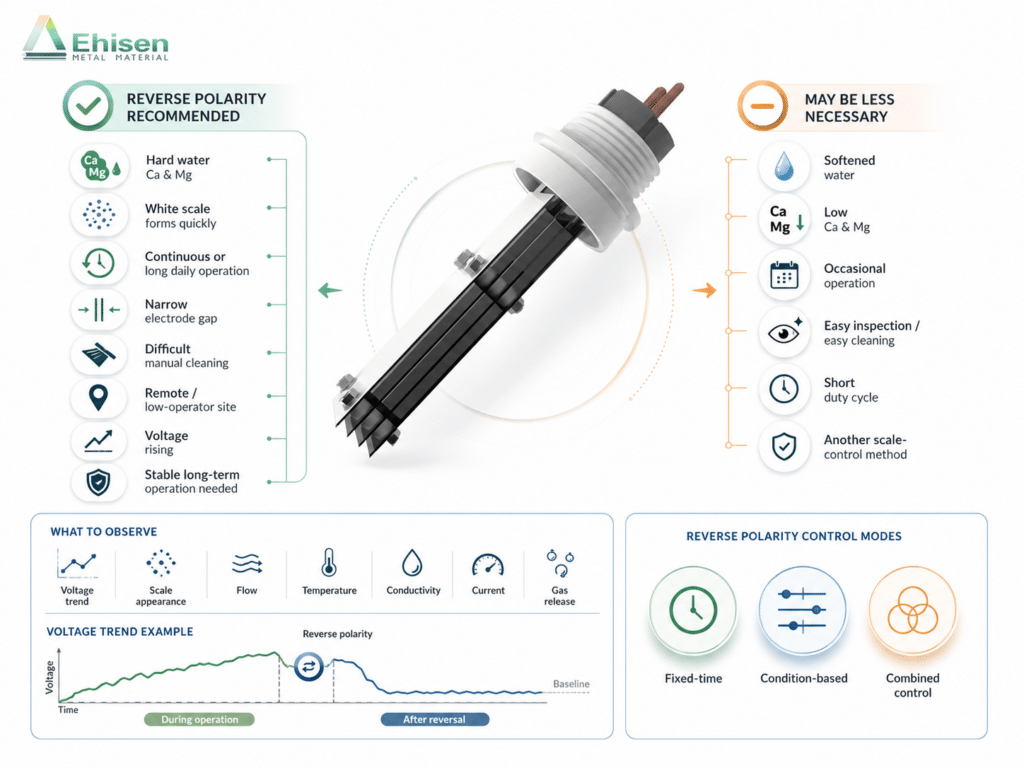
Reverse polarity may be valuable when:
- Feedwater contains significant calcium and magnesium.
- White scale develops quickly.
- The generator operates continuously or for long daily periods.
- The electrode gap is relatively narrow.
- The cell is difficult to dismantle.
- Manual cleaning is expensive.
- The installation is remote.
- The equipment must run with limited operator intervention.
- Voltage rises noticeably between cleaning cycles.
- The customer requires stable long-term operation.
Reverse polarity may be less necessary when:
- Softened water is consistently used.
- Calcium and magnesium levels are low.
- The generator operates only occasionally.
- The cell is easy to inspect and clean.
- Manual cleaning is acceptable.
- The operating cycle is short.
- Another effective scale-control system is installed.
Observe the voltage trend
Voltage is one of the most practical indicators.
A basic evaluation method is:
- Clean the cell.
- Operate it under stable conditions.
- Record the current, voltage, conductivity, temperature, and flow.
- Continue operating for a known period.
- Observe whether the voltage gradually increases.
- Reverse the polarity.
- Monitor whether the voltage moves back toward the clean-cell baseline.
If voltage decreases after reversal, scale or surface fouling may have contributed to the previous increase.
However, the operator should also verify:
- Salt concentration
- Conductivity
- Flow
- Temperature
- Electrical connections
- Gas discharge
- Rectifier output
Observe the scale itself
Visual inspection can also help.
Relevant signs include:
- White layers on the electrode
- Deposits concentrated near the liquid inlet or outlet
- Scale trapped between plates
- Blocked channels
- Loose particles downstream
- Different deposit levels on the two polarity directions
The thickness and adhesion of the scale are important.
A thin, soft layer may be removed easily by reversal.
A thick, hard, aged deposit may require chemical cleaning.
Observe production stability
Scaling may also be suspected when the system shows:
- Rising voltage at constant current
- Reduced current at a fixed voltage limit
- Unstable available-chlorine output
- Higher energy consumption
- Increased temperature
- Uneven gas release
- More frequent alarms
- Reduced flow through the cell
These symptoms should be considered together rather than individually.
Fixed-time reversal
A fixed-time system changes polarity after a predetermined operating period.
Advantages include:
- Simple control logic
- Predictable switching
- Easy programming
- Lower sensor requirements
The disadvantage is that the selected time may not match the actual scaling rate.
The cell may reverse too early under soft-water conditions or too late under hard-water conditions.
Condition-based reversal
A condition-based system may use voltage increase, conductivity, operating hours, or another measured parameter to determine when reversal is needed.
Advantages include:
- Better response to changing conditions
- Reduced unnecessary switching
- More direct connection to cell performance
Limitations include:
- Greater control complexity
- Dependence on reliable sensors
- Risk of confusing scale with another fault
- Need for appropriate alarm logic
Combined control
A combined strategy can be more reliable.
For example, the system may use:
- A normal time-based cycle
- A maximum permitted operating period
- A voltage-rise condition
- Flow confirmation
- Conductivity limits
- Temperature protection
The final control logic should be developed according to the equipment design rather than copied from an unrelated generator.
5. How Reverse Polarity Removes Scale
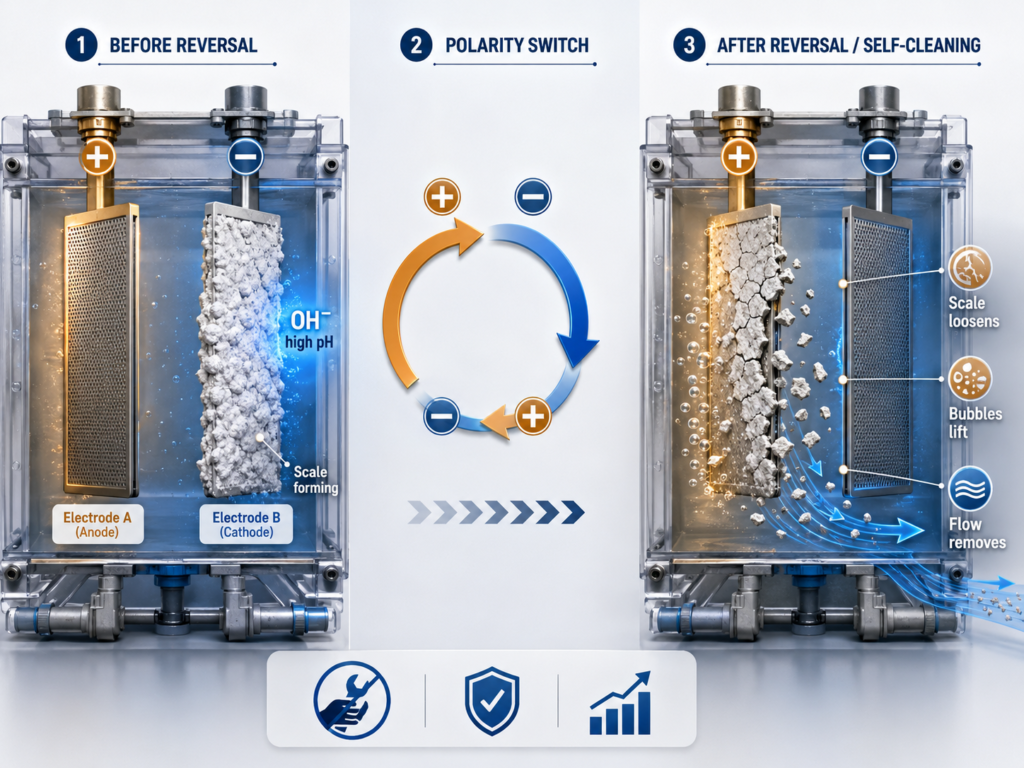
Reverse polarity changes which electrode operates as the anode and which operates as the cathode.
Before reversal:
- Electrode A is the anode.
- Electrode B is the cathode.
- Scale tends to develop on Electrode B.
After reversal:
- Electrode A becomes the cathode.
- Electrode B becomes the anode.
- The previously scaled surface is exposed to a different electrochemical environment.
Periodic polarity reversal has been used in electrochemical systems as a method of limiting electrode fouling and supporting operation with less external intervention.
The self-cleaning effect involves several mechanisms.
The cathodic high-pH environment disappears
Before reversal, hydroxide ions form on the cathode surface.
This encourages hardness precipitation.
Once the scaled cathode becomes the anode, it no longer produces hydroxide through the cathodic water-reduction reaction.
The alkaline surface environment that promoted scale formation disappears.
The local surface chemistry changes
The former cathode now operates under anodic polarization.
This changes:
- Surface potential
- Local pH
- Ionic environment
- Gas-evolution behavior
- Interfacial reactions
Some mineral deposits become less stable under the new conditions.
They may begin to:
- Dissolve
- Crack
- Lose adhesion
- Separate from the electrode
Patent literature for reversible electrochemical generators describes changing electrode polarity as a method for removing accumulated deposits and contaminants from electrode surfaces.
Gas bubbles create mechanical disturbance
Gas evolution occurs on both electrode types, but the type and location of gas generation change when polarity is reversed.
Bubbles forming beneath or within a deposit can create mechanical stress.
This can help:
- Lift weakly attached scale
- Crack brittle layers
- Separate deposits from the surface
- Expose the coating underneath
Liquid flow removes loosened particles
Polarity reversal can weaken the deposit, but the hydraulic system must remove it.
If the cell has sufficient flow, detached particles can be carried out of the electrode gap.
If flow is poor, the particles may:
- Settle at the bottom
- Become trapped between plates
- Enter dead zones
- Redeploy on another surface
- Block downstream piping
The effectiveness of reverse polarity therefore depends on both electrochemistry and flow design.
Reverse polarity controls scale rather than guaranteeing a perfectly clean cell
It is important to avoid overstating the effect.
Reverse polarity may significantly reduce scale accumulation, but it does not guarantee that the cell will remain completely free of deposits under all conditions.
Its performance may be limited by:
- Very hard water
- High silica
- Poor flow
- Narrow electrode gaps
- Incorrect switching time
- Damaged electrode coating
- Inadequate water pretreatment
- Deposits with complex composition
The correct description is that reverse polarity is a self-cleaning and scale-control method.
How to verify that the cleaning function works
A practical verification process may include:
- Record the clean-cell voltage.
- Operate for the selected interval.
- Record the voltage before reversal.
- Change polarity.
- Record the voltage after stable operation resumes.
- Inspect deposit thickness.
- Compare the two polarity directions.
- Adjust the cycle if necessary.
The reversal function is likely working when:
- Voltage remains close to the normal range.
- Scale does not become progressively thicker.
- Detached particles leave the cell.
- Both polarity directions show similar performance.
- Manual cleaning frequency is reduced.
If voltage remains high after reversal, another problem may be present.
6. How Often Should Polarity Be Reversed?
There is no universal reversal interval for every sodium hypochlorite generator.
The correct interval depends on the rate at which scale forms and the ability of the reversal cycle to remove it.
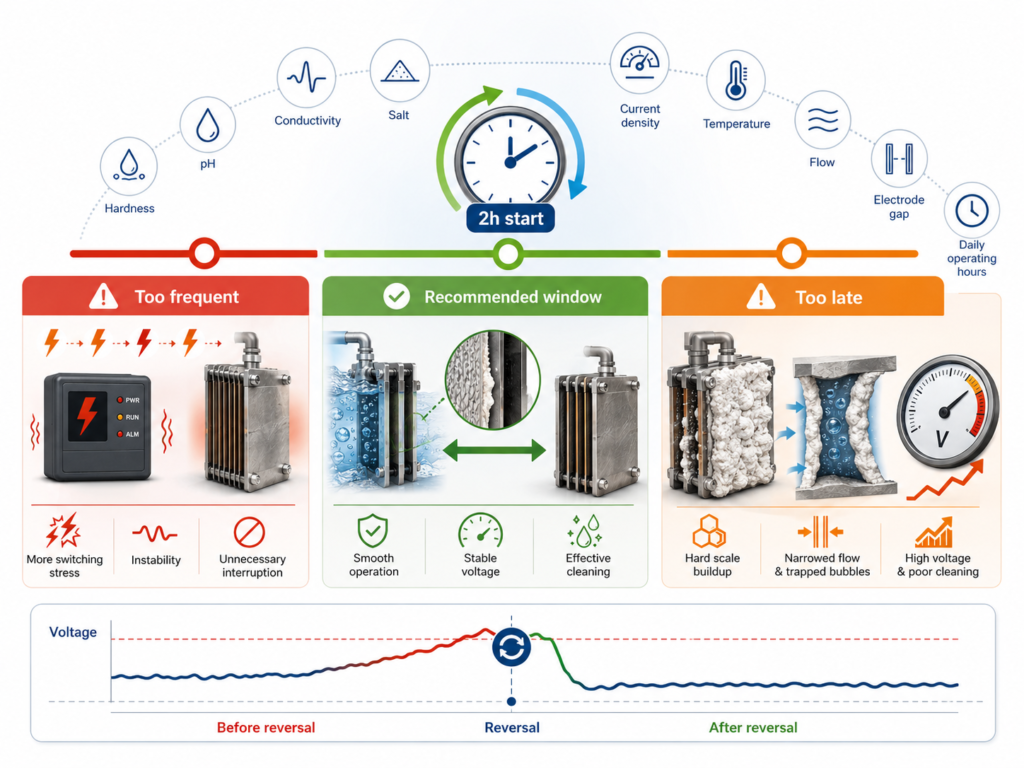
Important factors include:
- Calcium concentration
- Magnesium concentration
- Total hardness
- Alkalinity
- Feedwater pH
- Conductivity
- Salt concentration
- Current density
- Operating current
- Water temperature
- Flow velocity
- Electrode gap
- Cell geometry
- Daily operating hours
- Coating design
- Deposit adhesion
Can two hours be used?
Approximately two hours may be used as an initial operating interval for some automatic reverse-polarity sodium hypochlorite generators.
However, two hours should not be presented as a universal industry standard.
A technically responsible statement is:
A two-hour reversal interval may be selected as an initial control setting, but the final interval should be optimized according to water hardness, voltage trends, current density, cell design, and observed scaling behavior.
In relatively soft water, a longer cycle may be suitable.
In hard water, scale may develop rapidly and require a shorter cycle or additional water treatment.
Why should scale be removed before it becomes thick?
Fresh deposits are often easier to loosen than thick, compact layers.
If the system waits too long:
- The deposit may become denser.
- Adhesion may increase.
- Flow channels may narrow.
- Gas may become trapped.
- Reversal may not fully remove the layer.
- Chemical cleaning may become necessary.
The purpose of the timer is therefore to reverse the polarity before the scale becomes difficult to remove.
Can polarity be reversed too frequently?
Yes.
More frequent reversal does not always provide better cleaning.
Each reversal changes:
- Electrode potential
- Current direction
- Gas generation
- Local pH
- Electrical load
- Connection temperature
- Surface reaction
Unnecessarily frequent switching may increase:
- Electrical transition cycles
- Contactor or switching-component wear
- Power-supply instability
- Electrode stress
- Production interruptions
The best cycle is not the shortest possible cycle. It is the cycle that controls scale while maintaining stable electrical and electrochemical operation.
Controlled switching
In some systems, the current is not reversed instantly at full load.
A controlled sequence may include:
- Reduce the current.
- Stop the direct-current output.
- Allow residual charge to decrease.
- Confirm normal flow.
- Change the electrical polarity.
- Restart at low current.
- Increase to the operating current.
- Monitor voltage and temperature.
The exact sequence depends on the rectifier and cell design.
Some reversible electrolytic-cell designs include controlled transition or depolarization steps to reduce electrical stress during switching.
Use operating records to optimize the interval
A useful operating record should include:
- Time of reversal
- Current before and after reversal
- Voltage before and after reversal
- Conductivity
- Salt concentration
- Temperature
- Flow rate
- Available-chlorine output
- Visual scale condition
- Cleaning history
After several cycles, the operator can determine whether the interval is suitable.
7. Can Every MMO Titanium Anode Be Used for Reverse Polarity?
No.
This is one of the most important issues for equipment manufacturers and electrode buyers.
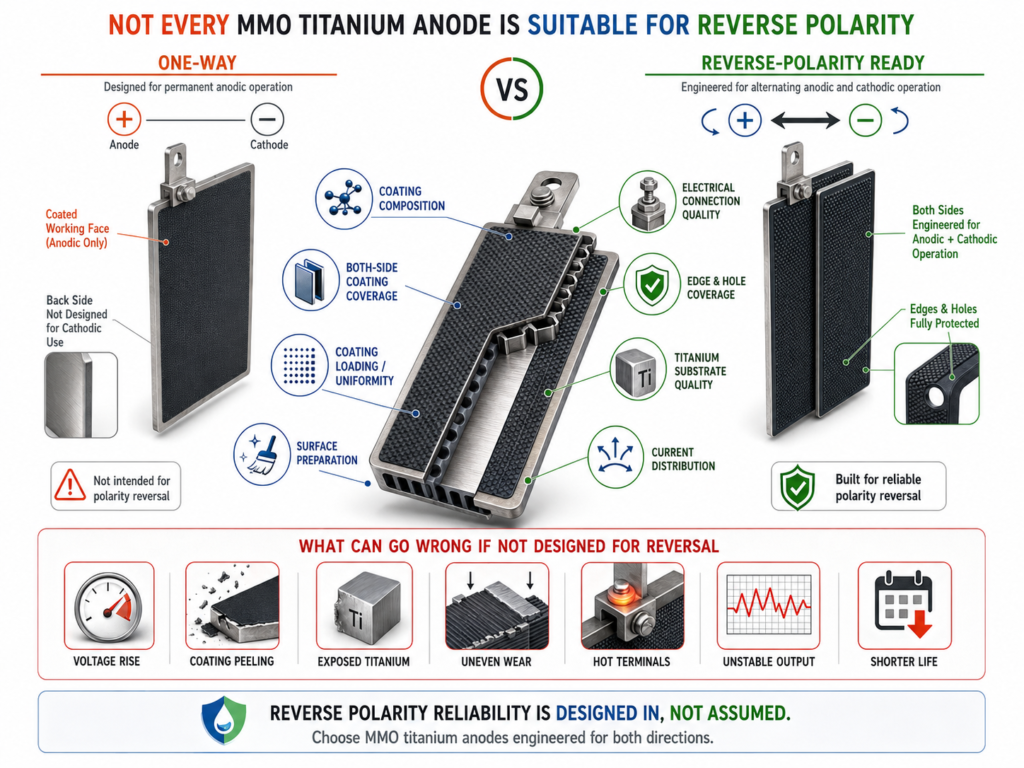
A coated titanium electrode designed for permanent anodic operation should not automatically be used in a reversible cell.
In a conventional one-way cell:
- One electrode remains the anode.
- One electrode remains the cathode.
- The anode requires a suitable catalytic coating.
- The cathode may use a different material or surface design.
In a reversible cell:
- Both electrodes alternately operate as anodes.
- Both may also operate as cathodes.
- Each working surface must tolerate the complete reversal cycle.
Coating composition
The coating should be designed for the intended reaction.
A coating used for:
- Cathodic protection
- Oxygen evolution
- Electroplating
- Organic oxidation
- Chlorine evolution
may have different catalytic and durability requirements.
A sodium hypochlorite generator electrode should be selected according to the chloride-containing electrolyte, operating current density, temperature, and reversal requirements.
Coating coverage
If both sides of an electrode become active anode surfaces during part of the operating cycle, both sides may require suitable coating.
A plate coated only on one surface may not be suitable if the uncoated surface is expected to operate anodically.
The buyer should confirm:
- Which faces are active
- Which surfaces are coated
- Whether the edges are coated
- Whether holes and welded regions require coverage
- Whether the connection zone should remain uncoated
Coating loading
The required noble-metal loading depends on:
- Current density
- Daily operating hours
- Electrolyte concentration
- Water impurities
- Operating temperature
- Reversal cycle
- Expected service life
A higher coating loading may provide more catalytic material, but loading alone does not determine performance.
Performance also depends on:
- Coating formulation
- Surface preparation
- Layer uniformity
- Thermal-treatment control
- Adhesion
- Edge coverage
- Current distribution
Titanium substrate
The titanium substrate should be evaluated for:
- Grade
- Thickness
- Flatness
- Strength
- Weldability
- Corrosion condition
- Surface defects
Thin plates may deform under thermal, hydraulic, or mechanical stress.
Warping can change the electrode gap and create uneven current distribution.
Surface preparation
Before coating, the titanium surface normally requires controlled preparation.
The objective is to:
- Remove contamination
- Remove unsuitable oxide layers
- Increase surface roughness
- Improve coating adhesion
- Create a consistent substrate condition
Poor pretreatment may lead to:
- Weak adhesion
- Local peeling
- Uneven coating
- Early voltage increase
- Reduced service life
Electrical connection
Connection resistance is another important factor.
A good coating cannot correct a poor electrical connection.
The design should consider:
- Current-entry position
- Busbar size
- Contact area
- Weld quality
- Terminal material
- Bolt pressure
- Corrosion protection
- Heat dissipation
High connection resistance may cause terminal heating and additional voltage loss.
Edge effects
Current density is not always uniform across a plate.
Edges, corners, holes, welds, and current-entry points may experience higher local current density.
These areas may be more vulnerable to:
- Coating consumption
- Local overheating
- Edge burning
- Gas concentration
- Mechanical damage
The electrode design should reduce severe current concentration where possible.
What can happen if the electrode is not designed for reversal?
Possible problems include:
- Rapid voltage increase
- Coating peeling
- Exposed titanium
- Uneven coating loss
- Poor scale removal
- Different performance in the two directions
- Excessive terminal heating
- Shortened service life
- Unstable chlorine production
- High energy consumption
The buyer should therefore ask more than:
Is this a ruthenium-iridium-coated titanium plate?
More useful questions are:
- Is the electrode designed for sodium hypochlorite generation?
- Is it designed for repeated polarity reversal?
- Are both required working surfaces coated?
- What current density was used for the design?
- What water conditions were considered?
- What reversal cycle is recommended?
- What service-life conditions were used?
8. Reverse Polarity, Manual Cleaning, and Water Pretreatment
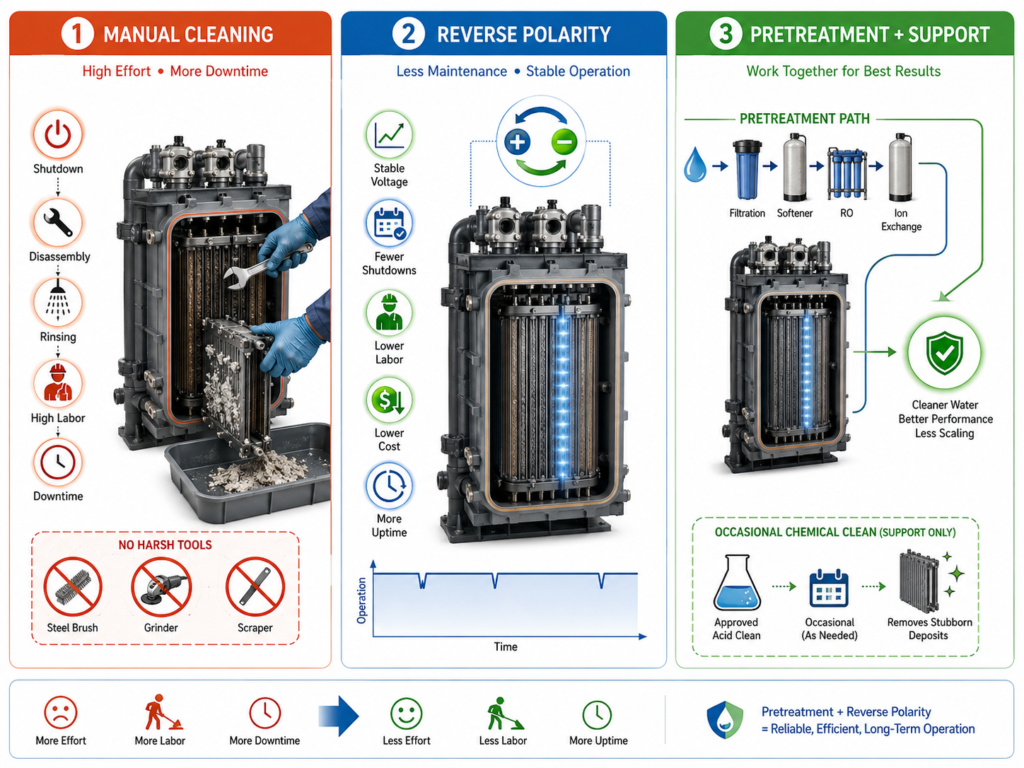
The main commercial advantage of reverse polarity is reduced maintenance.
Without automatic reversal, the operator may need to:
- Stop the generator.
- Disconnect and isolate the power.
- Drain or flush the cell.
- Open the electrode housing.
- Remove the electrode assembly.
- Clean the scale.
- Rinse the components.
- Inspect the seals.
- Reassemble the cell.
- Restart and test the equipment.
This process consumes time and labor.
Repeated disassembly may also increase the risk of:
- Gasket damage
- Incorrect reassembly
- Leakage
- Loose electrical connections
- Operator exposure to chemicals
- Production interruptions
The real purpose of reverse polarity
Reverse polarity is sometimes described as a method for improving sodium hypochlorite output.
This is only indirectly true.
Reverse polarity does not replace:
- Correct current
- Correct electrode area
- Suitable salt concentration
- Proper coating
- Good flow
- Appropriate temperature control
Its main benefits are:
- Less manual cleaning
- Fewer shutdowns
- Lower labor cost
- More stable cell voltage
- More consistent long-term production
- Reduced maintenance frequency
The most accurate summary is:
Reverse polarity does not directly create more chlorine. It helps the generator continue producing chlorine with less manual intervention.
Does reverse polarity eliminate acid cleaning?
Not always.
Chemical cleaning may still be required when:
- Water is extremely hard.
- The reversal interval is too long.
- Flow is insufficient.
- The cell has dead zones.
- Deposits contain silica or iron.
- Scale has become thick and compact.
- The polarity-control system has failed.
- The electrode gap traps detached particles.
Reverse polarity reduces the rate and severity of scale accumulation, but it cannot correct every water-quality problem.
Water pretreatment
Water softening can reduce calcium and magnesium before they enter the cell.
Possible pretreatment methods include:
- Ion-exchange softening
- Reverse osmosis
- Nanofiltration
- Controlled blending
- Filtration
- pH adjustment, where appropriate
The appropriate method depends on:
- Water analysis
- Equipment capacity
- Operating cost
- Required product quality
- Waste-disposal requirements
For very hard water, combining pretreatment with reverse polarity may provide better long-term results than relying on either method alone.
Chemical cleaning
Any acid-cleaning procedure should consider:
- Acid type
- Concentration
- Temperature
- Contact time
- Flow method
- Coating compatibility
- Gasket compatibility
- Rinsing
- Waste handling
An excessively strong or prolonged cleaning process may damage other cell components even if the titanium substrate is resistant.
The cleaning procedure should be confirmed with the electrode and equipment supplier.
Avoid aggressive mechanical cleaning
Coated titanium electrodes should not normally be cleaned using:
- Steel wire brushes
- Sandpaper
- Grinding tools
- Metal scrapers
- Abrasive blasting
- Hard blades
These methods may scratch or remove the catalytic coating.
Safer methods may include:
- Automatic polarity reversal
- Water flushing
- Approved chemical cleaning
- Soft non-metallic cleaning tools
- Gentle removal of loose material
When should the electrode be replaced?
Cleaning is useful when the main problem is removable scale.
Replacement or recoating should be considered when the electrode has:
- Persistent high voltage after cleaning
- Large areas of coating loss
- Exposed titanium
- Severe deformation
- Damaged welds
- Cracks
- Overheated terminals
- Unstable operation in both directions
- Reached the evaluated service life
The titanium substrate may sometimes be recoated, but it should first be inspected for mechanical and corrosion damage.
9. Common Problems and Misunderstandings
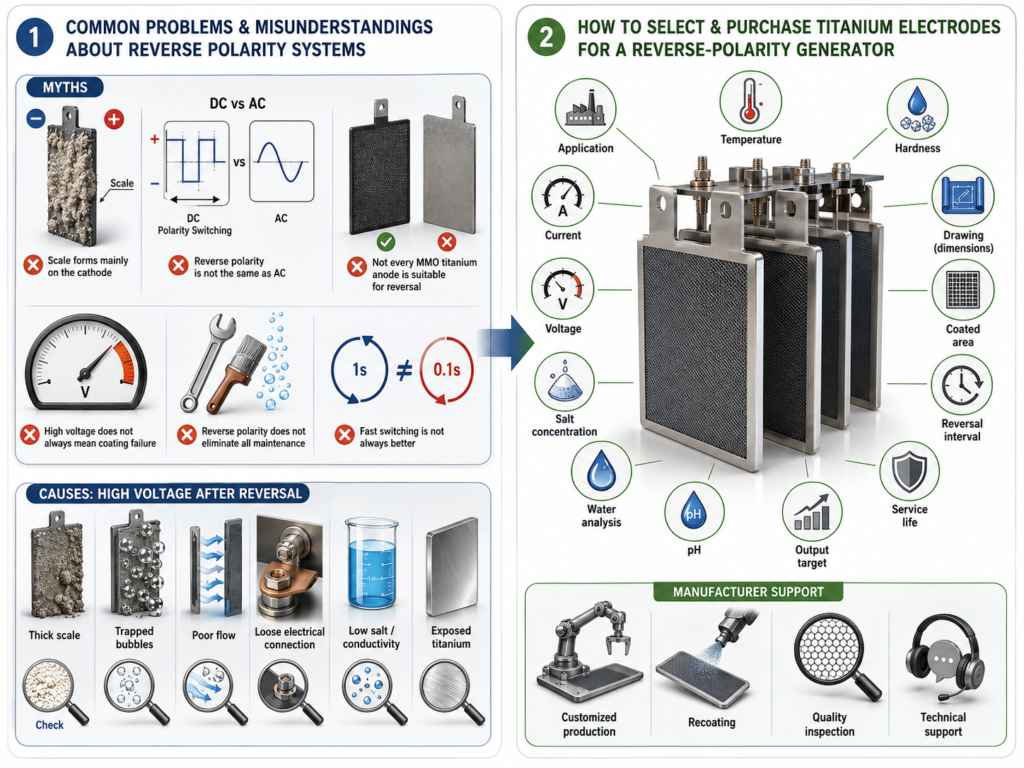
Misunderstanding 1: Scale mainly forms on the anode
Under normal direct-current electrolysis, hardness scale is generally associated with the cathode because hydroxide generation raises the local pH.
Misunderstanding 2: The cathode remains clean
The cathode is usually the surface most likely to develop calcium and magnesium deposits.
In a reversible cell, each electrode becomes the cathode during part of the operating cycle.
Misunderstanding 3: Two hours is a universal reversal standard
A two-hour interval may be a practical initial setting, but the final cycle must be based on actual operating conditions.
Misunderstanding 4: Any MMO titanium anode can be reversed
A coating designed for one-way anodic operation may not be suitable for repeated anodic and cathodic cycling.
Misunderstanding 5: Reverse polarity directly increases chlorine output
Reverse polarity mainly maintains cleaner surfaces and more stable operating conditions. It does not replace sufficient current, electrode area, or chloride concentration.
Misunderstanding 6: High voltage always means coating failure
Voltage may also rise because of:
- Scale
- Low conductivity
- Low salt concentration
- Cold electrolyte
- Poor flow
- Loose connections
- Gas accumulation
- Excessive electrode gap
Misunderstanding 7: Bare titanium can replace coated titanium
Bare titanium conducts electricity, but its passive oxide film creates high resistance under anodic conditions. It is not equivalent to a catalytic coated anode.
Misunderstanding 8: Reverse polarity eliminates all maintenance
The cell still requires inspection, water-quality control, flushing, and occasional cleaning.
Misunderstanding 9: Faster switching always gives better cleaning
Excessive switching may increase electrical wear and electrode stress without improving scale removal.
Misunderstanding 10: Reverse polarity is the same as alternating current
Reverse polarity normally means periodically changing the direction of direct current, not applying continuously alternating current.
What if voltage remains high after reversal?
Possible causes include:
- Scale is too thick.
- Deposits are not removed by the flow.
- Salt concentration is too low.
- Conductivity is insufficient.
- Electrical contacts are loose.
- Electrode spacing has changed.
- Gas is trapped.
- The coating is deteriorated.
- Bare titanium is exposed.
- The rectifier is malfunctioning.
The system should be inspected before simply shortening the reversal interval.
What if one polarity direction has a higher voltage?
A consistent difference between the two directions may indicate:
- Unequal coating condition
- Unequal active area
- Different electrical contact resistance
- Uneven scale distribution
- Asymmetric flow
- Unequal plate spacing
- Local coating damage
Both directions should be monitored separately.
What if scale returns very quickly?
Rapid scaling may indicate:
- Very hard feedwater
- High alkalinity
- High current density
- Inadequate flow
- Excessive operating temperature
- Long reversal cycles
- Narrow plate spacing
- Incomplete water pretreatment
The solution may require both operating adjustments and water-treatment improvements.
10. How to Select and Purchase Titanium Electrodes for a Reverse-Polarity Generator
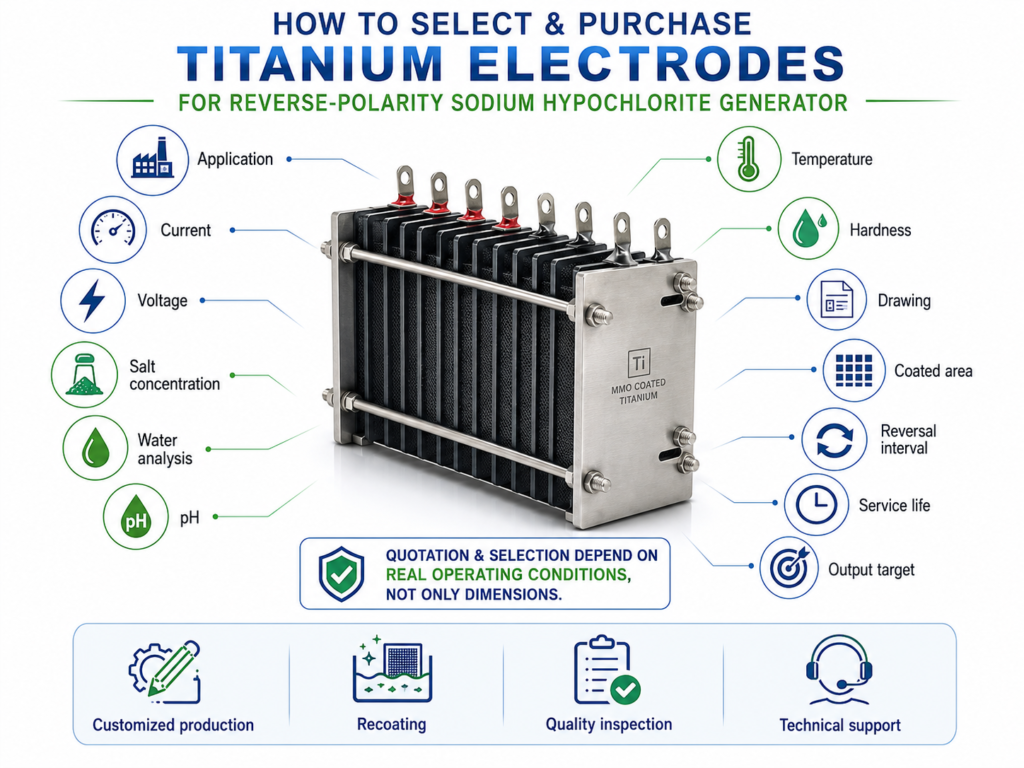
A reliable quotation cannot be prepared from electrode length and width alone.
The electrode supplier needs to understand the actual operating conditions.
Application information
The buyer should identify the application clearly:
- On-site sodium hypochlorite generation
- Seawater electrochlorination
- Swimming-pool disinfection
- Drinking-water disinfection
- Wastewater disinfection
- Cooling-water treatment
- Industrial process-water treatment
Different applications may use different salt concentrations, water sources, temperatures, and production requirements.
Electrical information
Provide:
- Nominal operating current
- Maximum current
- Normal voltage
- Maximum voltage
- Current density, if known
- Power-supply mode
- Number of electrode groups
- Series or parallel connection
- Reversal interval
- Reversal procedure
The total current alone is not enough. The supplier also needs the effective coated area.
Electrolyte and water information
Provide:
- Sodium chloride concentration
- Water source
- Conductivity
- pH
- Temperature
- Calcium
- Magnesium
- Total hardness
- Alkalinity
- Sulfate
- Silica
- Iron
- Other known impurities
A complete water-analysis report is particularly useful for systems with serious scaling problems.
Electrode drawing
The drawing should show:
- Length
- Width
- Thickness
- Hole positions
- Electrode gap
- Connection points
- Welded parts
- Coated area
- Uncoated contact area
- Installation method
- Quantity
The supplier should also know whether the electrode is:
- Plate
- Mesh
- Tube
- Rod
- Multi-plate assembly
- Bipolar structure
- Monopolar structure
Coating requirements
The buyer should confirm:
- Single-sided or double-sided coating
- Reversible or one-way operation
- Required active surfaces
- Expected service life
- Daily operating hours
- Maximum current density
- Inspection requirements
The coating design should be based on operating conditions rather than selected only by a general coating name.
Production requirements
Useful project information includes:
- Target sodium hypochlorite output
- Available-chlorine concentration
- Production hours per day
- Number of production cycles
- Maximum water temperature
- Planned maintenance interval
- Expected equipment life
Existing equipment problems
For replacement projects, provide details such as:
- Current electrode dimensions
- Previous coating type
- Previous service life
- Voltage when new
- Current voltage
- Scaling frequency
- Cleaning method
- Failure photos
- Operating records
This information can help determine whether the problem is caused by:
- Electrode design
- Coating selection
- Water hardness
- Current density
- Flow
- Electrical connections
- Reversal settings
How Ehisen supports sodium hypochlorite generator projects
Ehisen manufactures customized noble-metal-coated titanium electrodes for sodium hypochlorite generation and other electrochemical applications.
Available products and services may include:
- Ruthenium-iridium-coated titanium plates
- Coated titanium mesh
- Coated titanium tubes
- Multi-plate electrode assemblies
- Reverse-polarity electrode structures
- Customized production according to drawings
- Replacement electrodes
- Recoating services, subject to substrate inspection
- Technical selection support
Electrode design can be evaluated according to:
- Salt concentration
- Operating current
- Current density
- Water hardness
- Temperature
- Reversal cycle
- Active area
- Electrical connection
- Expected service life
- Cell structure
Manufacturing and quality control may include:
- Titanium-material verification
- Dimensional inspection
- Surface pretreatment
- Controlled coating application
- Multi-stage thermal treatment
- Coating-coverage inspection
- Weld inspection
- Connection inspection
- Production records
- Witness-sample testing when required
The final coating formulation and loading should be confirmed according to the specific operating conditions.
Information to send with an inquiry
For faster technical evaluation and quotation, buyers can provide:
- Electrode drawing
- Electrode quantity
- Nominal and maximum current
- Operating voltage
- Salt concentration
- Feedwater analysis
- Operating temperature
- Daily operating time
- Polarity-reversal interval
- Expected service life
- Target sodium hypochlorite output
- Current operating problems
Conclusion
Reverse polarity is an effective scale-control method for many sodium hypochlorite generators, particularly when the feedwater contains calcium, magnesium, and other hardness minerals.
During normal electrolysis, hydroxide ions are generated near the cathode. The resulting high local pH promotes the precipitation of calcium carbonate, magnesium hydroxide, and related deposits.
As scale accumulates, it may:
- Reduce the effective electrode area
- Increase electrical resistance
- Cause cell voltage to rise
- Obstruct liquid flow
- Trap gas bubbles
- Create uneven current distribution
- Increase maintenance requirements
When the polarity is reversed, the scaled cathode becomes the anode. The local surface chemistry changes, the conditions that promoted scale formation disappear, and the combined effects of anodic polarization, gas evolution, and liquid flow can help loosen and remove deposits.
The main purpose of reverse polarity is not to directly increase sodium hypochlorite production.
Its main value is to:
- Reduce manual cleaning
- Reduce equipment shutdowns
- Lower labor costs
- Maintain more stable voltage
- Support consistent long-term operation
A two-hour interval may be used as an initial control setting in some generators, but it should not be treated as a universal standard.
The final reversal cycle should be determined according to:
- Water hardness
- Voltage trends
- Current density
- Flow conditions
- Electrode spacing
- Cell geometry
- Deposit formation
- Electrode design
Most importantly, not every MMO-coated titanium electrode is automatically suitable for reverse-polarity operation.
A reliable reversible cell requires coordinated design of:
- Coating composition
- Coating coverage
- Titanium substrate
- Electrode geometry
- Electrical connections
- Current distribution
- Power-supply controls
- Hydraulic flow
- Reversal sequence
For equipment manufacturers and industrial buyers, the most useful questions are not simply:
Does the generator reverse polarity every two hours?
Instead, buyers should ask:
Where is scale forming, and why?
How much does the voltage increase during operation?
Are both electrode surfaces designed to become anodes?
Is the coating suitable for repeated polarity reversal?
Can the flow remove deposits after they loosen?
Is the reversal interval based on actual operating data?
When these questions are considered during the design stage, reverse polarity can become an effective self-cleaning strategy rather than an additional control function with uncertain results.
For a new sodium hypochlorite generator or replacement electrodes for an existing reversible electrolytic cell, send Ehisen the electrode drawings, operating current, salt concentration, water-quality information, reversal cycle, target sodium hypochlorite output, and expected service life.
Our team will evaluate the titanium-electrode structure and coating configuration according to the actual project conditions.