
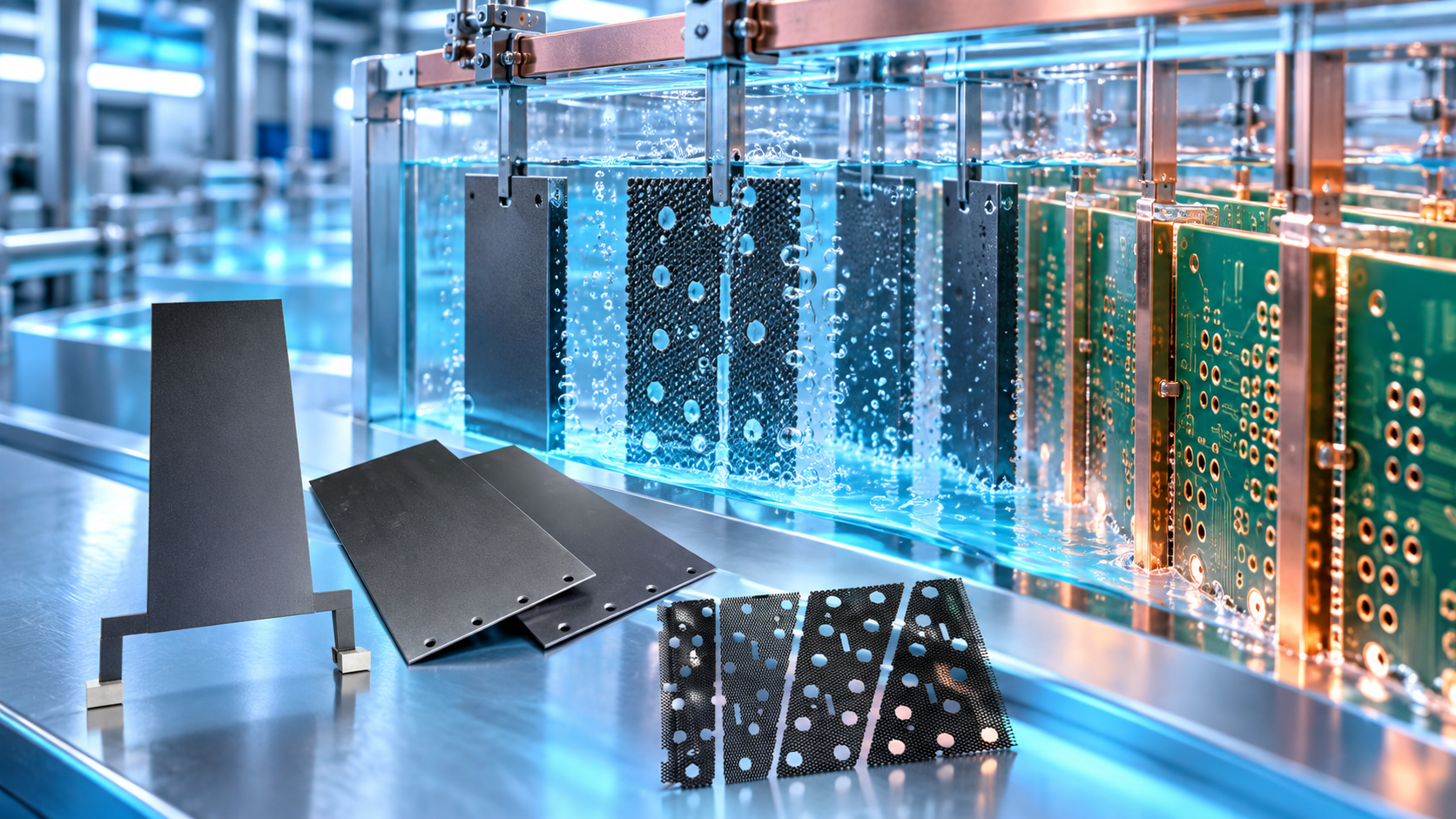
For PCB manufacturers and plating-equipment suppliers, a titanium anode should not be evaluated only by dimensions, coating name, or precious-metal loading. Its real performance depends on how the anode design matches the plating chemistry, current distribution, waveform, flow conditions, additive system, and target service life.
Introduction
As printed circuit boards continue to move toward higher circuit density, smaller holes, higher aspect ratios, and more complex interconnection structures, copper electroplating has become far more demanding than simply depositing copper onto a PCB.
For conventional PCB products, mature acid copper plating processes are often sufficient as long as they can provide the required copper thickness, acceptable uniformity, and reliable through-hole plating.
However, the situation changes significantly when production moves toward HDI boards, high-aspect-ratio through holes, blind via filling, high-speed via filling, pulse plating, and pulse-reverse plating. At this level, manufacturers must control much more than average copper thickness.
They need to understand how uniform the copper thickness is across the panel, whether sufficient copper can be deposited deep inside the holes, whether surface copper can be reduced while maintaining adequate hole-wall copper, whether current density can be increased without sacrificing filling performance, whether additive consumption remains stable, and whether plating performance can remain consistent from batch to batch.
These issues are influenced not only by the plating chemistry, but also by equipment design, current distribution, electrolyte flow, power-supply control, and the anode system.
For this reason, in addition to traditional soluble phosphorized copper anodes, another important solution is increasingly used in advanced PCB copper plating systems: titanium-based insoluble anodes.
A titanium anode used for PCB copper plating is not simply a bare titanium plate placed into the plating bath. In practice, PCB titanium anodes normally use titanium plate, expanded titanium mesh, or perforated titanium sheet as the structural and conductive substrate. The surface is then coated with an electrocatalytic precious-metal-oxide coating designed to operate under strongly acidic and anodic conditions.
So why would a PCB manufacturer replace phosphorized copper with an insoluble titanium anode? What problems can titanium anodes solve? And why do they also introduce new challenges related to additive consumption, coating lifetime, and equipment cost? To understand these questions, we first need to look at the electrochemistry of PCB copper plating.

1. How PCB Copper Plating Works and What the Anode Actually Does
The basic principle of PCB copper electroplating is an electrochemical reduction reaction.
In a typical acid copper sulfate electrolyte, the PCB acts as the cathode. Copper ions in the plating solution migrate toward the PCB surface under the influence of the electric field and mass transfer. At the cathode, Cu²⁺ ions gain electrons and are reduced to metallic copper:
Cu²⁺ + 2e⁻ → Cu
Copper is then deposited onto the board surface, circuit features, and hole walls until the required copper thickness is reached.
For simple flat surfaces, this process is relatively straightforward. For through holes and blind vias, however, the situation becomes much more complex.
Inside a hole, mass transfer is more limited than on the board surface. At the same time, local current density can vary significantly between the panel surface, the hole entrance, the hole wall, and the bottom of a blind via.
Without proper control of electrolyte flow, current distribution, and organic additives, copper tends to deposit faster on the surface and near the hole entrance than in the deeper regions. This is one of the reasons high-aspect-ratio through-hole plating becomes increasingly difficult.
It is also why modern blind-via filling relies heavily on the coordinated action of accelerators, suppressors, levelers, chloride ions, and controlled electrolyte flow. These additives modify polarization and copper deposition kinetics in different areas, helping improve throwing power, leveling performance, and bottom-up filling behavior.
However, there is another important question that is sometimes overlooked: where does the copper deposited on the cathode come from?
With a conventional soluble phosphorized copper anode, copper ions removed from the electrolyte at the cathode are continuously replenished by dissolution of the copper anode. The anodic reaction can be simplified as:
Cu → Cu²⁺ + 2e⁻
In other words, the copper anode performs two functions at the same time: it conducts current and supports the anodic electrochemical reaction, while also serving as the copper-ion source for the plating solution.
Once an insoluble titanium anode is introduced, this operating principle changes fundamentally. The titanium anode does not supply copper ions. Copper replenishment must therefore be handled by a separate copper dissolution or replenishment system, while the titanium anode is responsible primarily for current transfer and the anodic electrochemical reaction.
This is the starting point for understanding the fundamental difference between titanium insoluble anodes and phosphorized copper anodes.

2. How Is an Insoluble Titanium Anode Different from a Soluble Copper Anode?
2.1 Soluble Phosphorized Copper Anodes: The Anode Is Consumed
In a conventional acid copper plating system, the phosphorized copper anode dissolves continuously:
Cu → Cu²⁺ + 2e⁻
From a production perspective, the mechanism is simple. The PCB cathode continuously removes copper ions from the plating solution, while the copper anode continuously dissolves and returns copper ions to the bath.
As a result, the anode itself is gradually consumed. Copper balls or copper nuggets must be replenished regularly, and the system must also manage anode bags, black film formation, anode sludge, copper-ball contact conditions, and changes in effective anode geometry.
This means that both the electrochemical condition and the physical condition of the anode change during operation.
2.2 Titanium Insoluble Anodes: The Anode Does Not Supply Copper
An insoluble titanium anode works differently. In a typical acid copper sulfate system using an oxygen-evolving titanium anode, the main anodic reaction can generally be expressed as:
2H₂O → O₂↑ + 4H⁺ + 4e⁻
The titanium anode does not dissolve to supply Cu²⁺. Instead, water is oxidized, oxygen is generated, and electrons are transferred through the external circuit.
Therefore, when an insoluble titanium anode is used, copper replenishment and anodic current transfer become two separate functions. This is why converting from soluble copper anodes to titanium insoluble anodes is rarely as simple as replacing copper balls with coated titanium mesh.
A complete insoluble-anode copper plating system may also involve an independent copper replenishment system, electrolyte circulation, oxygen removal, current control, additive management, and redox chemistry in certain process designs.
2.3 Major Difference No. 1: Different Reaction Products
The main product of the anodic reaction with a soluble copper anode is Cu²⁺. For an oxygen-evolving titanium anode, the main anodic products are O₂ and H⁺.
This difference may appear simple on paper, but it has important consequences for the plating process. Oxygen generation creates gas bubbles. These bubbles can temporarily reduce the effective conductive area between the electrode surface and the electrolyte.
If oxygen bubbles are not removed efficiently, they can create localized shielding effects and affect current distribution. This is why PCB titanium anode design cannot focus only on whether the coating contains enough precious metal.
- Mesh opening and orientation
- Open-area ratio
- Electrolyte flow direction
- Spray direction
- Gas escape path
- Distance between anode and cathode
In some equipment designs, oxygen bubbles moving toward the cathode can also contribute to surface defects or bubble retention in holes. For this reason, gas management should be considered as part of the electroplating equipment design.
2.4 Major Difference No. 2: Different Anodic Processes
With phosphorized copper, the anode itself is continuously consumed. Its geometry, copper-ball arrangement, contact condition, effective surface area, and local current distribution can all change over time.
A titanium insoluble anode behaves differently. Under normal operating conditions, the geometry of the titanium substrate remains relatively stable. The electrochemical reaction mainly takes place on the catalytic coating at the surface.
This means the two systems rely on different forms of stability. With a soluble copper system, the main challenge is how the anode can dissolve in a stable and controlled manner. With an insoluble titanium anode, the main challenge becomes how the coating can maintain a stable and uniform anodic reaction while the electrode geometry remains essentially unchanged.
This is why the concept of a dimensionally stable anode is important in PCB copper plating. A stable anode geometry makes it easier for equipment designers to control current distribution through anode arrangement, anode zoning, shielding plates, anode-to-cathode distance, segmented rectification, and local current compensation.
2.5 Major Difference No. 3: Different Anode Potentials
Another important difference between soluble copper anodes and oxygen-evolving titanium anodes is their operating potential.
Under standard electrochemical conditions, the standard reduction potential of the Cu²⁺/Cu couple is approximately +0.34 V, while the standard reduction potential of the O₂/H₂O couple under acidic conditions is approximately +1.23 V.
These values are only thermodynamic reference values under standard conditions and should not be directly interpreted as the actual operating voltage of a PCB plating cell. Real anode potential is also affected by electrolyte composition, acid concentration, temperature, current density, electrode material, catalytic activity, overpotential, and mass transfer.
Nevertheless, the comparison highlights an important point: an oxygen-evolving insoluble anode generally operates in a stronger oxidative environment than a dissolving copper anode.
This introduces one of the most important issues in PCB insoluble-anode systems: organic additive oxidation.
At the surface of an insoluble anode, the relatively high anodic potential, oxygen evolution, and reactive oxidative intermediates can accelerate the degradation of some organic plating additives. In chloride-containing acid copper systems, active chlorine species may further contribute to the decomposition of certain brighteners or accelerator-type additives.
For PCB applications, simply having a coating that can evolve oxygen is not enough. A more important question is whether the anode can perform the required anodic reaction while minimizing unwanted oxidation of the plating additives.

3. Why Are Titanium Anodes Used in PCB Copper Plating?
3.1 Advantage No. 1: More Stable Copper Thickness Distribution
One of the most important advantages of an insoluble titanium anode is that its geometry remains relatively stable during operation.
With phosphorized copper balls, the physical condition of the anode changes continuously as the copper dissolves. Copper-ball shape, packing condition, electrical contact, and effective anodic surface area can all change over time.
A titanium anode, by contrast, can maintain a relatively stable working geometry. This gives equipment designers a more predictable platform for controlling anode area, anode-to-board distance, local anode coverage, edge compensation, shielding, and segmented current output.
In practical terms, this makes it easier to maintain a stable electric-field distribution. For demanding PCB products, this can help improve both surface copper uniformity and copper distribution inside holes.
Changing from phosphorized copper to titanium does not automatically improve plating uniformity. The final result depends on the complete system: titanium anode + equipment geometry + shielding + electrode spacing + electrolyte flow + power supply + plating chemistry.
3.2 Advantage No. 2: Greater Potential for Higher Production Efficiency
Another important advantage of insoluble titanium anodes is their ability to support process designs operating at higher current densities.
With conventional soluble anodes, higher current loading may require careful control of anode dissolution, anode film behavior, copper-ball contact, local passivation, and changes in effective anode area.
An insoluble anode does not rely on continuous metal dissolution to sustain the anodic reaction. As a result, it can provide greater flexibility when a plating line is designed around higher current densities.
According to Faraday’s law, if cathodic current efficiency remains sufficiently stable, increasing the effective current density increases the amount of copper deposited per unit time. This is why titanium anodes can create the conditions for higher productivity.
However, simply replacing the anode does not automatically increase plating capacity. High-speed PCB copper plating is also limited by Cu²⁺ mass transfer, additive response, hole mass transfer, electrolyte circulation, temperature, pulse parameters, copper microstructure, and filling behavior.
The productivity advantage of an insoluble anode becomes meaningful only when the chemistry and equipment are also capable of operating at higher current density.
3.3 Advantage No. 3: More Stable Process Control
In a conventional copper-anode system, the anode also functions as the copper-ion source. This means that copper replenishment is directly linked to anode dissolution.
When an insoluble anode is introduced, the two functions are separated: the titanium anode handles the anodic electrochemical reaction, while the copper replenishment system manages Cu²⁺ supply.
This makes the overall equipment more complex, but from a process-control perspective it also provides new possibilities. Copper concentration can be managed as an independent control variable.
The system can separately control copper dissolution rate, electrolyte circulation, Cu²⁺ concentration, copper replenishment, and anode current. Because the titanium anode also maintains a more stable geometry, problems associated with anode sludge, changing copper-ball packing, and anode consumption can be reduced.
When properly designed, this can contribute to better process repeatability.
3.4 Advantage No. 4: Higher Process Capability
For many PCB manufacturers, this may be the most important advantage.
Titanium anodes are not always selected because they provide the lowest direct plating cost. They are often selected because certain PCB products require process capabilities that are increasingly difficult to achieve with a conventional anode system.
As product requirements become more demanding, manufacturers may need better panel uniformity, better throwing power, more stable high-aspect-ratio plating, improved via-filling capability, higher current density, and more advanced pulse plating.
At this point, the anode system may become one of the limiting factors in the plating process. Pulse-reverse plating, for example, is an important method for improving copper distribution in high-aspect-ratio through holes because it can modify concentration polarization, additive adsorption, and local current distribution.
Dimensionally stable titanium anodes are widely compatible with this type of advanced process architecture.
For some PCB products, the real question is no longer “Can we reduce plating cost per square meter?” The more important question becomes “Can this plating line reliably manufacture this type of PCB?”
3.5 Disadvantage No. 1: Higher Initial Equipment Investment
The insoluble anode itself is only one part of the system. Once the anode no longer provides Cu²⁺, the equipment must have another method to replenish copper.
Depending on the specific process, this may require an independent copper dissolution unit, circulation tanks, redox chemistry, concentration monitoring, more complex electrolyte circulation, gas removal, and upgraded power-supply control.
Therefore, converting a conventional soluble-copper plating line to an insoluble-anode system is usually not simply a matter of buying several titanium anodes. The entire system must be evaluated.
This is one of the main reasons insoluble-anode systems generally require a higher initial equipment investment.
3.6 Disadvantage No. 2: More Complex Operating-Cost Control
For a conventional oxygen-evolving insoluble anode, one of the major operating challenges is additive consumption. The stronger oxidative environment near the anode can increase the decomposition rate of organic additives.
This may lead to higher brightener consumption, more frequent additive replenishment, larger CVS fluctuations, greater chemical-control requirements, and increased plating-chemistry cost.
In addition, the precious-metal-oxide coating on the titanium anode has a finite lifetime. When the coating reaches the end of its useful life, the anode must be recoated or replaced.
Therefore, the operating-cost calculation changes from simply asking how much copper balls cost to evaluating copper replenishment, additives, anode depreciation, energy, maintenance, yield, and productivity as part of the total process cost.
It is not always technically correct to say that titanium anodes always have a higher operating cost. The total cost of ownership should also include productivity, yield, maintenance, process stability, and manufacturing capability.
3.7 When Does It Make Sense to Choose Titanium Anodes?
Choosing titanium anodes is essentially a balance between cost and process capability.
If a conventional phosphorized-copper system can already meet product requirements with stable quality, and there is no strong demand for improved throwing power, faster filling, higher current density, or advanced pulse operation, then converting the entire plating system simply because titanium anodes appear more advanced may not make economic sense.
However, as PCB requirements increase, this balance may change. Manufacturers may face increasing demand for higher aspect ratios, thinner surface copper while maintaining hole-wall thickness, tighter within-panel uniformity, faster blind-via filling, more sophisticated pulse waveforms, and improved lot-to-lot consistency.
At this point, the anode system can move from being a simple consumable component to becoming part of the core process capability. In certain situations, the question of whether or not to use an insoluble titanium anode may determine whether the production line can manufacture a particular class of PCB.
From this perspective, as PCB technology continues to move toward higher density and tighter process windows, the importance of dimensionally stable insoluble anodes in advanced copper plating is likely to continue increasing.

4. How Should a PCB Titanium Anode Be Designed?
4.1 Start with the Actual Process Requirement
If a titanium-anode manufacturer receives only a mechanical drawing and manufactures exactly according to that drawing, it may still be insufficient.
For a conventional machined component, dimensional accuracy may be the primary requirement. For a PCB titanium anode, this is not the case.
A PCB anode is simultaneously a mechanical component, an electrical current-distribution component, and an electrochemical functional component. Therefore, the design should begin with the customer’s actual plating requirements.
For most PCB copper plating applications, the main requirements can be summarized into three areas: good and stable plating uniformity, predictable anode lifetime, and controlled additive consumption.
These three requirements are not controlled by the same design factors. Plating uniformity is influenced primarily by mechanical design, anode geometry, and equipment integration. Anode lifetime is strongly related to coating chemistry, current density, electrolyte conditions, and waveform. Additive consumption is closely related to surface electrocatalytic behavior, coating structure, electrolyte chemistry, and operating potential.
A useful way to think about a PCB titanium anode is: the titanium substrate determines how the current is distributed, while the functional coating determines how the anodic reaction takes place.
4.2 Designing for Uniform Current Distribution
4.2.1 Electrical Resistance Must Be Considered
In a large PCB plating system, different parts of the same anode do not automatically receive exactly the same electrical conditions.
Current enters the anode through a bus bar, contact point, or conductive connection and must then travel through the titanium substrate. If the anode is large, the conductor cross-section is insufficient, the connection points are poorly positioned, or local contact resistance is high, voltage drop can occur across the anode.
As a result, some areas may carry more current while other areas carry less. For this reason, mechanical design should consider not only the outer dimensions, but also conductive cross-section, number of electrical connection points, connection position, welding structure, conductive path, and equivalent resistance between each anode area and the power connection.
For large anodes or high-precision plating systems, electric-field simulation and current-distribution testing may also be useful.
4.2.2 Titanium Plate or Titanium Mesh?
PCB insoluble anodes commonly use titanium plate, perforated titanium plate, or expanded titanium mesh. There is no universal answer as to which substrate is best. The more important question is which structure best matches the plating equipment.
Titanium plate provides high mechanical strength, dimensional stability, and predictable projected surface area. However, in oxygen-evolving applications, gas removal and electrolyte flow must be carefully considered.
Titanium mesh provides a more open structure. Electrolyte can pass through the mesh, and oxygen bubbles can often be removed more easily when the mesh is properly integrated with the equipment flow field.
However, a larger mesh opening does not automatically mean a better design. Mesh geometry affects actual coated area, projected current distribution, fluid flow, mechanical strength, oxygen removal, and the influence of structures behind the anode.
For this reason, mesh opening, strand width, thickness, orientation, and open-area ratio should be selected together with the equipment design.
4.2.3 The Effect of Oxygen Bubbles on Current Uniformity
An oxygen-evolving titanium anode introduces another dynamic factor: gas bubbles.
As oxygen continuously forms at the anode surface, local gas coverage temporarily reduces the effective electrode/electrolyte contact area. If bubble release is uneven, the effective current-carrying area can also fluctuate unevenly.
Therefore, the anode must be designed for more than electrical uniformity. It must also support uniform gas release.
For vertical plating equipment, the natural upward movement of oxygen should be considered. For horizontal plating equipment, gas removal must be integrated with spray flow, electrolyte circulation, suction or pressure control, and upper and lower anode configuration.
A well-designed PCB titanium anode is therefore not simply a titanium substrate with a precious-metal coating. It is part of the overall electric-field and fluid-flow design of the plating cell.
4.3 How Should the Coating Be Designed?
If the mechanical structure controls how current reaches different parts of the anode, the coating determines what electrochemical reaction occurs once the current reaches the surface. This is where the core technical capability of an anode manufacturer becomes especially important.
4.3.1 Principle No. 1: Match the Coating to the Plating Conditions
PCB acid copper plating normally requires an insoluble coating suitable for operation under oxygen-evolution conditions. Iridium-oxide-based mixed-metal-oxide coatings are among the commonly used coating systems.
However, simply specifying an Ir-Ta coating does not mean that the anode will automatically be suitable for every PCB copper plating system.
Even within acid copper plating, operating conditions may vary significantly between customers. Important variables include current density, temperature, sulfuric-acid concentration, Cu²⁺ concentration, chloride concentration, additive system, direct current or pulse operation, presence of reverse current, actual waveform, and electrolyte flow.
Therefore, a PCB anode coating should not be selected only by coating name. The operating conditions should be treated as part of the design input.
4.3.2 Principle No. 2: Lifetime Must Be Designed Around the Real Electrical Load
Titanium-anode lifetime is not a fixed number. The same coating can perform very differently under different current densities, temperatures, electrolyte compositions, waveforms, and maintenance conditions.
When designing coating life, the anode manufacturer should ideally understand continuous or intermittent operation, average current density, peak current density, operating temperature, effective anode area, DC or pulse operation, reverse pulse current, reverse pulse duration, and the target maintenance interval.
For pulse-reverse plating, knowing only the average current density is not enough. During the reverse portion of the waveform, an electrode that normally operates anodically may experience temporary cathodic polarization.
This condition can significantly affect the durability of a conventional oxygen-evolving coating. For this reason, a titanium anode designed for pulse-reverse PCB plating should not automatically use the same design as a conventional DC plating anode.
4.3.3 Principle No. 3: Additive Consumption Is One of the Most Important Design Challenges
For a general industrial oxygen-evolving anode, the main design goals may be low cell voltage, high electrocatalytic activity, and long lifetime.
For PCB copper plating, an additional requirement must be considered: minimizing the oxidation of organic plating additives.
This is not easy. A surface that is highly active for oxidation may also increase the oxidation rate of organic molecules.
Therefore, PCB anode design often involves a balance between stable oxygen evolution, low unwanted organic oxidation, and acceptable coating lifetime.
Different coating structures, barrier concepts, and surface designs may be used to reduce direct contact between additives and highly oxidative catalytic sites.
This is why additive consumption should be considered an important performance parameter when evaluating PCB titanium anodes. It is not enough to measure only cell voltage and accelerated lifetime.

5. Common Operating Issues with PCB Titanium Anodes
5.1 Additive Consumption
5.1.1 Avoid Using One Universal Consumption Value
Customers often ask: How much brightener will this anode consume per ampere-hour? In practice, there is no universal answer.
Additive consumption depends on additive chemistry, additive concentration, chloride concentration, anode potential, current density, actual anode area, temperature, electrolyte flow, anode structure, and analytical method.
Data from one plating chemistry may not be directly transferable to another. A more meaningful evaluation method is to use the customer’s actual plating chemistry, representative current loading, CVS analysis, comparative anode testing, and cumulative ampere-hour testing.
This allows additive consumption to be evaluated under conditions closer to actual production.
5.1.2 Why Do Additives Decompose at the Anode?
Additive consumption in an insoluble-anode system can generally be understood through several mechanisms.
The first is direct oxidation of additives at the anode surface. The second is indirect oxidation by highly reactive intermediates generated during oxygen evolution. The third, in chloride-containing systems, is oxidation by active chlorine species formed near the anode.
Chloride ions are often an important part of the additive system in acid copper plating, so simply eliminating chloride is normally not a practical solution.
The real challenge is how the system can maintain the required bath chemistry while minimizing undesirable anodic side reactions. This is one of the reasons PCB-specific coating design is important.
5.1.3 Why Does Additive Consumption Sometimes Increase Suddenly?
If additive consumption has been stable and then suddenly increases, it is not always correct to immediately conclude that the titanium anode has failed.
A more systematic investigation should consider whether the operating current has increased, effective anode area has changed, some anodes have lost electrical connection, current distribution between anodes has become uneven, chloride concentration has changed, bath temperature has increased, electrolyte circulation has changed, plating chemistry has changed, the anode surface has become contaminated, pulse parameters have changed, or CVS measurement and automatic dosing have become inaccurate.
Abnormal additive consumption should normally be investigated as a complete plating-system issue rather than an anode-only issue.
5.2 An Often Overlooked Problem: Cathodic Polarization of the Anode
5.2.1 What Is Anode Cathodization?
Anode cathodization refers to a condition in which an electrode, or part of an electrode, that should normally remain anodically polarized temporarily experiences cathodic polarization.
In simple terms, the electrode is supposed to lose electrons, but under certain conditions it temporarily begins to receive electrons.
This may occur in multi-anode systems, neighboring anodes with significant voltage differences, edge areas, poorly balanced current distribution, or complicated pulse and pulse-reverse systems.
The root cause is often an electrical-potential difference between neighboring electrodes or sections of the anode system.
5.2.2 Why Can Cathodization Damage Anode Lifetime?
PCB oxygen-evolving coatings are designed to operate in an anodic oxidative environment. Their composition, oxidation state, microstructure, and interface stability are optimized on that basis.
When the electrode is driven cathodically, the surface experiences a reducing environment instead. Repeated or prolonged anodic-to-cathodic cycling can contribute to coating composition changes, surface morphology changes, partial reduction of active oxides, lower coating stability, and accelerated loss of active material.
Therefore, if one anode in a plating line repeatedly fails much earlier than the others, the investigation should not focus only on coating loading. The process should also check actual working voltage of each anode, current in each zone, rectifier output, contact resistance, voltage difference between neighboring anodes, and waveform experienced during pulse-reverse operation.
5.3 How Should Titanium Anodes Be Maintained?
An insoluble titanium anode is not a maintenance-free component. Important routine practices may include:
- Monitoring anode voltage and total cell voltage
- Checking whether current is balanced between anode zones
- Inspecting electrical connections for overheating or oxidation
- Checking the anode surface for scale, metal deposition, or organic contamination
- Keeping mesh openings clear so that gas and electrolyte can flow freely
- Avoiding mechanical scratching of the coating
- Avoiding unvalidated aggressive grinding or chemical cleaning
- Tracking cumulative ampere-hours whenever possible
For production lines with sufficient process control, recording cumulative ampere-hours for each group of anodes can provide more meaningful lifetime information than simply measuring operating time in months. The reason is straightforward: the anode experiences electrochemical load, not just elapsed time.

6. Emerging Applications and Future Development
6.1 High-Current-Density Via Filling
A commonly discussed advantage of insoluble titanium anodes is their ability to support higher current densities. However, in the past, this advantage did not always translate directly into higher via-filling productivity.
The reason is that blind-via filling is not simply a matter of increasing current. True bottom-up filling depends on the carefully balanced interaction between accelerator, suppressor, leveler, chloride, electrolyte flow, local mass transfer, and current distribution.
If current density is increased without redesigning the chemistry, copper may deposit too quickly on the surface or near the via opening. This can result in premature closure, void formation, or poor filling morphology.
As high-current-density filling chemistry continues to develop, additive systems are becoming better able to support faster deposition while maintaining filling performance. This creates new opportunities for titanium insoluble anodes. However, higher current density also creates new anode-design requirements.
6.1.1 The Anode Must Match High-Speed Filling Chemistry
Higher current density usually means higher anodic load, faster oxygen evolution, more gas generation, and greater additive oxidation risk.
If the plating chemistry is expensive and the anode significantly increases additive decomposition, the productivity benefit may be offset by chemical consumption.
For this reason, one of the key goals of high-speed filling anode design is to maintain low and stable additive consumption even under high anodic loading.
6.1.2 Coating Lifetime Must Be Reconsidered
Higher current density means more charge passes through each unit area of the anode. If a coating originally designed for lower loading is simply used at higher current density, its service life may decrease significantly.
Therefore, high-speed plating should not be approached as simply using the original anode at a higher current. A better approach is to reevaluate precious-metal loading, coating structure, coating thickness, titanium surface pretreatment, effective anode area, oxygen removal, and current distribution.
In this sense, high-speed via filling is pushing PCB titanium anodes away from the role of a standard oxygen-evolving component and toward a more highly customized electrochemical functional component.
6.2 Oxygen-Evolving Pulse-Reverse Copper Plating
Another important area of development is oxygen-evolving pulse-reverse copper plating. Pulse-reverse plating is particularly valuable for high-aspect-ratio through holes.
Instead of applying a constant DC current to the PCB cathode, the process periodically introduces reverse-current pulses. These reverse pulses can influence copper deposition near the hole entrance, concentration polarization, additive adsorption, local current distribution, and deposit microstructure.
With properly optimized parameters, pulse-reverse plating can improve copper thickness distribution inside high-aspect-ratio holes.
In simplified terms, insoluble-anode pulse-reverse systems can be divided into two general approaches based on the main anodic reaction.
One approach uses a reversible redox couple. For example:
Fe²⁺ → Fe³⁺ + e⁻
The generated Fe³⁺ may then participate in a separate copper-dissolution loop. The advantage of such a system is that the anodic reaction can be shifted away from direct oxygen evolution, potentially reducing the strongly oxidative environment around the anode.
However, introducing a redox system also means that the additional ions must be controlled as part of the plating chemistry.
The second approach is direct oxygen-evolving pulse-reverse plating. In this case, the anode continues to operate through oxygen evolution rather than relying on an additional redox couple.
This reduces dependence on a separate redox chemistry, but it places much greater demands on both the coating and the additive system.
6.2.1 Challenge No. 1: Coating Lifetime under Pulse-Reverse Conditions
A conventional oxygen-evolving coating is normally designed under the assumption that the electrode will remain anodically polarized.
Pulse-reverse plating periodically changes the electrode potential. This may expose the coating to repeated oxidation and reduction cycles.
As a result, a coating that performs well under DC oxygen evolution may not necessarily provide acceptable durability under pulse-reverse conditions.
For this reason, titanium anodes designed for oxygen-evolving pulse-reverse PCB plating should be specifically engineered for waveform stability. They should not simply reuse a standard DC coating without verification.
6.2.2 Challenge No. 2: Additive Consumption
The second challenge can be even more difficult. Oxygen evolution already creates a highly oxidative environment. Pulse-reverse operation expands the potential window experienced by the electrode. At the same time, many high-productivity pulse processes aim to use higher peak current density.
The anode therefore needs to meet three important targets at the same time: low additive consumption, long coating lifetime, and high pulse-load capability.
These three objectives do not necessarily move in the same direction. Increasing electrocatalytic activity may change additive oxidation behavior. Improving coating stability may alter the surface electrochemical response. Increasing precious-metal loading can increase theoretical life, but it does not automatically solve cathodic polarization or additive oxidation.
For this reason, an oxygen-evolving pulse-reverse anode is essentially a multi-objective electrochemical design problem. This is likely to become one of the areas where PCB titanium-anode technology becomes increasingly differentiated.

7. What Information Should a Buyer Provide When Requesting a PCB Titanium Anode?
For a PCB manufacturer or plating-equipment supplier, sending only a mechanical drawing is usually not enough.
A drawing tells the anode manufacturer the dimensions, hole positions, mounting structure, titanium plate or mesh geometry, and electrical connection position. But the drawing does not tell the manufacturer which coating should be used, how much precious-metal loading is required, how additive consumption should be controlled, or what coating lifetime should be targeted.
A more complete PCB titanium-anode inquiry should ideally include the following information:
- PCB plating application: through-hole plating, blind-via filling, pattern plating, or another process
- DC, pulse, or pulse-reverse operation
- Basic electrolyte composition
- Approximate Cu²⁺ concentration
- Approximate H₂SO₄ concentration
- Chloride concentration range
- Additive system
- Operating temperature
- Average forward current density
- Peak forward current density
- Reverse current density, if applicable
- Reverse pulse duration and frequency
- Duty cycle
- Effective anode area
- Anode-to-PCB distance
- Existing anode structure
- Current anode lifetime
- Current additive consumption
- Whether localized early anode failure has occurred
- Target lifetime
- Target additive-consumption level
The more complete this information is, the more accurately the anode manufacturer can design the product around actual operating conditions.
Otherwise, a so-called PCB titanium anode quotation may end up comparing little more than the weight of the titanium substrate and the value of the precious-metal coating. That does not represent the true technical value of a PCB titanium anode.
Conclusion: The PCB Titanium Anode Is Becoming Part of the Plating Process Capability
From a materials perspective, the structure of a PCB titanium anode may appear relatively simple: a titanium substrate combined with a precious-metal-oxide functional coating.
From the perspective of the entire PCB copper plating process, however, the anode can influence current distribution, copper-thickness uniformity, equipment productivity, additive consumption, process stability, throwing power, via filling, pulse plating, and long-term operating cost.
For this reason, evaluating a PCB titanium anode should involve more than two questions: how much iridium does it contain, and how much does it cost?
More meaningful questions include whether the anode matches the actual copper plating chemistry, whether the structure matches the electric field and electrolyte flow of the equipment, what lifetime can be expected at the actual current density, whether brightener and leveler consumption can remain under control, and whether the coating will remain stable during pulse or pulse-reverse operation.
For conventional PCB products, soluble phosphorized copper anodes remain a mature and cost-effective solution. But as PCB manufacturing continues to move toward higher aspect ratios, higher-density interconnections, faster via filling, thinner surface copper, tighter uniformity requirements, and increasingly complex pulse processes, the role of the anode is also changing.
The anode is no longer simply a component that carries current. It is becoming part of the process capability of the entire copper plating line.
A better starting question is not “How much does one titanium anode cost?” but “What plating conditions do we have, and what process problem do we need the anode to solve?”
Once the actual operating conditions are understood, the anode can be designed around titanium substrate geometry, current distribution, precious-metal-oxide coating, target lifetime, pulse waveform, and additive compatibility.
If you are developing or upgrading a PCB through-hole plating line, blind-via filling process, high-speed copper plating system, pulse plating line, or oxygen-evolving pulse-reverse process, providing the anode drawing together with the plating chemistry, current density, operating temperature, and pulse parameters will allow a much more meaningful technical evaluation.
Compared with quoting only according to dimensions, designing the titanium anode around the actual operating conditions provides a much better foundation for achieving stable copper thickness distribution, controlled additive consumption, and predictable anode lifetime.