
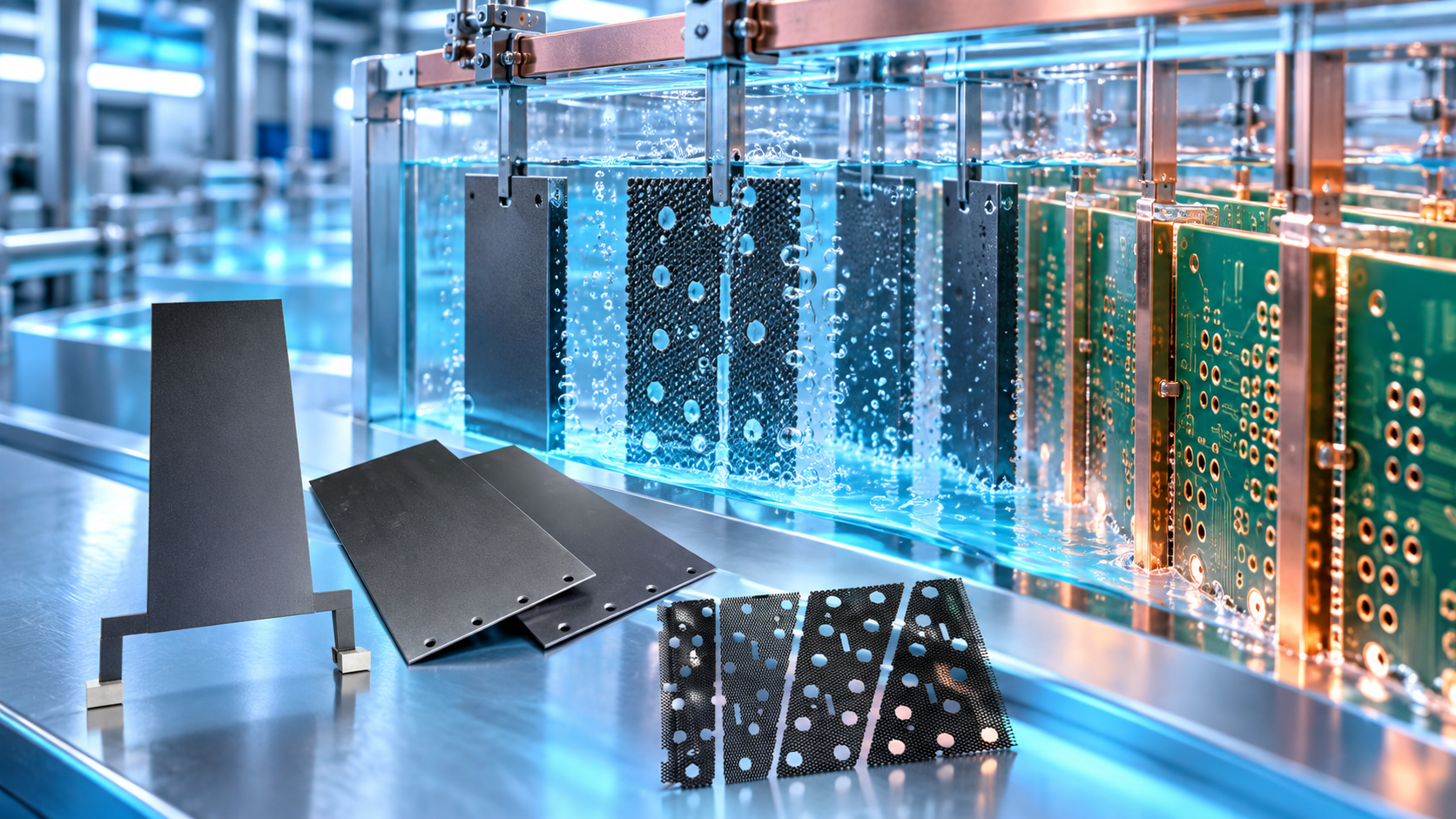
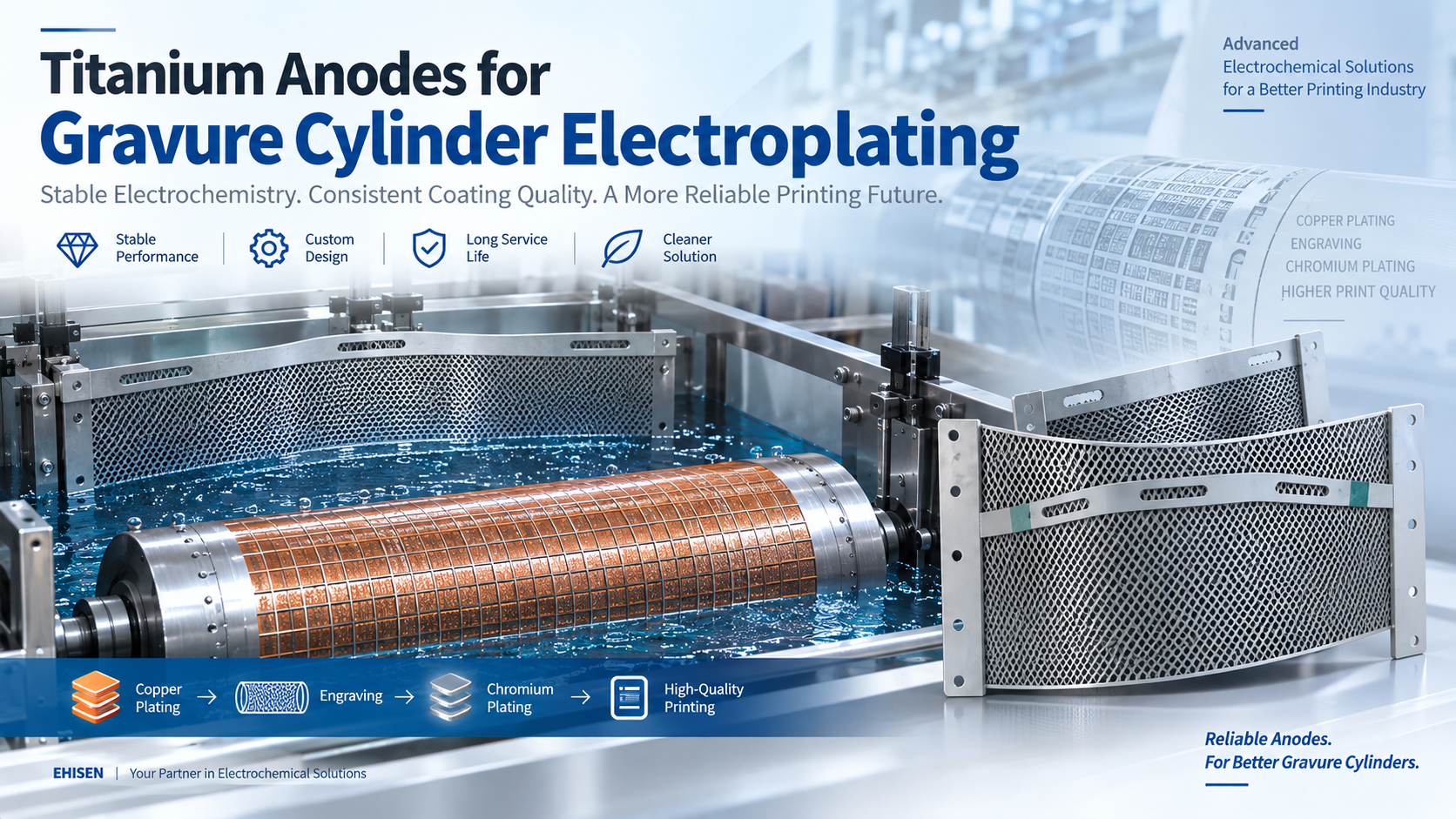
For many buyers of titanium anodes, the word “coating” sounds simple. A titanium plate, mesh, tube, rod or basket is prepared, a precious metal layer is applied, and the electrode is then used in an electrolytic system. However, in the titanium anode industry, coating is not one single process. Different coating methods create different types of layers, follow different quality-control logic, and serve different electrochemical purposes.
Introduction
This is especially important when comparing electroplating, selective brush plating and what many titanium anode suppliers call “brush coating.” These terms are often mixed together in quotations, product pages and technical discussions. In reality, they do not mean the same thing.
Electroplating and selective brush plating are electrochemical deposition processes. They are mainly used to form metallic coatings, such as platinum on titanium. Brush thermal decomposition, on the other hand, is a chemical and thermal process. It is widely used to prepare mixed metal oxide coatings, commonly called MMO coatings, such as ruthenium-iridium oxide, iridium-tantalum oxide and other precious metal oxide catalytic layers on titanium substrates.
For titanium anode buyers, this distinction is not just a matter of terminology. It directly affects product selection, service life, cost, coating inspection, repair strategy and whether the anode can remain stable in the actual electrolyte. Choosing the wrong coating process may result in poor adhesion, unstable voltage, early coating consumption, or a mismatch between the coating and the intended electrochemical reaction.
This article explains the differences among electroplating, selective brush plating and brush thermal decomposition from a practical titanium anode manufacturing perspective. It also provides a purchasing guide to help engineering buyers, project managers and procurement teams choose the right process before sending an inquiry.
1. First Clarify the Concepts: Selective Brush Plating Is Not the Same as the “Brush Coating” Commonly Mentioned in the Titanium Anode Industry

The first misunderstanding comes from the word “brush.”
In general metal finishing, selective brush plating refers to a localized electroplating method. Instead of immersing the entire part in a plating tank, the operator uses a plating tool, a wrapped anode, an electrolyte and a direct-current power supply to deposit a metal layer only on a selected area. This method is often used for local repair, dimensional restoration, surface modification and on-site maintenance.
In the titanium anode industry, however, many suppliers use the phrase “brush coating” to describe a completely different process: applying a precursor solution onto a titanium substrate with a brush, drying it, and then heating it so the precursor decomposes into a precious metal oxide coating. This is not selective brush plating in the strict electroplating sense. It is more accurately described as brush thermal decomposition, thermal decomposition coating, or brush-applied thermal decomposition coating.
The two processes may both involve a brush-like tool, but their coating formation mechanisms are fundamentally different.
Selective brush plating needs an electrical circuit during deposition. The workpiece is connected as part of the electrochemical system. Metal ions in the electrolyte are reduced and deposited as a metallic layer on the selected surface. The coating is formed through electrodeposition.
Brush thermal decomposition does not rely on electrochemical reduction during coating formation. Instead, a prepared precursor solution containing precious metal compounds is applied to the titanium surface. After drying and heating, the precursor decomposes and converts into an oxide layer. Multiple coating and firing cycles are usually required to build the designed catalytic layer.
Therefore, when a buyer asks, “Is your titanium anode brush coated?” the supplier must clarify what “brush coated” means. Is the buyer asking about selective brush plating of a metallic layer? Or is the buyer referring to the common MMO titanium anode process where a precursor solution is brushed and thermally decomposed?
This clarification is important because these two processes lead to different coating structures.
A selectively brush-plated coating is usually metallic. It may be suitable for local metal deposition, repair or precious metal plating in defined areas. A thermally decomposed brush-applied coating is usually an oxide catalytic layer. It is designed for electrochemical reactions such as chlorine evolution, oxygen evolution, hypochlorite generation, wastewater oxidation, cathodic protection, electroplating assistance, electrowinning, water treatment and other industrial electrolysis systems.
From a purchasing perspective, the question should not be “Which process sounds better?” The correct question is: “What coating chemistry and electrochemical function does my application require?”
If the application requires a metallic platinum surface, electroplating or selective brush plating may be considered. If the application requires an MMO catalytic oxide layer, brush thermal decomposition is usually the more relevant process.
At Ehisen, we often see buyers use the words “plating,” “brush plating,” “brush coating” and “MMO coating” interchangeably in early inquiries. A responsible titanium anode supplier should not simply quote a price based on unclear wording. The supplier should first confirm the electrolyte, current density, operating temperature, required service life, anode shape, coating type and inspection requirements. Only then can the coating route be selected correctly.
2. Electroplating: More Commonly Used to Form Metallic Precious Metal Coatings

Electroplating is an electrochemical process used to deposit a metal layer onto a conductive surface. In a typical plating system, the workpiece acts as the cathode. Metal ions in the plating bath receive electrons at the cathode surface and are reduced into metal atoms. These atoms build up on the substrate and form a coating.
For titanium anodes, electroplating is commonly associated with metallic precious metal coatings, especially platinum-coated titanium anodes. A platinum-coated titanium anode combines the corrosion resistance and mechanical strength of titanium with the conductivity and electrochemical properties of platinum. This type of product is widely used in applications where a metallic noble metal surface is preferred.
Electroplated platinum on titanium may be used for certain electroplating baths, laboratory electrochemical systems, specialized electrolytic processes and applications where the buyer specifically requires a metallic platinum layer instead of an oxide coating. In these cases, the key requirement is not simply that the surface contains precious metal. The key requirement is that the precious metal exists primarily as a metallic deposited layer.
The quality-control logic of electroplating is closely related to electrical parameters and bath conditions. Important factors include current distribution, bath composition, ion concentration, temperature, pH, agitation, plating time, substrate conductivity, surface activation and anode-cathode arrangement. If these factors are not controlled properly, the coating may show uneven thickness, poor adhesion, burning, nodules, pinholes, edge buildup or weak areas in recessed regions.
For simple flat plates, electroplating is relatively easier to control. The current distribution is more predictable, and the distance between electrodes can be managed more consistently. However, for complex titanium structures such as deep baskets, long tubes, dense mesh, multi-layer assemblies, narrow gaps or welded frames, current distribution becomes more challenging. Areas closer to the counter electrode may receive more current and build thicker deposits, while shielded or recessed areas may receive less current and form thinner deposits.
This is why electroplated coatings on complex titanium anode structures require careful fixture design, electrical contact control and process validation. A coating that looks bright on the outer surface does not automatically mean that the inner surface, edges, weld areas or hidden zones have received sufficient and uniform deposition.
Another important point is that titanium is a passive metal. Titanium naturally forms a stable oxide film on its surface. This oxide film is one reason titanium has excellent corrosion resistance, but it can also make coating adhesion difficult if the surface is not properly prepared. For electroplating, surface activation is especially important. If the passive oxide film, oil, handling contamination or machining residue remains on the surface, the plated layer may not bond reliably.
Therefore, electroplating is not simply “putting titanium into a bath and applying current.” For titanium-based precious metal anodes, the complete process normally includes material inspection, mechanical preparation, degreasing, surface activation, masking if required, plating, rinsing, drying, inspection and sometimes post-treatment depending on the project requirements.
When buyers evaluate electroplated titanium anodes, they should not only ask for the platinum thickness. They should also ask how the supplier controls surface preparation, electrical contact, coating uniformity, inspection points and traceability. Thickness is important, but thickness alone cannot represent the whole coating quality. A nominally thick coating with poor adhesion or poor coverage may fail earlier than a properly bonded coating designed for the actual working conditions.
Electroplating is a strong choice when the required product is a metallic precious metal coating and the structure can be plated with acceptable uniformity. It is especially suitable when the buyer needs a defined metallic platinum layer, good conductivity and a coating process that can be evaluated through thickness measurement and surface inspection.
However, electroplating is not automatically the best choice for every titanium anode. If the application depends on catalytic oxide behavior, chlorine evolution selectivity, oxygen evolution stability or MMO coating chemistry, then the buyer should consider brush thermal decomposition instead.
3. Brush Thermal Decomposition: More Suitable for MMO Precious Metal Oxide Catalytic Layers

Brush thermal decomposition is one of the most widely used methods for preparing MMO titanium anodes. In this process, the titanium substrate is first pretreated. Then a precursor solution containing precious metal compounds and other functional components is applied to the surface. The coating is dried and heated so the precursor decomposes and forms an oxide layer. This process is repeated multiple times until the designed coating loading and catalytic structure are achieved.
The important point is that the coating is not deposited as a metallic layer through electrochemical reduction. It is formed by chemical conversion and thermal treatment. The final surface is a mixed metal oxide catalytic layer rather than a simple metallic deposit.
Common MMO coating systems include ruthenium-iridium oxide, iridium-tantalum oxide, ruthenium-iridium-titanium oxide and other customized formulations. The specific coating system should be selected according to the electrolyte and target reaction. For example, chloride-containing environments often require coatings with strong chlorine evolution performance, while oxygen evolution environments usually require coatings with better oxygen evolution stability. Cathodic protection, seawater electrolysis, hypochlorite generation, industrial wastewater oxidation, electrowinning and electroplating assistance all have different coating requirements.
The function of an MMO coating is not only to “cover titanium.” It is to provide an active electrocatalytic surface. The coating should reduce reaction overpotential, maintain stable electrochemical activity, resist corrosion in the electrolyte and keep good adhesion to the titanium substrate during long-term operation.
Because the coating is created through repeated solution application and heat treatment, the process control logic is different from electroplating. Important factors include precursor formulation, solvent system, coating viscosity, application amount per pass, drying condition, decomposition temperature, firing time, furnace atmosphere, heating uniformity, layer-by-layer build-up, final heat treatment and cooling control.
The typical appearance of a thermally decomposed MMO coating may include a fine cracked or mud-crack-like surface morphology. This should not automatically be judged as a defect. In many oxide-coated titanium anodes, controlled micro-crack morphology is related to the thermal formation of the oxide layer and can increase real surface area. However, uncontrolled cracking, peeling, powdering, exposed titanium, deep defects or uneven coating accumulation are quality concerns.
The difference between a professional MMO coating and a simple painted layer lies in the chemical transformation and process repeatability. Applying a precursor solution is only one step. The real coating performance depends on whether the precursor is converted into a stable catalytic oxide structure and whether the layer is strongly bonded to the prepared titanium surface.
This is why brush thermal decomposition places high demands on the supplier’s experience. The operator must control how much solution is applied in each pass. Too much solution may cause uneven drying, local accumulation, weak layers or excessive stress. Too little solution may lead to insufficient active material and incomplete coverage. The furnace process must also be stable. If heating is not uniform, different areas of the same anode may develop different coating structures and performance.
For large titanium mesh, long rods, tubular anodes, baskets, complex welded parts or customized assemblies, the challenge becomes even greater. The supplier must ensure that the precursor reaches all functional surfaces, that drying does not create pooling, and that the thermal cycle is suitable for the whole structure. Hidden areas, sharp edges, weld seams and contact points must be considered before production.
Brush thermal decomposition is generally more suitable than electroplating when the product requirement is an MMO catalytic oxide layer. It allows the coating formulation to be designed according to the working environment. It also makes it possible to prepare different functional oxide systems for different electrochemical reactions.
For buyers, the key is to describe the application accurately. A request such as “MMO titanium anode” is only the beginning. The supplier still needs to know the electrolyte composition, chloride concentration if relevant, operating current density, temperature, pH range, expected lifetime, polarity reversal risk, cleaning method, installation structure and whether the anode works mainly for chlorine evolution, oxygen evolution or mixed reactions.
At Ehisen, coating selection is not treated as a fixed catalog choice only. For customized titanium anodes, we evaluate the application and then recommend a suitable coating system and process route. This is especially important for buyers who are replacing lead anodes, graphite anodes, stainless steel electrodes or previous titanium anodes that failed too early.
4. The Core Difference Between the Two Main Processes Is the Coating Formation Mechanism and Quality-Control Logic

The most important difference between electroplating and brush thermal decomposition is not the tool used. It is the coating formation mechanism.
Electroplating forms a coating by electrochemical reduction. Metal ions in the electrolyte become metal atoms on the cathode surface. The coating is usually a metallic layer. Process control focuses on current, voltage, bath chemistry, electrical contact, current distribution and deposition time.
Brush thermal decomposition forms a coating by precursor conversion. A chemical precursor is applied, dried and thermally decomposed into an oxide. The coating is usually a mixed metal oxide layer. Process control focuses on formulation, application uniformity, drying, decomposition temperature, firing time, thermal history and layer structure.
This difference leads to different inspection logic.
For electroplated metallic coatings, buyers often focus on thickness, surface brightness, adhesion and coverage. Thickness can be evaluated through suitable measurement methods depending on coating type and substrate geometry. The supplier may also inspect appearance, continuity, adhesion and dimensional effect.
For MMO thermal decomposition coatings, thickness alone is not always the most meaningful indicator. MMO coatings are functional catalytic layers, and their performance depends on active component loading, distribution, oxide structure, adhesion, electrochemical behavior and resistance to consumption or passivation. In many cases, coating loading, formulation control, surface condition, accelerated life testing and electrochemical performance are more relevant than a simple visual judgment.
This is why asking only “How many microns is the MMO coating?” may not be enough. A buyer may receive a number, but that number may not explain whether the coating is suitable for the electrolyte. For MMO anodes, the more meaningful questions include:
♦What coating system is recommended for this electrolyte?
♦Is the anode mainly for chlorine evolution, oxygen evolution or another reaction?
♦How is the titanium substrate pretreated?
♦How is the coating applied to complex surfaces?
♦What inspection methods are used before shipment?
♦Can the supplier provide test records or third-party testing if required?
♦How will the coating be matched to the buyer’s expected operating life?
In electroplating, the coating grows as a metallic deposit from the surface outward. In thermal decomposition, the coating is built layer by layer through repeated chemical and thermal transformation. In electroplating, poor current distribution often causes thickness differences. In thermal decomposition, poor application or firing control may cause uneven active loading, weak bonding or local coating stress.
The failure modes are also different.
A poorly electroplated coating may peel, blister, crack, show insufficient thickness, or lose conductivity if the deposit is porous or poorly bonded. A poorly prepared MMO coating may lose active components, powder off, develop unstable voltage, expose titanium substrate, or cause titanium passivation under severe electrochemical conditions.
For titanium anodes, titanium passivation is particularly important. Titanium has excellent corrosion resistance because of its oxide film, but if the catalytic coating fails and the titanium substrate becomes electrochemically passivated, the anode voltage may rise and the electrode may no longer perform properly. Good coating design should delay active layer consumption and reduce the risk of premature substrate passivation.
Therefore, the supplier must understand both coating chemistry and electrochemical application. A supplier that only understands general metal plating may not automatically understand MMO titanium anodes. A supplier that only applies oxide coating without understanding electroplating may not be suitable for metallic platinum-coated titanium anodes. A professional titanium anode manufacturer should be able to distinguish these routes and explain why one is more suitable than another for a given project.
| Comparison Item | Electroplating Process | Brush Thermal Decomposition Process |
|---|---|---|
| Common Titanium Anode Products | Platinized titanium anodes and localized metallic deposition layers | Ru-Ir, Ir-Ta and composite MMO titanium anodes |
| Coating Formation Method | Metal ions are electrochemically reduced and deposited on the substrate surface | After precursor coating, the layer is formed into oxides through drying and thermal decomposition |
| Main Coating Form | Metallic precious metal layers, such as Pt | Oxides or mixed oxides, such as RuO₂, IrO₂ and Ta₂O₅ |
| Key Control Points | Current density, plating time, bath condition, anode-cathode distance, fixture installation and coating thickness uniformity | Titanium substrate pretreatment, precursor formulation, coating loading, drying and firing system, number of coating cycles and precious metal loading |
| Common Evaluation Indicators | Platinum layer thickness, appearance, adhesion, uniformity and effective working area | Precious metal loading, element ratio, chlorine/oxygen evolution performance, accelerated life test and working potential stability |
| Key Questions During Procurement | Platinum layer thickness, testing method, thickness control on complex structures and whether a third-party report is required | Coating system, precious metal content, applicable electrolyte, lifetime test conditions and whether it matches the actual working conditions |
This is where Ehisen’s manufacturing experience becomes valuable. Titanium anode projects often involve custom shapes, specified coating systems, strict drawings, welding, machining, surface treatment and testing. The coating process cannot be separated from the whole manufacturing route. A good coating starts from base material selection and continues through forming, welding, cleaning, surface preparation, coating, heat treatment, inspection and packaging.
5. Why Does Pretreatment Directly Affect Coating Life?

For titanium anodes, pretreatment is not a simple cleaning step. It is one of the key factors that determines whether the coating can bond well and remain stable during operation.
Titanium naturally forms a passive oxide film when exposed to air. This film protects titanium from corrosion, but it can also prevent strong bonding between the substrate and the applied coating if not properly controlled. In addition, titanium parts may carry oil, dust, fingerprints, machining residue, welding discoloration, cutting contamination or embedded particles. Any of these can create weak points under the coating.
A typical pretreatment route for titanium anode coating may include degreasing, mechanical roughening, blasting, pickling, etching, rinsing and drying. The exact process depends on the substrate form, coating system and application. Flat plates, expanded mesh, tubes, rods, baskets, wires and porous structures may need different handling.
The first purpose of pretreatment is cleanliness. The coating should be applied to a clean and active surface, not to oil or loose oxide. If contamination remains, the coating may appear acceptable at first but detach under current load, gas evolution, temperature change or chemical attack.
The second purpose is surface activation. A properly activated titanium surface helps the coating bond more effectively. This is especially important for electroplated precious metal coatings because the passive film can interfere with deposition and adhesion.
The third purpose is mechanical interlocking. Roughening, blasting and etching can increase the real surface area and create micro-scale features where the coating can anchor. For thermally decomposed MMO coatings, this can improve coating-substrate bonding and help the oxide layer remain attached during long-term operation.
The fourth purpose is current distribution and electrochemical stability. A surface with poor local contact, uneven oxide, embedded contamination or untreated weld scale may create local weak points. These weak points may become the first locations where coating consumption, delamination or passivation begins.
Pretreatment must also be controlled carefully. More aggressive treatment is not always better. Excessive etching may damage thin titanium mesh, reduce dimensional accuracy, create hydrogen-related risks, or weaken delicate structures. Insufficient etching may leave the surface too passive or too smooth for reliable coating adhesion. The supplier must balance cleaning, activation, roughness and dimensional stability.
For complex titanium anodes, pretreatment is even more challenging. For example, expanded titanium mesh has many edges and openings. A tubular anode has inner and outer surfaces. A basket may have welded joints, perforated plates, hooks, contact areas and removable parts. A porous or sintered titanium structure may have internal surface area that is difficult to clean and dry. If pretreatment is not uniform, the final coating will not be uniform either.
This is why buyers should not evaluate a titanium anode only by the final color of the coating. A black or dark oxide surface may look similar from supplier to supplier, but the hidden pretreatment quality may be very different. The difference may only become visible after months of operation, when one coating remains stable and another starts to peel, powder or show rising voltage.
At Ehisen, pretreatment is treated as part of the coating system, not as a separate low-value step. For customized projects, we consider the substrate grade, thickness, shape, welding condition, surface state and final application before deciding the preparation route. This is particularly important for customers who require long operating life, stable cell voltage and consistent performance between batches.
For procurement teams, the practical lesson is simple: do not only ask what coating material is used. Ask how the titanium surface is prepared before coating. A good supplier should be able to explain the pretreatment logic clearly without hiding behind vague words such as “standard process” or “normal cleaning.”
6. Why Do Complex Structures Test the Supplier’s Real Capability?

Many titanium anode buyers start with a drawing. The drawing may show a mesh basket, a cylindrical anode, a perforated plate, a rod assembly, a tubular electrode, a welded frame, a multi-layer structure or a customized electrolyzer component. On paper, the coating requirement may look simple: coat all active surfaces with platinum or MMO.
In production, however, complex structures are much more difficult than flat plates.
The first challenge is surface accessibility. For electroplating, current must reach the surface effectively. Recessed areas, inner walls, overlapping structures and narrow gaps may receive less current. This can cause thin deposition or poor coverage. For thermal decomposition coating, the precursor solution must be applied evenly and must not pool in corners or remain too thick in low areas. The drying and firing process must convert the coating uniformly without creating weak layers.
The second challenge is edge effect. Sharp edges often behave differently from flat surfaces. In electroplating, edges may receive higher current density and develop thicker or rougher deposits. In thermal decomposition, edges may dry faster and accumulate stress differently. If the supplier does not control edge preparation and coating application, edges may become early failure points.
The third challenge is welding. Welded titanium structures may contain heat-affected zones, discoloration, oxide scale, geometric irregularities and local stress. These areas must be cleaned and prepared properly before coating. If welds are not handled well, the coating may bond poorly around the joint. For anodes used in high-current or corrosive environments, weld quality and coating quality are closely connected.
The fourth challenge is electrical contact. A titanium anode is not only a coated object; it is an electrical component. Hooks, terminals, threaded connections, copper-core connections, titanium-clad copper bars and welded contact points must be designed to carry current reliably. Poor contact can cause local heating, voltage instability or uneven current distribution. Coating quality cannot compensate for poor electrical design.
The fifth challenge is dimensional control. Some titanium anodes are installed in narrow electrolytic cells where electrode spacing matters. If coating, welding or heat treatment changes the dimensions beyond tolerance, installation may become difficult or current distribution may be affected. This is especially important for custom electrolyzer parts and repeated batch orders.
The sixth challenge is batch consistency. A prototype may be made carefully by an experienced operator, but a production batch requires repeatable process control. Buyers should care about whether the supplier can maintain the same coating quality across multiple pieces, multiple batches and repeated orders.
Complex structures therefore test the supplier’s integrated capability. A supplier must understand titanium material, forming, cutting, welding, machining, cleaning, coating, heat treatment, inspection and packaging. If any step is weak, the final anode may fail even if the coating formula itself is suitable.
This is one of the reasons why Ehisen emphasizes manufacturing capability rather than only coating chemistry. For industrial buyers, the best anode is not just a good coating on a simple sample. It is a complete electrode that fits the drawing, survives the operating environment, carries current properly and can be reproduced reliably.
♦When evaluating suppliers for complex titanium anodes, buyers should pay attention to several points.
♦Can the supplier read and review technical drawings before quoting?
♦Can the supplier identify coating risks in hidden surfaces, welds, sharp edges or narrow gaps?
♦Can the supplier customize the coating process for plates, mesh, tubes, rods, baskets or assemblies?
♦Can the supplier provide inspection records, photos, test reports or third-party testing when required?
♦Can the supplier communicate clearly about what can be controlled and what needs customer confirmation?
A professional supplier will not simply say “we can coat everything” without technical discussion. Instead, the supplier will ask about the working surface, non-working surface, masking requirement, electrical connection, installation direction, electrolyte, operating current, expected life and inspection standard. These questions are not delays. They are part of responsible engineering.
7. How Should Buyers Choose Electroplating, Selective Brush Plating or Brush Thermal Decomposition?

The best process depends on the coating function, not on the process name. Before choosing, buyers should first define what the anode needs to do in the electrochemical system.
Choose electroplating when a metallic precious metal coating is required
Electroplating is suitable when the buyer needs a metallic coating, especially metallic platinum on titanium. This may apply to certain electroplating systems, laboratory electrodes, special electrolytic processes and applications where a noble metal surface is required for conductivity, corrosion resistance or electrochemical performance.
Electroplating is usually more appropriate when the coating requirement is expressed as a metallic layer, such as platinum thickness on titanium. It is also suitable when the part geometry allows acceptable current distribution and the supplier can control surface activation and deposition uniformity.
When sending an inquiry for electroplated titanium anodes, buyers should provide the base titanium grade, shape, size, drawing, required coating metal, target thickness, working area, masked area if any, electrolyte, temperature, current density, expected service life and inspection requirements. If the anode has complex geometry, buyers should also ask how the supplier will control coating uniformity in inner surfaces, corners and edges.
Choose selective brush plating when localized metallic deposition or repair is required
Selective brush plating is useful when only a specific area needs a metallic deposit. It is a localized electroplating method and can be helpful for repair, dimensional restoration, limited-area plating or situations where tank immersion is not practical.
However, buyers should be careful not to confuse selective brush plating with MMO brush thermal decomposition. Selective brush plating does not automatically mean the product is an MMO titanium anode. It usually creates a metallic deposit through electrochemical plating in a local area.
For new titanium anode production, selective brush plating may be considered when the coating is metallic and the coating area is local rather than the whole part. It may also be useful in repair-related situations, depending on the substrate condition and required coating. But if the buyer needs a full MMO catalytic oxide coating over a titanium mesh, plate, tube or basket, selective brush plating is usually not the correct term.
When sending an inquiry involving selective brush plating, buyers should clearly mark the local coating area, required metal, thickness, base material, surface condition and reason for using local plating rather than full plating. This helps the supplier determine whether selective brush plating is technically suitable.
Choose brush thermal decomposition when an MMO catalytic oxide coating is required
Brush thermal decomposition is normally the preferred route when the product is an MMO titanium anode. This includes ruthenium-iridium coated titanium anodes, iridium-tantalum coated titanium anodes, ruthenium-iridium-titanium coated anodes and other mixed precious metal oxide systems.
This process is suitable when the coating needs to function as an electrocatalytic oxide layer rather than a metallic layer. It is commonly used in chloride systems, oxygen evolution systems, water treatment, cathodic protection, hypochlorite generation, electrowinning, electrochemical oxidation and other industrial electrolysis applications.
When sending an inquiry for MMO titanium anodes, buyers should provide more than the size and shape. The most important information includes:♦
♦electrolyte composition;
♦chloride content if applicable;
♦pH range;
♦operating temperature;
♦current density;
♦working voltage if known;
♦expected service life;
♦continuous or intermittent operation;
♦polarity reversal risk;
♦cleaning method;
♦installation drawing;
♦working surface area;
♦required coating type if already specified;
♦testing or documentation requirements.
With this information, the supplier can recommend a suitable MMO coating system. For example, a coating designed mainly for chlorine evolution should not be blindly used in a strong oxygen evolution environment. A coating designed for mild water treatment may not be suitable for high-current industrial electrowinning. A coating that works in one electrolyte may fail quickly in another if the chemistry is different.
A practical decision guide
♦If the buyer needs a metallic platinum surface, start by discussing electroplating.
♦If the buyer needs local metallic repair or selected-area metal deposition, discuss selective brush plating.
♦If the buyer needs a mixed metal oxide catalytic layer on titanium, discuss brush thermal decomposition.
♦If the buyer is not sure, provide the operating conditions and ask the supplier to recommend the coating route.
This approach is better than choosing based on price alone. A lower-cost coating that does not match the electrolyte may lead to early failure, downtime and replacement cost. A coating with excessive precious metal loading but poor pretreatment may also fail to deliver the expected value. The right choice is a balance among coating chemistry, process method, substrate design, operating conditions and quality control.
Common Misunderstandings in Titanium Anode Coating Selection

Misunderstanding 1: “All precious metal coatings are similar.”
Precious metal coatings can be metallic or oxidized. Platinum metal, ruthenium oxide, iridium oxide and iridium-tantalum oxide are not the same type of coating. They have different formation methods, different electrochemical behavior and different suitable applications.
Misunderstanding 2: “A thicker coating always means a longer life.”
Thickness or loading is important, but it is not the only factor. Coating life is also affected by substrate pretreatment, coating formulation, distribution of active components, operating current density, electrolyte chemistry, temperature, polarity reversal, cleaning method and mechanical damage. A well-designed coating with proper adhesion may outperform a poorly bonded coating with a larger nominal amount of precious metal.
Misunderstanding 3: “Black coating means MMO coating quality is good.”
Many MMO coatings appear dark, but color alone cannot prove performance. A visually uniform coating may still have poor adhesion, insufficient active loading or unsuitable chemistry. Buyers should focus on the coating system, process control and inspection records rather than appearance only.
Misunderstanding 4: “The same anode can be used in all electrolytes.”
Different electrolytes require different coating systems. Chloride-rich, sulfate-based, acidic, alkaline, seawater, wastewater and metal electrowinning environments create different electrochemical demands. A coating should be selected according to the actual medium and reaction.
Misunderstanding 5: “The supplier only needs the drawing to quote.”
The drawing is necessary, but not enough. A titanium anode is an electrochemical component. The supplier also needs operating conditions. Without electrolyte, current density, temperature and service life requirements, the quotation may only cover the shape, not the real performance requirement.
What Information Should Buyers Prepare Before Sending an Inquiry?

To receive a more accurate quotation and coating recommendation, buyers should prepare the following information whenever possible.
First, provide the application. Is the anode used for electroplating, water treatment, sodium hypochlorite generation, cathodic protection, electrowinning, electrolytic oxidation, laboratory testing, seawater electrolysis or another process?
Second, provide the electrolyte. The supplier needs to know the main chemical composition, concentration, pH and whether chloride, fluoride, sulfate, organic matter or other aggressive components are present.
Third, provide operating parameters. Current density, total current, voltage range, temperature, operation time per day and expected service life are all important.
Fourth, provide the drawing or dimensions. The drawing should show the working area, connection area, holes, welds, tolerances, installation requirements and whether any areas must remain uncoated.
Fifth, provide the preferred coating if known. If the project already specifies platinum, ruthenium-iridium oxide, iridium-tantalum oxide or another coating, tell the supplier. If not, provide the operating conditions and ask for a recommendation.
Sixth, provide inspection requirements. Some projects require coating thickness testing, coating loading records, adhesion inspection, surface photos, material certificates, dimensional inspection, electrical testing, pressure testing for assemblies or third-party reports.
Seventh, provide batch requirements. Prototype production and mass production may require different planning. If the buyer expects repeated orders, the supplier should consider batch consistency and process documentation from the beginning.
The more complete the information, the more reliable the coating recommendation. For customized titanium anodes, a professional quotation is not only a price list. It is the result of technical evaluation.
How Ehisen Supports Titanium Anode Coating Selection
Ehisen is a manufacturer and supplier focused on precious metal coated titanium anodes. Our work covers titanium substrates, customized anode structures, metallic precious metal coatings and MMO precious metal oxide coatings for industrial electrochemical applications.
For buyers, our value is not only that we can produce titanium anodes. It is that we help distinguish which coating route is suitable for the actual working condition.
When a customer requires platinum-coated titanium anodes, we evaluate whether the structure is suitable for electroplating, what coating thickness is reasonable, how the working surface should be defined, and how the coating should be inspected.
When a customer requires MMO titanium anodes, we evaluate the electrolyte, reaction type and operating parameters before recommending a coating system. We also consider the titanium substrate form, pretreatment route, coating application method, thermal decomposition process and inspection plan.
When a customer provides only a drawing, we review the structure and identify possible manufacturing or coating risks, such as narrow gaps, hidden surfaces, welding areas, contact points and dimensional tolerances.
When a customer is replacing a previous anode that failed early, we try to understand the failure mode. Was the coating consumed? Did the coating peel? Did the voltage rise? Was the titanium passivated? Was the electrolyte different from the original design? Was the current density too high? These questions help avoid repeating the same problem.
This engineering communication is especially important for OEM projects, custom electrolyzers, water treatment equipment, electroplating lines and overseas procurement projects where the buyer needs stable quality and clear documentation.
Conclusion: Choose the Coating Process According to the Coating Function
Electroplating, selective brush plating and brush thermal decomposition are not interchangeable terms.
Electroplating is mainly used to form metallic coatings through electrochemical deposition. It is suitable when the buyer needs a metallic precious metal layer, such as platinum on titanium.
Selective brush plating is a localized electroplating method. It is suitable for selected-area metallic deposition, repair or special local coating requirements.
Brush thermal decomposition is a coating route used to prepare MMO precious metal oxide catalytic layers. It is suitable when the anode needs an oxide coating for chlorine evolution, oxygen evolution, hypochlorite generation, water treatment, cathodic protection, electrowinning or other industrial electrochemical reactions.
The core difference is the coating formation mechanism. Electroplating builds a metallic layer by current-driven deposition. Brush thermal decomposition builds an oxide catalytic layer by precursor application, drying and firing. Because the mechanisms are different, the quality-control logic is also different.
For titanium anodes, pretreatment is critical. A clean, active and properly roughened titanium surface helps the coating bond to the substrate and remain stable during operation. Complex structures further test the supplier’s real manufacturing capability because coating quality must be controlled not only on flat visible surfaces, but also on edges, welds, inner surfaces, mesh openings and connection areas.
For buyers, the best purchasing strategy is to provide the actual working conditions and ask the supplier to recommend the appropriate coating process and coating system. Do not choose only by name, color, thickness or price. Choose according to the electrolyte, reaction type, current density, temperature, service life and anode structure.
If you are selecting titanium anodes for electroplating, water treatment, hypochlorite generation, cathodic protection, electrowinning or customized electrolytic equipment, Ehisen can help evaluate your working conditions, recommend a suitable precious metal coating system and manufacture titanium anodes according to your drawings and project requirements.
Send us your drawing, electrolyte information and operating parameters, and our team will help you choose the right titanium anode coating solution for your application.
Contact Us