
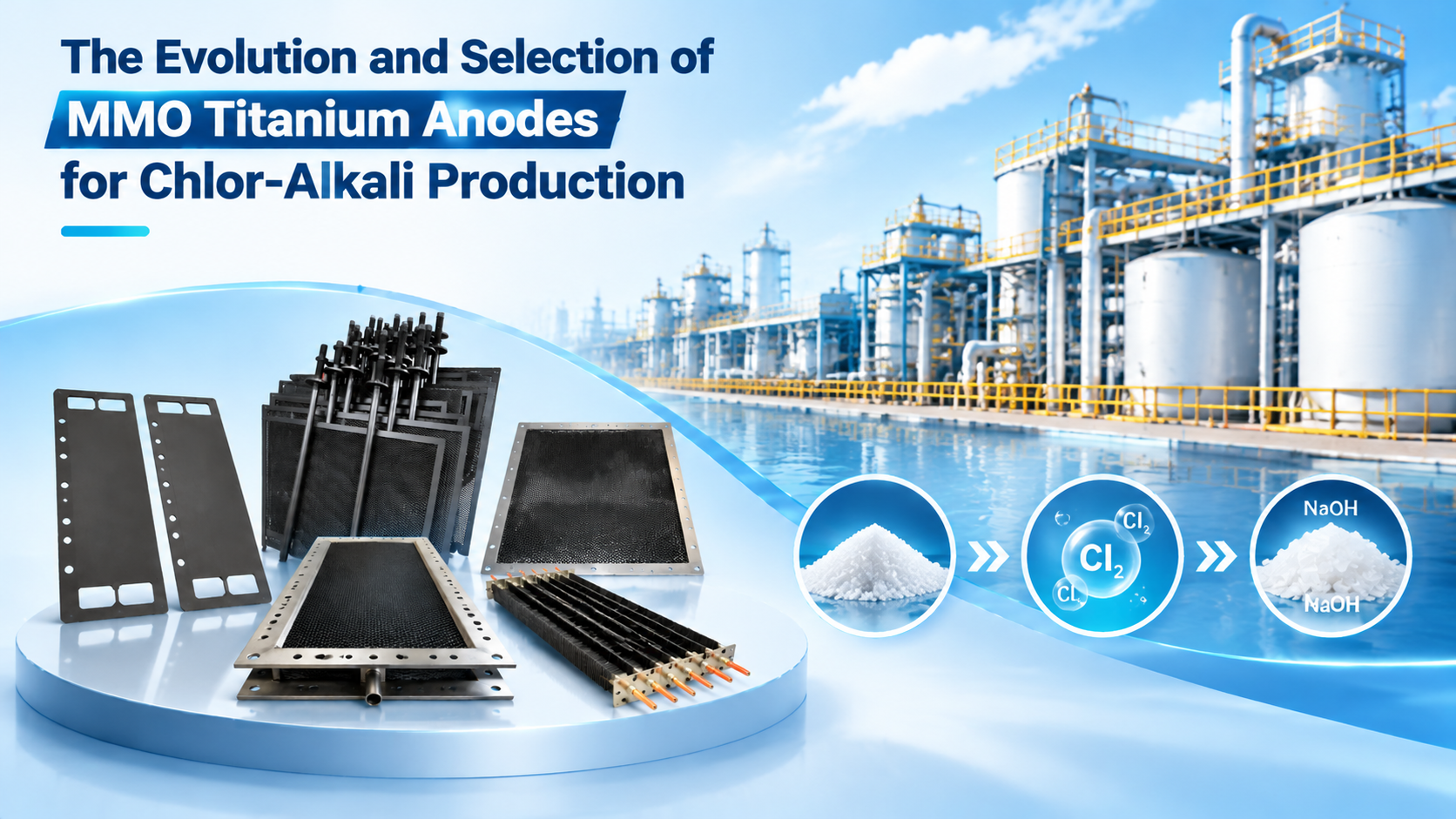
Titanium anodes play a critical role in modern chlor-alkali electrolysis, directly influencing chlorine evolution efficiency, cell voltage, energy consumption, and long-term operational stability. This comprehensive guide explores why MMO titanium anodes, particularly ruthenium-based and Ru-Ir coated titanium anodes, are widely used in industrial chlorine production. It covers the working principles of chlor-alkali electrolysis, the historical development of titanium anode technology, the advantages of precious metal oxide coatings, and the manufacturing processes behind high-performance electrodes. We also examine the factors affecting anode service life, quality inspection and testing methods, and key considerations when selecting a reliable chlor-alkali titanium anode manufacturer. Whether you are an electrolyzer manufacturer, chemical plant engineer, or industrial procurement specialist, this guide will help you understand titanium anode technology and make more informed purchasing decisions.
Introduction
The chlor-alkali industry is one of the fundamental sectors of modern chemical manufacturing. Through the electrolysis of sodium chloride solution (brine), manufacturers produce three essential industrial chemicals: chlorine (Cl₂), sodium hydroxide (NaOH), and hydrogen (H₂). These products are widely used in water treatment, pharmaceuticals, plastics, chemical synthesis, pulp and paper manufacturing, and many other industrial applications.
As one of the most energy-intensive electrochemical processes in the chemical industry, chlor-alkali production places demanding requirements on electrode materials. The anode, in particular, directly participates in the chlorine evolution reaction and has a significant influence on electrochemical efficiency, operating voltage, production stability, and maintenance requirements.
Over the past century, chlor-alkali electrode technology has evolved from traditional graphite anodes to modern dimensionally stable anodes (DSA), primarily based on titanium substrates coated with precious metal oxides.
Among these technologies, ruthenium-based mixed metal oxide (MMO) titanium anodes have become an important electrode solution for industrial chlorine production due to their favorable chlorine evolution activity, dimensional stability, and suitability for continuous electrolysis under properly controlled operating conditions.
But why is titanium preferred over traditional electrode materials? How do Ru-based MMO coatings improve chlorine evolution performance? What manufacturing processes determine the quality and service life of a titanium anode?
This article explores the development, working principles, material advantages, coating technology, quality control requirements, and purchasing considerations of titanium anodes for the chlor-alkali industry.
1. Overview of the Chlor-Alkali Industry: History and Industrial Applications
What Is the Chlor-Alkali Industry?
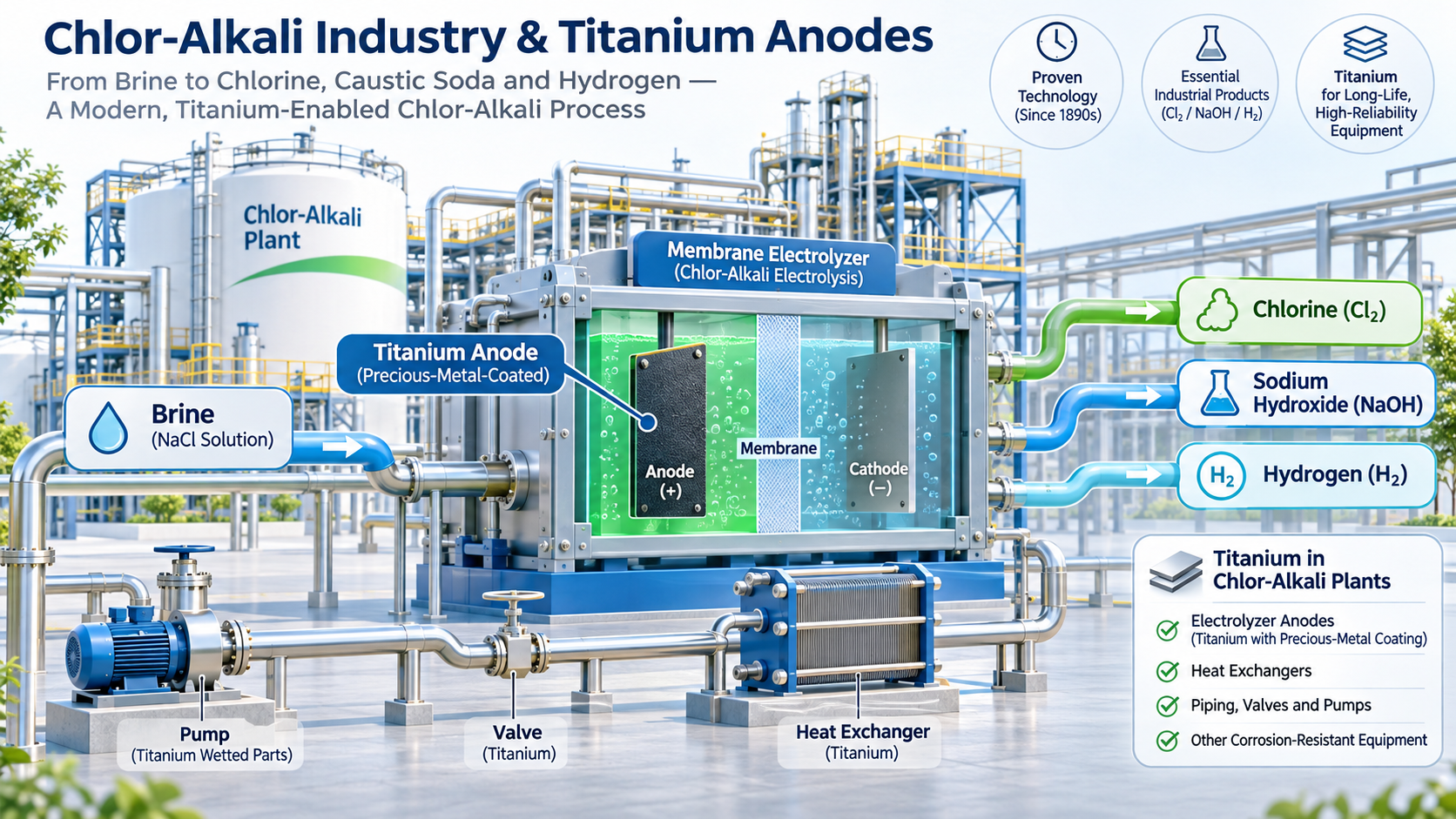
The chlor-alkali industry is a major branch of the chemical manufacturing sector that produces chlorine, caustic soda, and hydrogen through the electrolysis of aqueous sodium chloride solutions.
The term “chlor-alkali” refers to the two principal products of this process: chlorine and an alkali, generally sodium hydroxide.
The industrial production process typically includes several interconnected stages:
- Salt dissolution and brine preparation
- Brine purification and impurity removal
- Electrolysis in industrial electrolyzers
- Chlorine gas collection and purification
- Sodium hydroxide collection and concentration
- Hydrogen collection and treatment
- Brine recovery and circulation
Among these operations, electrolysis is the core chemical conversion process. Electrical energy drives the electrochemical reactions at the anode and cathode, converting sodium chloride and water into valuable chemical products.
Because industrial electrolyzers often operate continuously under chemically aggressive conditions, electrode material selection is critical to production efficiency and operational reliability.
Industrial Applications of Chlor-Alkali Products
The three main products of chlor-alkali electrolysis support a wide range of downstream industries.
1. Chlorine (Cl₂)
Chlorine is an important chemical raw material used in:
- PVC and other chemical intermediate production
- Drinking water and wastewater disinfection
- Pharmaceutical and fine chemical manufacturing
- Industrial bleaching and disinfection
- Inorganic chemical production
- Organic synthesis
2. Sodium Hydroxide (NaOH)
Also known as caustic soda, sodium hydroxide is widely used in:
- Pulp and paper manufacturing
- Textile processing
- Alumina refining
- Soap and detergent production
- Chemical processing
- Industrial cleaning
- Water treatment and pH adjustment
3. Hydrogen (H₂)
Hydrogen is generated as a co-product during electrolysis. After appropriate collection and purification, it can be used as an industrial fuel, a chemical feedstock, or in other industrial processes.
These applications make chlor-alkali production an essential part of the global chemical supply chain.
Historical Development of Chlor-Alkali Production
The chlor-alkali industry has a history extending back more than a century. Early industrial electrolysis systems relied on electrode materials and cell designs that were less durable and less energy-efficient than modern technologies.
Graphite became a widely used anode material during the early development of industrial chlorine production. Its electrical conductivity and relatively accessible manufacturing process made it suitable for large-scale electrolysis.
However, graphite anodes gradually deteriorate under anodic operating conditions. Material consumption changes electrode dimensions and surface characteristics, potentially affecting electrode spacing, electrical resistance, and production stability.
These limitations encouraged researchers and industrial manufacturers to develop more durable electrode materials.
A major breakthrough came with the development of dimensionally stable metal anodes based on titanium substrates and precious metal oxide coatings during the 1950s and 1960s.
The industrial adoption of these electrodes during the late 1960s and 1970s marked a significant technological transformation in chlor-alkali production.
Titanium-based metal anodes gradually replaced traditional graphite electrodes in many applications, supporting improvements in electrode geometry, electrochemical performance, and maintenance management.
Subsequently, the introduction and expansion of ion-exchange membrane electrolysis during the 1970s and 1980s brought further improvements to industrial chlor-alkali technology.
Today, titanium-based MMO anodes remain an important component of modern chlorine-producing electrolyzers.
Why Is Titanium Important in Chlor-Alkali Equipment?
Titanium is one of the most important engineering materials used in selected chlor-alkali equipment because of its combination of corrosion resistance, mechanical properties, relatively low density, and manufacturing flexibility.
Its applications extend beyond electrode substrates.
Depending on the chemical environment and equipment design, titanium may also be used in:
- Metal anode electrolyzer components
- Anolyte circulation systems
- Brine preheaters
- Wet chlorine cooling equipment
- Dechlorination systems
- Chlorine-water circulation equipment
- Heat exchangers
- Corrosion-resistant piping
- Pumps and valves
Titanium forms a protective passive oxide film that contributes to its corrosion resistance in many environments. It can also be processed into plates, meshes, tubes, rods, and customized welded structures.
However, titanium is not universally corrosion-proof. Its suitability depends on temperature, electrolyte composition, pH, potential, and the presence of oxidizing or reducing species.
For coated anodes, the titanium substrate also requires an appropriate conductive catalytic coating because the passive titanium oxide film is relatively electrically resistive under anodic conditions.
This combination of titanium structural support and precious metal oxide catalytic functionality forms the foundation of modern MMO titanium anode technology.
2. How Does Chlor-Alkali Electrolysis Work?
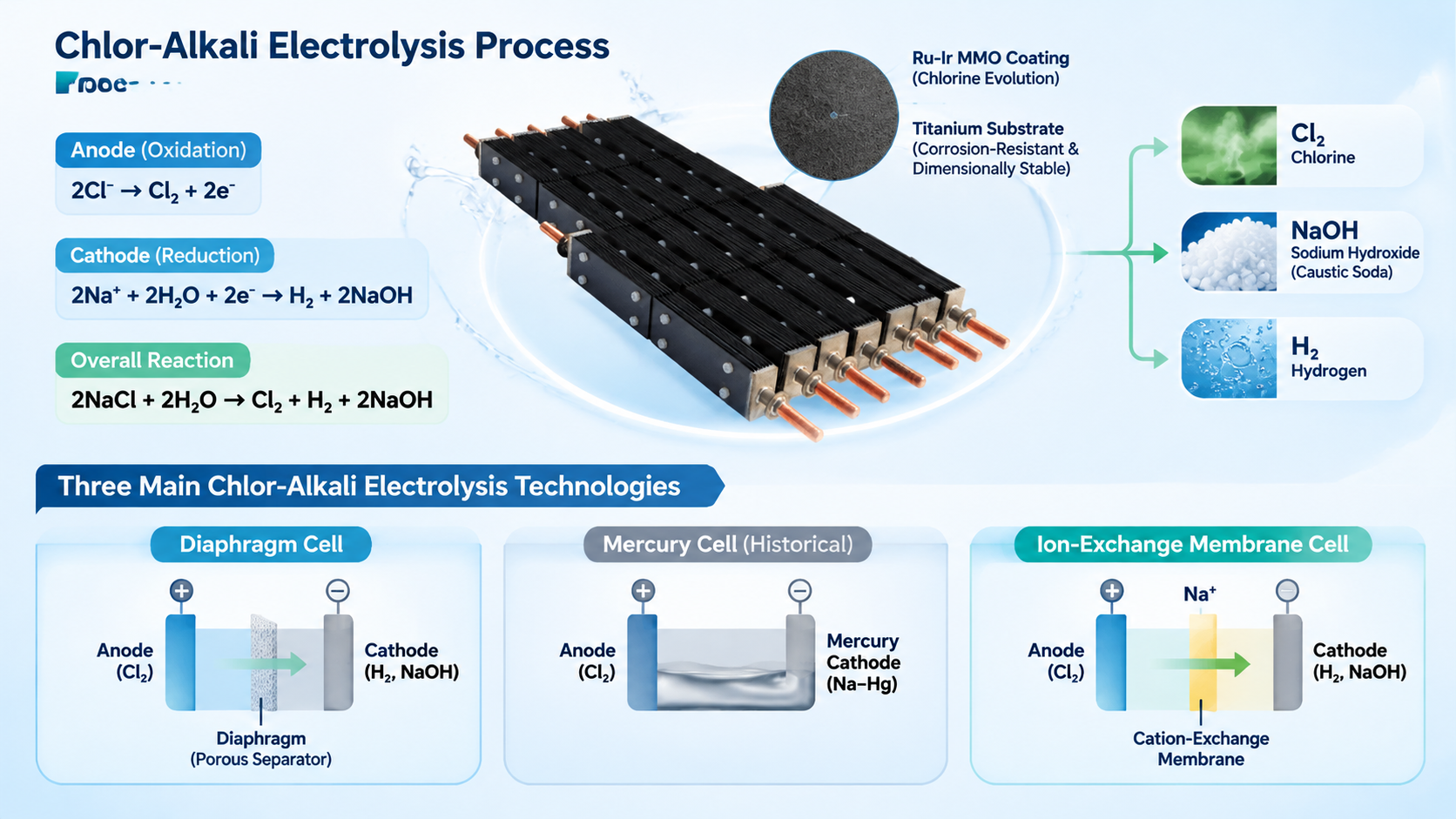
Chlor-alkali electrolysis is an electrochemical process that converts sodium chloride and water into chlorine gas, hydrogen gas, and sodium hydroxide by applying direct electrical current to an electrolytic cell.
A typical electrolyzer contains an anode, a cathode, an electrolyte, electrical connections, and a separation system.
The anode and cathode perform different electrochemical reactions, while the separation system prevents undesirable mixing of their products.
Anode Reaction: Chlorine Evolution
At the positively charged anode, chloride ions lose electrons and are oxidized to chlorine gas.
The principal anode reaction is:
2Cl⁻ → Cl₂ + 2e⁻
This reaction is called the chlorine evolution reaction (CER).
During this process, chloride ions transfer electrons to the anode surface and form chlorine molecules, which subsequently leave the electrode as gas bubbles.
The anode material plays a critical role in facilitating this electrochemical reaction.
A suitable catalytic coating can reduce the additional potential required to achieve chlorine evolution at a specified current density.
This additional potential is known as the chlorine evolution overpotential.
A lower chlorine evolution overpotential is desirable because it can reduce the anodic contribution to the total electrolyzer operating voltage.
However, total cell voltage also depends on cathode performance, electrolyte resistance, membrane or diaphragm resistance, electrode spacing, gas bubble behavior, and other polarization losses.
Therefore, anode catalytic performance must be evaluated as part of the complete electrochemical system.
Cathode Reaction: Hydrogen and Sodium Hydroxide Production
At the negatively charged cathode, water molecules receive electrons and undergo reduction.
The cathode half-reaction is:
2H₂O + 2e⁻ → H₂ + 2OH⁻
Hydrogen gas is generated and released from the cathode surface, while hydroxide ions remain in the electrolyte.
Sodium ions transported from the brine combine with hydroxide ions to form sodium hydroxide in solution.
The corresponding cathode reaction, including sodium ions, can be expressed as:
2Na⁺ + 2H₂O + 2e⁻ → H₂ + 2NaOH
This reaction represents the formation of hydrogen and caustic soda in the cathode compartment.
Overall Electrochemical Reaction
Combining the anode and cathode reactions gives the overall chlor-alkali reaction:
2NaCl + 2H₂O → Cl₂ + H₂ + 2NaOH
This equation demonstrates how sodium chloride and water are converted into three valuable industrial chemicals through electrical energy.
In practical production, the electrochemical reactions must be accompanied by effective separation of chlorine from the cathodic products.
Without sufficient separation, chlorine can react with hydroxide ions and other species, potentially forming hypochlorite, chlorate, and other unwanted products.
These side reactions can reduce current efficiency, affect product purity, and create additional process-control challenges.
Three Main Electrolysis Technologies: Diaphragm, Mercury, and Membrane Cells
Throughout the history of chlor-alkali production, three principal electrolysis technologies have been developed: diaphragm cells, mercury cells, and ion-exchange membrane cells.
Although all three technologies produce chlorine and sodium hydroxide, they use different methods to separate the anodic and cathodic products.
1. Diaphragm Cell Electrolysis
<image-placeholder>Diaphragm chlor-alkali electrolyzer schematic</image-placeholder>
The diaphragm process uses a porous separator between the anode and cathode compartments.
Purified brine enters the anode compartment, where chloride ions are oxidized to chlorine gas. The electrolyte passes through the porous diaphragm toward the cathode compartment.
At the cathode, water is reduced to hydrogen and hydroxide ions.
The diaphragm limits the mixing of the anodic and cathodic products, although it does not provide the same selective ion transport as a modern cation-exchange membrane.
Consequently, the resulting sodium hydroxide solution generally contains residual sodium chloride and requires additional processing when higher purity or concentration is needed.
Historically, diaphragm electrolyzers were an important application for the transition from graphite electrodes to metal anodes.
MMO-coated titanium anodes offer improved dimensional stability compared with consumable graphite electrodes and are widely used in suitable diaphragm cell configurations.
2. Mercury Cell Electrolysis
The mercury cell process uses liquid mercury as the cathode.
During electrolysis, chlorine is generated at the anode, while sodium forms an amalgam with mercury at the cathode.
The sodium amalgam is subsequently reacted with water in a separate decomposition unit to produce sodium hydroxide and hydrogen.
This process historically provided advantages in caustic soda concentration and product purity.
However, mercury presents significant environmental and occupational health concerns.
As environmental requirements have become increasingly stringent, mercury-based chlor-alkali production has been progressively replaced by mercury-free technologies.
Although mercury cells played an important role in the historical development of metal oxide-coated titanium anodes, membrane technology is generally the preferred direction for many modern chlor-alkali projects.
3. Ion-Exchange Membrane Cell Electrolysis
<image-placeholder>Ion-exchange membrane chlor-alkali electrolysis schematic</image-placeholder>
Membrane electrolysis is an important technology in modern chlor-alkali manufacturing.
It uses a selective cation-exchange membrane to separate the anode and cathode compartments.
The membrane primarily allows sodium ions to migrate from the anode compartment toward the cathode compartment while restricting the transport of chloride ions and hydroxide ions.
At the anode, chloride ions are oxidized to chlorine gas.
At the cathode, water is reduced to hydrogen and hydroxide ions. Sodium ions passing through the membrane combine with hydroxide ions to form sodium hydroxide.
Because the membrane limits unwanted ion transport, the process can produce caustic soda with relatively low salt contamination.
Membrane electrolysis also avoids the use of mercury and can provide favorable energy performance when the electrolyzer is properly designed and operated.
However, membrane systems require strict control of brine purity, membrane condition, electrode spacing, and operating conditions.
Why Titanium Anodes Matter in Membrane Cells
In membrane electrolyzers, the titanium anode operates directly in the chlorine-generating environment.
Its coating composition and surface characteristics influence chlorine evolution kinetics, electrode potential, gas bubble behavior, and long-term electrochemical stability.
The anode must also be compatible with the mechanical arrangement and operating requirements of the membrane cell.
For procurement teams, this means that electrode specifications should include more than the titanium grade and external dimensions. Coating composition, active material loading, electrical connections, dimensional tolerances, and testing requirements are also important.
3. The Evolution of Titanium Anodes in Chlor-Alkali Production
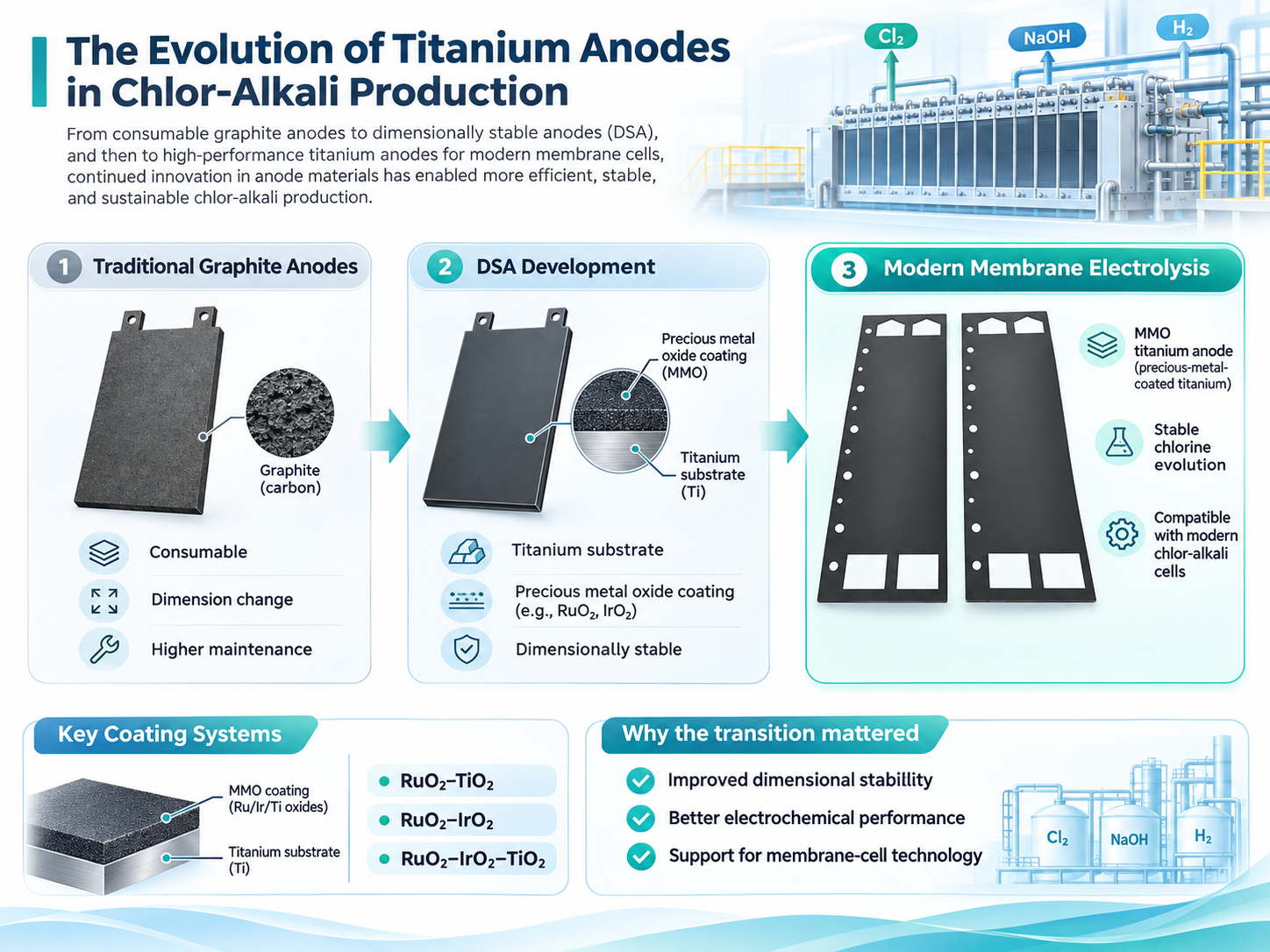
The development of titanium anodes represents one of the major technological advances in industrial chlor-alkali electrolysis.
The transition from consumable graphite electrodes to precious metal oxide-coated titanium anodes improved electrode dimensional stability and provided opportunities to optimize chlorine evolution performance.
Traditional Graphite Anodes and Their Limitations
Before the widespread adoption of metal oxide-coated titanium anodes, graphite was a commonly used electrode material in chlorine production.
Graphite provides electrical conductivity and can be manufactured into relatively large electrode structures.
However, graphite is gradually consumed or degraded during anodic operation.
This creates several limitations for industrial electrolyzers.
1. Progressive Electrode Consumption
Graphite gradually loses material during electrolysis, changing its dimensions and surface characteristics.
2. Changes in Electrode Spacing
As graphite is consumed, the effective distance between the anode and cathode may increase if electrode positions remain fixed.
A larger electrode gap can contribute to higher electrolyte resistance and increased operating voltage.
3. Maintenance Requirements
The progressive deterioration of graphite electrodes requires periodic inspection, adjustment, and replacement.
These operations may involve additional labor and production interruptions.
4. Potential Material Contamination
Graphite degradation can introduce particles into the electrolyte, creating additional concerns for process cleanliness and equipment maintenance.
These limitations encouraged the development of metal-based electrodes that could maintain their structural geometry more effectively during continuous electrolysis.
The Development of Dimensionally Stable Anodes (DSA)
Research into metal-supported electrodes advanced significantly during the middle of the twentieth century.
A major breakthrough involved the application of catalytically active precious metal oxides to titanium substrates.
In 1956, Dutch researcher H. Beer proposed the use of metal anodes for industrial electrolysis. Subsequent research and patent developments established important methods for manufacturing titanium-supported oxide electrodes.
By 1965, important patent developments had helped establish the technical foundation of dimensionally stable anodes.
In 1968, industrial commercialization of titanium-based metal anodes began in the chlor-alkali sector.
During the following years, metal oxide-coated titanium anodes were increasingly adopted in industrial chlorine production, replacing graphite electrodes in many installations.
The basic structure of a DSA consists of:
- A titanium substrate that provides mechanical support
- A specially prepared substrate surface
- A catalytically active precious metal oxide coating
Unlike graphite, the titanium substrate is not intended to be consumed during normal electrochemical operation.
The catalytic coating provides the active surface required for chlorine evolution.
This separation of structural and catalytic functions became a defining characteristic of modern industrial anode technology.
The Introduction of Titanium-Based Metal Oxide Coatings
Ruthenium oxide-based coatings were particularly important in the development of chlorine-evolving anodes.
Ruthenium dioxide (RuO₂) exhibits favorable electrocatalytic activity for the chlorine evolution reaction.
When combined with suitable additional metal oxides and applied to a properly prepared titanium substrate, ruthenium-based coatings can provide useful combinations of catalytic activity and coating stability.
Common coating systems include:
- RuO₂–TiO₂
- RuO₂–IrO₂
- RuO₂–IrO₂–TiO₂
- Other application-specific mixed metal oxide systems
The exact formulation depends on the desired electrochemical properties and operating environment.
The coating is generally formed through controlled precursor application and thermal treatment.
Its composition, distribution, loading, and microstructure all influence the final electrode performance.
The Transition Toward Modern Membrane Electrolysis
The second half of the twentieth century saw major improvements in chlor-alkali technology.
During the 1970s, metal anodes became increasingly established in diaphragm and other chlorine-producing electrolyzers.
In China, industrial trials and the adoption of metal anodes began during the early 1970s, followed by broader implementation and technical upgrading.
During the mid-1980s and subsequent years, ion-exchange membrane technology was increasingly introduced into industrial chlor-alkali production.
This represented another major transformation in the industry.
Membrane electrolyzers offered a mercury-free production route and favorable opportunities for improving energy efficiency and caustic soda quality.
As membrane technology developed, electrode design also became more closely integrated with membrane properties, current distribution, gas release, and mechanical cell configuration.
Today, titanium-based MMO anodes remain an important technology in industrial chlorine evolution.
Their development demonstrates how improvements in electrode materials can influence the design, efficiency, and reliability of an entire electrochemical production system.
4. Why Choose Ruthenium-Based MMO Titanium Anodes for Chlor-Alkali Electrolysis?
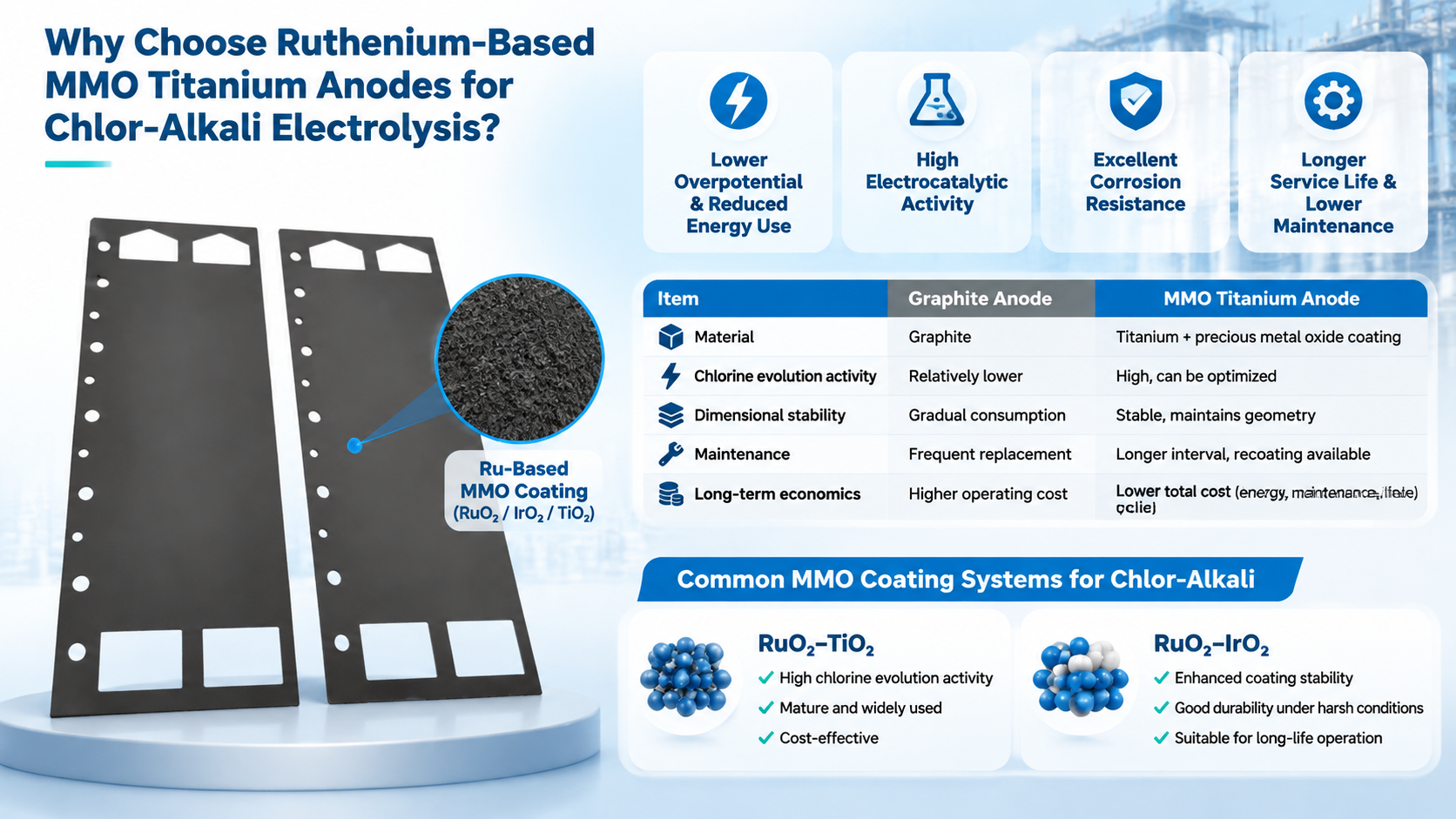
Ruthenium-based mixed metal oxide coatings are widely studied and used in chlorine-evolving electrochemical systems because of their favorable catalytic properties.
For industrial chlor-alkali production, the most important requirements include low chlorine evolution overpotential, stable electrochemical activity, suitable corrosion resistance, and reliable performance during continuous operation.
Low Chlorine Evolution Overpotential
The chlorine evolution reaction requires an appropriate catalytic surface to proceed efficiently at industrial current densities.
Ruthenium dioxide is an important electrocatalytic component because it can exhibit relatively low chlorine evolution overpotential.
In practical terms, a properly designed ruthenium-based coating may enable the desired chlorine generation rate at a lower anode potential than a less active electrode surface under comparable conditions.
This is particularly important because electrical energy consumption is a major operating consideration in chlor-alkali manufacturing.
The operating voltage of an electrolyzer can be represented conceptually as:
Cell Voltage = Reversible Voltage + Anode Overpotential + Cathode Overpotential + Ohmic Losses + Other Polarization Losses
The anode coating principally influences the anodic polarization component.
When an improved coating reduces anode overpotential under otherwise comparable conditions, it may contribute to a reduction in total cell voltage.
However, actual energy consumption also depends on cathode performance, membrane or diaphragm resistance, electrolyte conductivity, electrode spacing, current efficiency, and other process factors.
Therefore, the energy-saving potential of a titanium anode should be evaluated through application-specific electrochemical testing and actual operating data.
High Electrocatalytic Activity
The catalytic activity of ruthenium oxide makes it particularly relevant to chlorine evolution.
An effective MMO coating provides electrochemically accessible active sites that facilitate electron transfer during the oxidation of chloride ions.
The number, distribution, and behavior of these active sites depend on several factors:
- Ruthenium oxide content
- Additional metal oxide components
- Coating microstructure
- Surface morphology
- Thermal treatment
- Coating uniformity
- Operating conditions
A properly engineered coating should provide the required catalytic activity without compromising the stability needed for long-term industrial operation.
For buyers, this means that coating performance should be evaluated according to its intended electrochemical application rather than precious metal content alone.
Corrosion Resistance and Dimensional Stability
Chlor-alkali anodes operate under strongly oxidizing electrochemical conditions in chloride-containing electrolytes.
The combination of a suitable titanium substrate and a properly designed MMO coating provides a corrosion-resistant electrode system for specified operating conditions.
The titanium substrate supplies mechanical support, while the active coating facilitates chlorine evolution.
Unlike graphite, the titanium substrate is designed to retain its basic geometry during the qualified service period.
This dimensional stability is particularly important in electrolyzers where electrode spacing affects electrical resistance, current distribution, and operating efficiency.
However, no MMO coating should be considered completely immune to degradation.
Ruthenium-based oxides can undergo gradual changes or dissolution under certain electrochemical conditions.
If the coating loses continuity, electrolyte penetration and interfacial oxidation may contribute to substrate passivation.
Long-term performance therefore depends on coating design, manufacturing quality, and operating conditions.
Longer Maintenance Intervals and Operational Reliability
MMO-coated titanium anodes are designed for industrial electrochemical operation over a specified service period.
When the coating and operating conditions are appropriately matched, these electrodes can reduce the maintenance requirements associated with progressive graphite consumption.
Potential operational benefits include:
- More stable electrode geometry
- Reduced frequency of electrode replacement
- Lower electrode-related maintenance requirements
- More predictable maintenance planning
- Opportunities for titanium substrate refurbishment
- Reduced handling associated with consumable electrode replacement
The actual maintenance interval depends on coating composition, current density, electrolyte chemistry, temperature, operating continuity, and other factors.
Buyers should request service-life information based on comparable operating conditions rather than rely on universal lifetime claims.
Comparison Between MMO Titanium Anodes and Traditional Graphite Anodes
The transition from graphite to dimensionally stable metal anodes was an important development in chlor-alkali technology.
The following table compares their general material and operational characteristics.
| Evaluation Factor | Graphite Anode | MMO Titanium Anode |
|---|---|---|
| Structural material | Graphite | Titanium |
| Active surface | Graphite surface | Catalytic metal oxide coating |
| Chlorine evolution activity | Depends on graphite characteristics and conditions | Can be optimized through coating composition |
| Dimensional stability | Gradual material consumption | Designed to retain substrate geometry |
| Electrode wear | Graphite consumption and degradation | Progressive coating degradation |
| Electrode spacing | May change as graphite is consumed | More stable when properly installed |
| Maintenance | Periodic replacement associated with consumption | Inspection, monitoring, recoating, or replacement |
| Material contamination | Graphite particles may be generated | Different degradation mechanisms; coating integrity remains important |
| Initial cost | Depends on electrode design | Includes titanium substrate and precious metal coating |
| Long-term economics | Influenced by replacement and energy costs | Influenced by coating life, voltage, maintenance, and refurbishment |
This comparison describes general material characteristics rather than guaranteed performance differences.
RuO₂–TiO₂ vs. RuO₂–IrO₂ Coating Systems
Ruthenium-based MMO coatings are not a single standardized material.
Different oxide systems may be developed to achieve different combinations of catalytic activity, coating stability, and manufacturing performance.
RuO₂–TiO₂ Coatings
RuO₂–TiO₂ is an established mixed metal oxide system associated with chlorine evolution.
Ruthenium oxide provides important electrocatalytic functionality, while titanium oxide influences the mixed-oxide structure and material characteristics.
The final electrochemical behavior depends on the oxide composition, crystalline structure, coating morphology, loading, and thermal treatment.
RuO₂–IrO₂ Coatings
Iridium oxide may be incorporated into ruthenium-based coatings to modify their electrochemical behavior and durability.
Depending on the composition and operating conditions, iridium oxide may influence coating stability and degradation behavior.
However, adding more iridium does not automatically guarantee lower chlorine evolution overpotential or longer service life.
The effect must be evaluated experimentally under relevant operating conditions.
Which Coating Is Better?
There is no universally superior formulation.
The appropriate coating should be selected according to:
- Electrolyzer type
- Intended electrochemical reaction
- Current density
- Electrolyte composition
- Operating temperature
- Required service life
- Economic considerations
For chlorine production, the key objective is to achieve an appropriate balance between catalytic activity, coating stability, and total operating cost.
5. Titanium Anode Manufacturing: From Substrate Preparation to MMO Coating
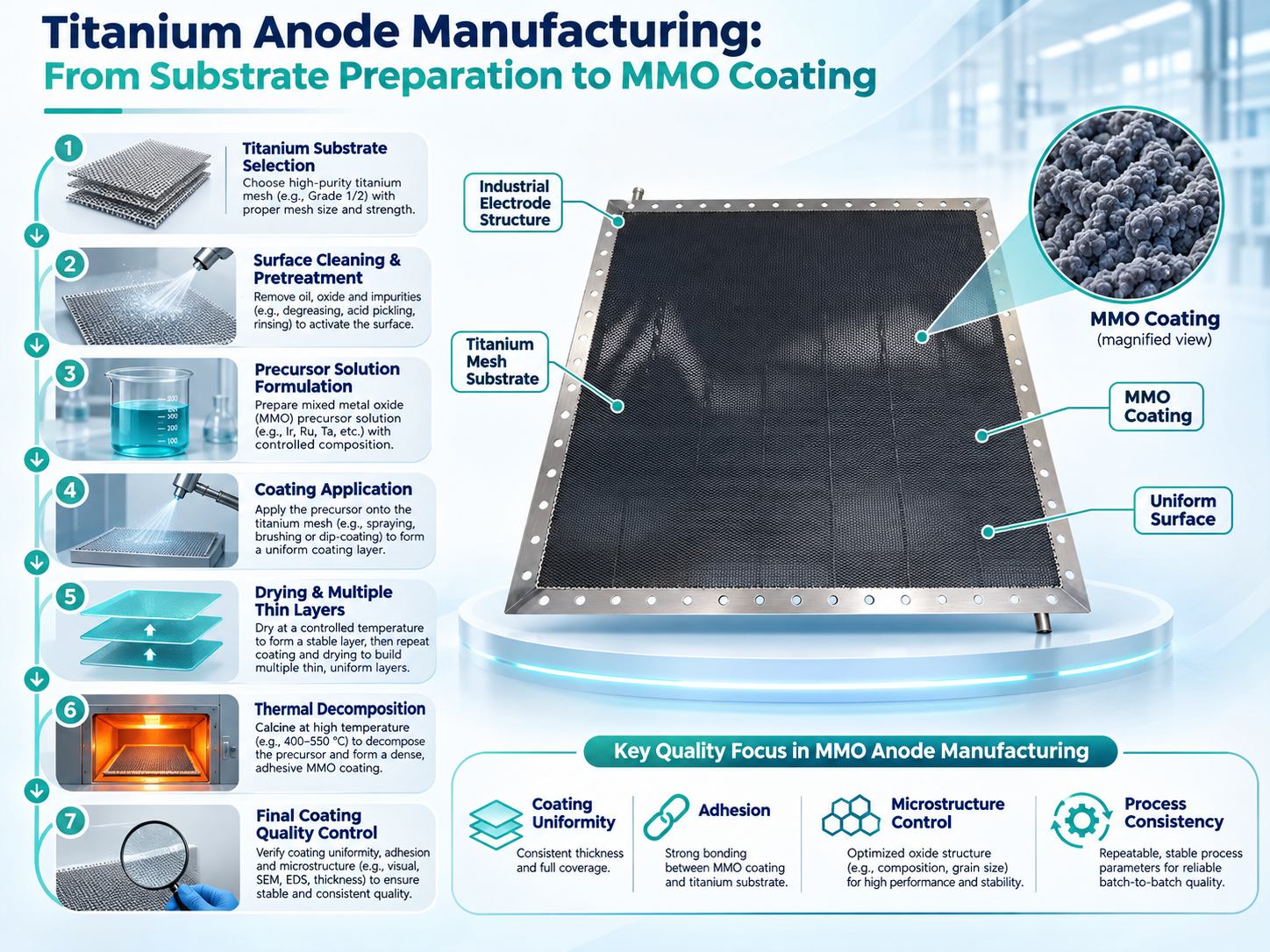
The performance and durability of an MMO titanium anode depend not only on its chemical formulation but also on the entire manufacturing process.
Substrate preparation, electrode fabrication, precursor solution control, coating application, drying, thermal processing, and final inspection all influence the finished product.
A coating formulation with favorable theoretical properties may still perform poorly if the manufacturing process is inconsistent.
For this reason, controlling the coating process is one of the most important aspects of industrial titanium anode production.
Titanium Substrate Selection and Fabrication
The titanium substrate provides the structural foundation of an MMO anode.
It must have suitable mechanical properties, dimensional accuracy, and surface characteristics for the intended application.
Commercially pure titanium grades are commonly considered for coated industrial anodes, depending on the electrode design and operating requirements.
Important substrate characteristics include:
- Titanium material grade
- Chemical composition
- Thickness
- Dimensional tolerance
- Surface condition
- Flatness
- Mechanical strength
- Weld quality
- Compatibility with the coating process
Depending on the electrolyzer structure, the substrate may be manufactured into different configurations.
Common forms include:
- Titanium plates
- Titanium meshes
- Expanded titanium meshes
- Titanium rods
- Titanium tubes
- Customized welded electrode assemblies
Mesh and expanded-metal structures can provide open areas for electrolyte circulation and gas release.
However, the most suitable geometry depends on the electrolyzer’s mechanical design, current distribution, and gas-removal requirements.
For replacement electrodes, the original technical drawing should be reviewed carefully to confirm dimensions, mounting positions, electrical connections, and critical tolerances.
Surface Cleaning and Pretreatment
Before coating, the titanium substrate must be adequately prepared.
Residual oil, grease, machining contaminants, and unsuitable surface oxides may interfere with coating formation and adhesion.
Depending on the manufacturing process, pretreatment may include:
- Degreasing
- Mechanical cleaning
- Surface roughening
- Chemical treatment
- Rinsing
- Controlled drying
- Surface inspection
The objective is to create a reproducible surface condition suitable for the selected coating system.
Surface roughness is particularly important because it influences precursor solution spreading and the interaction between the coating and titanium substrate.
An appropriately prepared surface can help improve coating adhesion.
However, excessive roughness is not automatically beneficial.
If the surface is too irregular, local variations in wet-film thickness may occur, potentially affecting coating uniformity.
The pretreatment process should therefore balance adhesion requirements with the need for consistent coating distribution.
Ruthenium-Based Precursor Solution Formulation
The coating process generally begins with a precursor solution containing selected metal compounds.
Depending on the target coating composition, these compounds may include ruthenium precursors and other suitable metal precursors.
The exact formulation depends on the intended oxide system, solvent chemistry, application method, and thermal treatment process.
Several parameters require careful control.
1. Precursor Concentration
Concentration influences the amount of active material deposited during each coating cycle.
A solution that is too dilute may require additional application cycles, while an excessively concentrated solution may make uniform coating more difficult.
2. Solution Viscosity
Viscosity affects liquid spreading, drainage, and wet-film formation.
Poorly controlled viscosity may contribute to local thickness variations.
3. Solvent Volatility
Solvent evaporation behavior influences wet-film stability and drying characteristics.
Rapid or uneven evaporation may affect precursor distribution.
4. Solution Homogeneity
A homogeneous precursor solution supports consistent distribution of the coating components.
Precipitation, contamination, or unstable solution chemistry may introduce coating defects.
5. Chemical Compatibility
The formulation must be compatible with the titanium substrate, application equipment, and subsequent thermal processing conditions.
These parameters should be controlled as part of a qualified manufacturing process rather than adjusted independently.
Coating Application Methods: Brush, Dip, and Spray Coating
Different coating application methods may be used according to electrode geometry, production volume, and coating requirements.
Brush Coating
Brush coating allows controlled application of precursor solution to selected surfaces.
It can be suitable for customized electrode structures and certain small-batch manufacturing requirements.
However, coating uniformity depends on application technique, solution loading, surface condition, and operator consistency.
Dip Coating
Dip coating involves immersing the titanium substrate in the precursor solution and withdrawing it under controlled conditions.
It may be suitable for selected electrode geometries.
Important factors include immersion time, withdrawal speed, solution viscosity, drainage behavior, and electrode orientation.
If excessive solution accumulates in certain areas, local coating thickness variations may occur.
Spray Coating
Spray coating provides flexibility in controlling solution deposition over suitable electrode surfaces.
Its performance depends on spray pattern, droplet distribution, deposition rate, solution properties, and process conditions.
No single application method is universally superior.
The appropriate process should be selected according to the electrode geometry, required coating distribution, manufacturing equipment, and validated production parameters.
Multiple Thin Coating Layers and Drying Control
Wet-film uniformity is important for obtaining consistent coating properties.
If too much precursor solution accumulates locally, the drying process may produce:
- Runs or sagging
- Uneven coating thickness
- Local precursor accumulation
- Excessive shrinkage
- Increased risk of coating defects
If insufficient solution is deposited, certain regions may receive inadequate active material.
This may result in discontinuous coverage or variations in catalytic activity.
For this reason, applying multiple relatively thin coating layers is an approach commonly evaluated in MMO titanium anode manufacturing.
A typical production cycle may involve:
- Applying a controlled amount of precursor solution.
- Drying the deposited wet film.
- Performing the required intermediate thermal treatment.
- Repeating the coating cycle as necessary.
- Completing the specified final thermal treatment.
This approach can help control the amount of material deposited during each application cycle and provide opportunities to improve coating distribution.
However, the number of coating cycles is not a universal indicator of quality.
More layers do not automatically mean better electrochemical performance.
The appropriate number of cycles depends on the precursor formulation, required loading, electrode geometry, and qualified thermal processing conditions.
Drying also requires attention to temperature uniformity, duration, airflow, electrode orientation, and solvent evaporation behavior.
The objective is to obtain a stable precursor layer before subsequent thermal processing.
Thermal Decomposition and Oxide Formation
Thermal treatment converts the precursor compounds into the intended metal oxide coating.
This is a critical stage because it influences coating composition, crystalline structure, electrical behavior, adhesion, and durability.
Important parameters include:
- Heating temperature
- Heating duration
- Heating and cooling profiles
- Furnace atmosphere
- Temperature uniformity
- Number of thermal cycles
- Electrode geometry
Insufficient thermal treatment may leave incompletely converted precursor compounds.
Excessive thermal treatment may promote unfavorable structural changes, increased thermal stress, or interfacial oxidation.
The appropriate temperature and treatment duration depend on the specific precursor system and target coating composition.
A single universal thermal treatment parameter should not be assumed suitable for all ruthenium-based MMO coatings.
Coating Uniformity, Adhesion, and Microstructure Control
After thermal processing, the coating must provide appropriate coverage, adhesion, and electrochemical functionality.
Thermally formed metal oxide coatings may develop microscopic pores and cracks due to precursor decomposition, shrinkage, and thermal stress.
The presence of microscopic surface features does not automatically indicate a defective electrode.
The important consideration is whether the coating structure meets the qualified specification and whether its integrity is sufficient for the intended electrochemical environment.
Deep defects extending toward the titanium substrate may provide pathways for electrolyte penetration.
This can increase the risk of interfacial degradation and titanium passivation.
Manufacturing quality control should therefore focus on reproducible coating structure, acceptable surface conditions, adhesion, and electrochemical performance.
The objective is not simply to produce a visually smooth surface, but to manufacture a coating that performs consistently under its intended operating conditions.
6. Factors Affecting MMO Titanium Anode Performance and Service Life
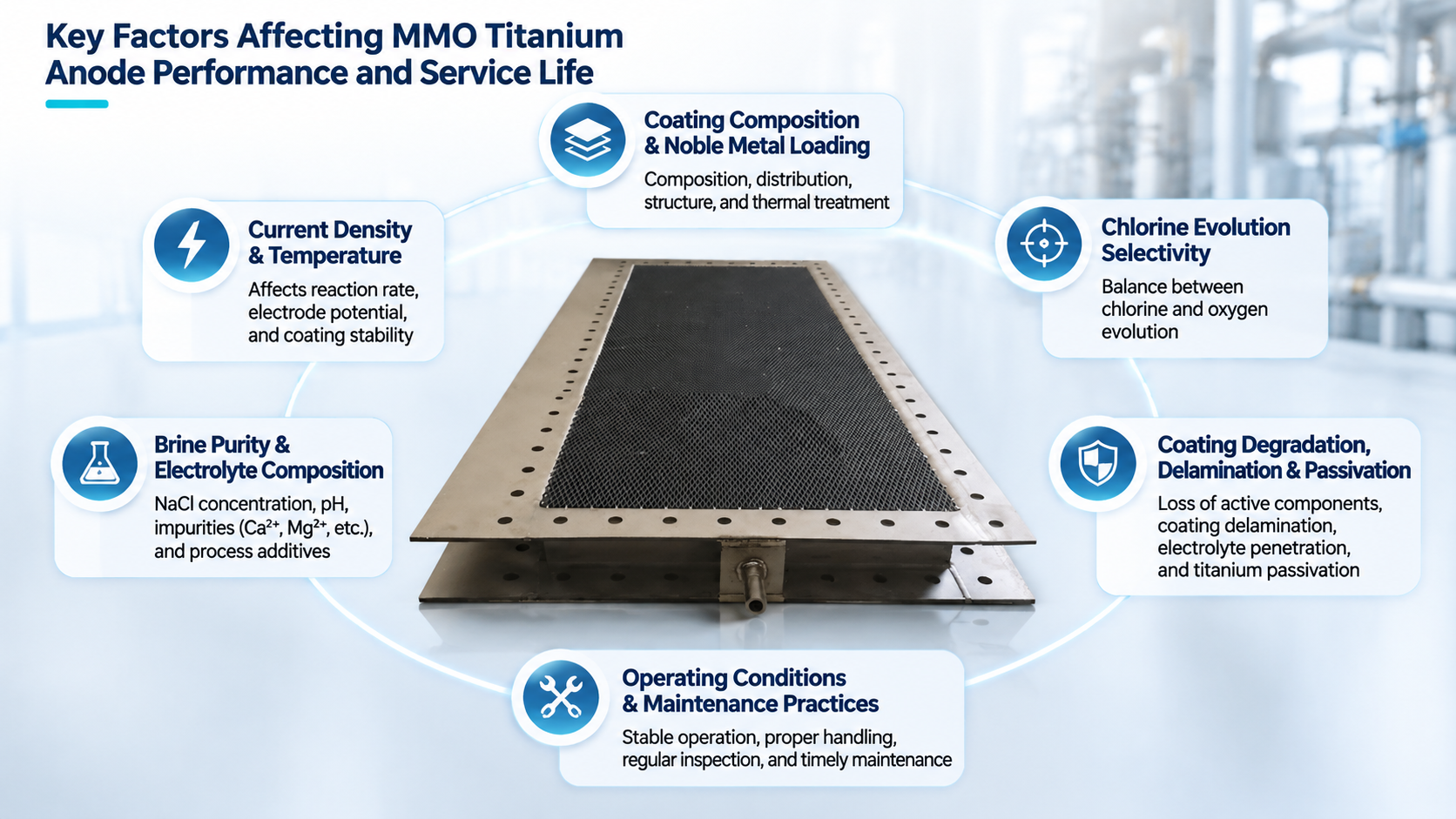
The service life of an MMO titanium anode cannot be determined by coating composition or precious metal loading alone.
Even electrodes with similar specifications may demonstrate different performance when used under different electrochemical conditions.
The main factors include current density, electrolyte composition, brine purity, temperature, coating structure, and operating continuity.
Coating Composition and Precious Metal Loading
The composition of an MMO coating determines its catalytic and material characteristics.
Ruthenium oxide is an important active component for chlorine evolution, while additional oxides may influence the coating’s structural and electrochemical properties.
Precious metal loading is an important manufacturing parameter, but higher loading does not automatically guarantee better performance.
A coating with higher nominal loading may contain more catalytic material without providing a proportional improvement in electrochemical activity or service life.
Other factors are equally important:
- Distribution of active components
- Coating uniformity
- Surface morphology
- Interfacial bonding
- Thermal treatment
- Electrical connectivity
- Resistance to electrochemical degradation
For buyers, the objective should be to select a coating that meets the required performance and durability criteria rather than simply requesting the highest possible precious metal loading.
Current Density and Operating Temperature
Current density describes the electrical current applied per unit of relevant electrode area.
It is commonly expressed in A/m² or kA/m².
Higher current density increases the electrochemical reaction rate but can also influence electrode potential, gas evolution, local temperature, and coating degradation.
An electrode designed for one current-density range should not automatically be considered suitable for a significantly different operating range.
Temperature also affects reaction kinetics, electrolyte conductivity, gas behavior, and material stability.
An increase in temperature may improve certain electrochemical characteristics while accelerating some degradation mechanisms.
The appropriate operating range must therefore be considered when selecting an MMO coating.
Brine Purity and Electrolyte Composition
Electrolyte composition is one of the most important factors affecting chlor-alkali electrode performance.
Relevant parameters include:
- Sodium chloride concentration
- pH
- Operating temperature
- Dissolved impurities
- Oxidizing species
- Process additives
- Changes in electrolyte composition
Brine purification is particularly important in membrane electrolysis.
Calcium, magnesium, and other impurities can negatively affect membrane condition and electrolyzer operation.
Depending on their nature and concentration, impurities may contribute to deposits, unwanted reactions, and changes in electrochemical behavior.
Poor brine quality may also complicate the diagnosis of electrode performance.
For example, an increase in cell voltage may result from membrane contamination or increased electrolyte resistance rather than anode coating deterioration alone.
Chlorine Evolution Selectivity
Chlorine evolution is the desired anodic reaction in chlor-alkali production.
However, oxygen evolution may also occur under certain conditions.
The balance between chlorine and oxygen evolution depends on electrode composition, electrolyte chemistry, chloride availability, pH, and anode potential.
Coating composition can influence the catalytic activity and selectivity of the electrode.
Therefore, high chlorine evolution activity alone does not prove that a coating will provide the required chlorine selectivity under every operating condition.
Application-specific electrochemical evaluation is important when chlorine purity and current efficiency are critical requirements.
Coating Degradation, Delamination, and Titanium Passivation
Several degradation mechanisms may affect the long-term performance of MMO titanium anodes.
1. Loss of Active Components
Under anodic conditions, coating components may gradually dissolve or undergo chemical changes.
The loss or alteration of active material can reduce catalytic activity and increase the potential required to maintain the same current density.
2. Coating Delamination
Delamination occurs when the coating separates from the titanium substrate or from underlying coating layers.
Potential contributing factors include inadequate surface preparation, contamination, excessive internal stress, unsuitable thermal treatment, and mechanical damage.
3. Electrolyte Penetration
Defects in the coating may allow electrolyte to reach the underlying substrate.
This can contribute to interfacial degradation and local substrate passivation.
4. Titanium Passivation
Titanium naturally forms a passive oxide film.
If the active coating loses continuity, an electrically resistive titanium oxide layer may develop in important regions.
This can increase interfacial resistance and reduce electrode performance.
5. Mechanical Damage
Scratches, impacts, improper handling, and installation errors may damage the coating and expose the substrate.
These failure mechanisms demonstrate why coating formulation and manufacturing quality must be considered together.
Operating Conditions and Maintenance Practices
Even a properly manufactured anode may experience accelerated degradation under unfavorable operating conditions.
Potential risk factors include:
- Excessive current density
- Inadequate electrolyte circulation
- Brine starvation
- Abnormal electrolyte composition
- Uncontrolled temperature
- Unexpected voltage fluctuations
- Reverse current conditions
- Improper shutdown procedures
Continuous operation and frequent start-stop operation may also impose different demands on electrode durability.
Routine monitoring of cell voltage, operating current, electrolyte condition, and electrode appearance can help identify abnormal performance at an early stage.
When an increase in cell voltage occurs, plant operators should evaluate the complete electrolyzer system before concluding that the anode coating has failed.
7. Titanium Anode Quality Inspection, Testing, and Recoating
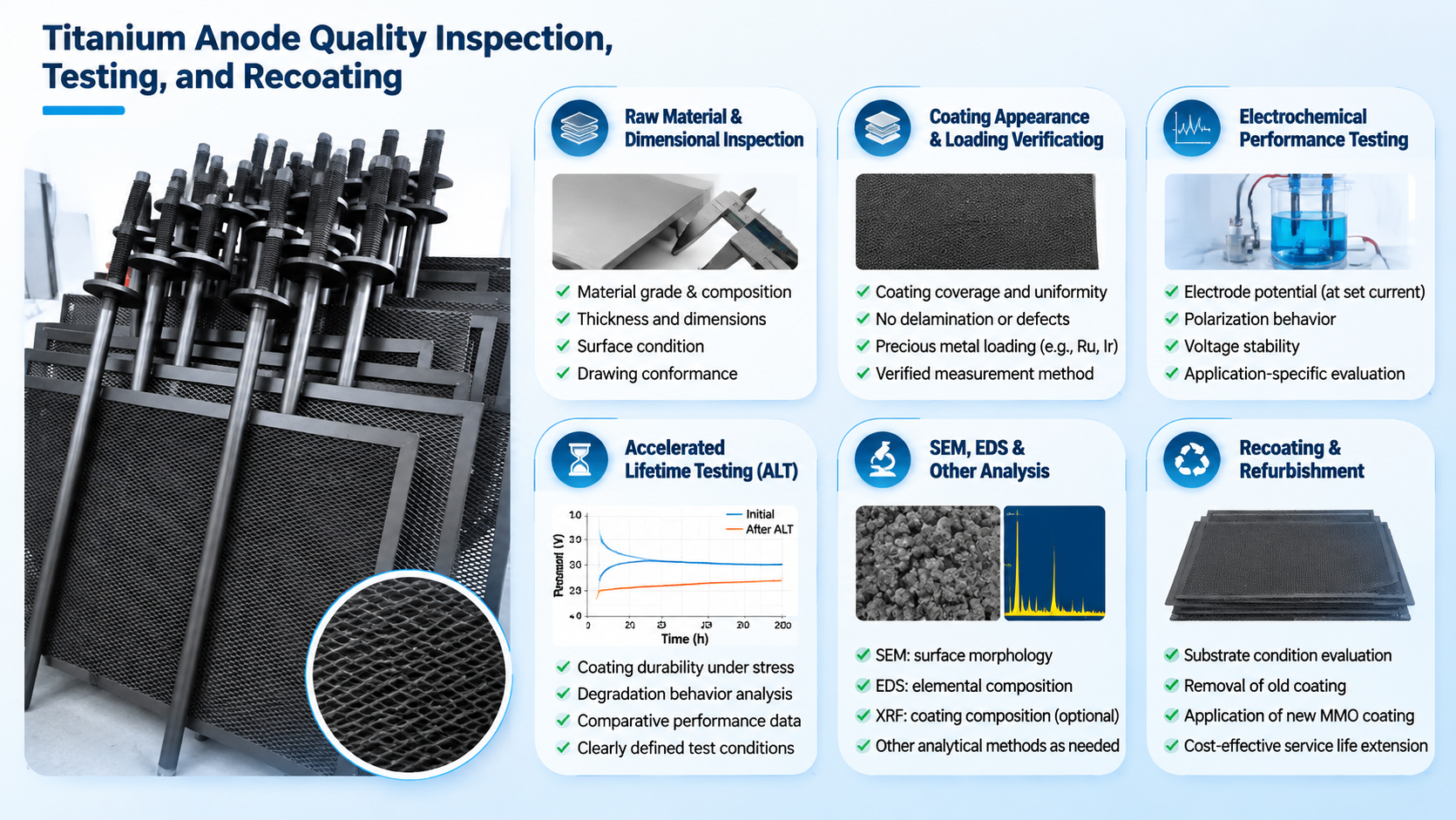
The quality of an MMO titanium anode should be evaluated through a combination of material inspection, manufacturing controls, coating verification, and electrochemical testing.
No single inspection method can establish every aspect of electrode quality.
A comprehensive quality control plan helps ensure that the finished electrode meets the approved technical specification and intended application requirements.
Raw Material and Dimensional Inspection
The titanium substrate should be inspected before fabrication.
Incoming material inspection may include:
- Material grade verification
- Chemical composition documentation
- Thickness measurement
- Dimensional verification
- Surface condition inspection
- Material traceability
After fabrication, the electrode should be checked against the approved technical drawing.
For mesh or welded electrode assemblies, additional inspection may include flatness, opening dimensions, overall geometry, and connection-point alignment.
Dimensional accuracy is especially important in membrane electrolyzers where electrode spacing and installation geometry can affect system performance.
Coating Appearance and Loading Verification
Visual inspection helps identify surface conditions that may require further investigation.
Depending on the qualified coating specification, relevant features include:
- Incomplete coating coverage
- Visible delamination
- Loose coating particles
- Mechanical scratches
- Abnormal coating accumulation
- Uneven surface coverage
- Surface contamination
However, color and surface texture alone cannot establish coating quality.
Precious metal oxide loading may also be verified through appropriate analytical methods or qualified manufacturing controls.
When reviewing coating loading data, buyers should confirm:
- Whether the value refers to total coating or a specific metal component
- Whether the loading is expressed as metal or oxide mass
- Whether the value is calculated per unit of geometric or coated surface area
- Whether the measurement method is documented
These details are important when comparing technical quotations from different manufacturers.
Electrochemical Performance Testing
Electrochemical testing evaluates how the electrode performs under defined operating conditions.
Depending on the application, testing may include:
- Electrode potential at a specified current density
- Polarization behavior
- Voltage stability
- Performance before and after durability testing
- Relevant gas evolution characteristics
- Other application-specific electrochemical evaluations
The electrolyte, temperature, current density, electrode area, reference electrode arrangement, and testing duration should be clearly documented.
Results obtained under different conditions may not be directly comparable.
For example, a potential measurement at one current density cannot be directly compared with a measurement at a substantially different current density without considering the testing conditions.
Accelerated Lifetime Testing (ALT)
Accelerated lifetime testing provides information about coating durability under intentionally intensified electrochemical conditions.
Depending on the application, an accelerated test may use higher current density, modified electrolyte conditions, or other selected stress parameters.
The objective is to investigate coating degradation behavior and compare electrode performance under a controlled testing method.
However, accelerated testing must be interpreted carefully.
A result obtained under severe laboratory conditions cannot automatically be converted into an exact number of years of industrial service.
Different stress conditions may produce different degradation mechanisms.
ALT results are most useful when the test method is clearly defined, consistently applied, and interpreted together with relevant industrial operating information.
SEM, EDS, and Other Analytical Methods
Advanced analytical methods can provide additional information about coating composition and surface structure.
Common methods include:
Scanning Electron Microscopy (SEM)
SEM is used to examine coating surface morphology and microscopic structural features.
Energy-Dispersive X-ray Spectroscopy (EDS)
EDS can provide information about the elemental composition of selected regions of the coating.
X-ray Fluorescence (XRF)
XRF can be used for suitable elemental analysis and coating composition evaluation when an appropriate calibration and measurement method are available.
Other laboratory methods may be used according to the project requirements.
These techniques provide different types of information and should be selected according to the inspection objective.
Titanium Anode Recoating and Refurbishment
An MMO titanium anode does not necessarily need to be discarded when its active coating reaches the end of its useful service period.
In some cases, the existing titanium substrate can be evaluated for refurbishment and recoating.
Before recoating, the substrate should be inspected for:
- Dimensional changes
- Mechanical deformation
- Surface damage
- Structural integrity
- Weld quality
- Electrical connection condition
- Corrosion or other material deterioration
If the substrate remains suitable, the old coating may be removed through an appropriate process before the new coating is applied.
Recoating can potentially reduce the need for new titanium substrate fabrication and provide an additional maintenance option.
However, not every used electrode is suitable for refurbishment.
Where the substrate is severely damaged, deformed, or outside critical dimensional tolerances, complete replacement may be the more appropriate solution.
The final decision should be based on technical inspection and an evaluation of total refurbishment cost.
8. How to Select a Reliable Chlor-Alkali Titanium Anode Manufacturer
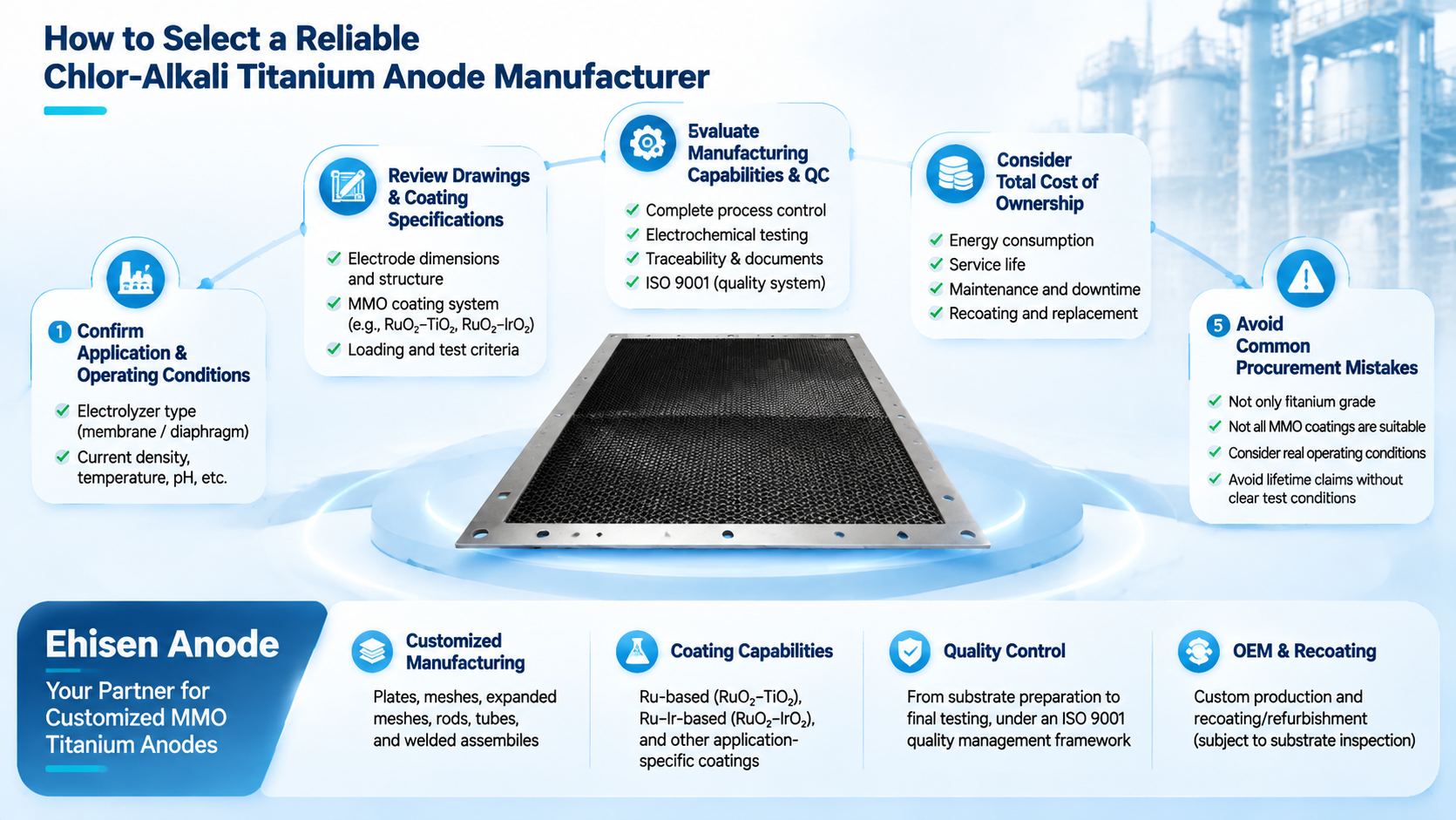
Selecting a titanium anode manufacturer is an important procurement decision for chlor-alkali plants and electrolyzer equipment manufacturers.
The lowest quotation does not necessarily represent the most economical option.
Buyers should evaluate technical suitability, coating manufacturing capabilities, dimensional precision, quality control, testing procedures, and long-term supply reliability.
Confirming Electrolyzer Type and Operating Conditions
The first step is to identify the intended application.
Is the electrode designed for a diaphragm cell, membrane cell, or another chlorine-evolving electrochemical system?
Different electrolyzer configurations may require different electrode structures, coating specifications, and installation arrangements.
The supplier should also understand the operating parameters, including:
- Operating current
- Current density
- Electrolyte composition
- Sodium chloride concentration
- Operating temperature
- pH
- Brine purity
- Continuous or intermittent operation
- Target service life
If the coating composition has not yet been determined, the operating information can be used for preliminary technical evaluation.
Reviewing Technical Drawings and Coating Specifications
An accurate technical drawing is essential for customized titanium anodes.
The drawing should clearly identify:
- Overall electrode dimensions
- Titanium substrate grade
- Substrate thickness
- Mesh or plate geometry
- Welding structure
- Electrical connection points
- Installation clearances
- Critical tolerances
- Coated active area
- Areas that must remain uncoated
- Drawing revision
The coating specification should also be discussed.
Relevant parameters may include coating family, intended electrochemical reaction, active material loading, coverage requirements, and testing criteria.
For replacement projects, an existing drawing or approved sample can help clarify the manufacturing requirements.
Evaluating Manufacturing Capabilities and Quality Control
A reliable manufacturer should understand the relationship between material selection, substrate preparation, coating application, thermal treatment, and final electrode performance.
Buyers should evaluate whether the manufacturer has documented procedures for:
- Raw material inspection
- Titanium fabrication
- Surface pretreatment
- Precursor solution control
- Coating application
- Drying and thermal processing
- Final dimensional inspection
- Coating inspection
- Electrochemical testing
- Batch traceability
Depending on the project, supporting documentation may include material certificates, inspection records, coating loading information, electrochemical test reports, and manufacturing traceability records.
ISO 9001 certification can provide additional evidence of an established quality management framework, although certification alone does not establish the electrochemical performance of a specific electrode.
Understanding Total Cost of Ownership
The initial purchase price of a titanium anode does not represent its complete operating cost.
Industrial buyers should also consider:
- Electricity consumption
- Electrode service life
- Frequency of maintenance shutdowns
- Replacement labor
- Production downtime
- Equipment compatibility
- Recoating costs
- Transportation and handling
- Quality risks associated with premature failure
A higher initial electrode cost may be economically justified if the electrode provides better verified operating performance or lower lifetime maintenance expenses.
The appropriate comparison is the total cost of ownership, supported by application-specific data.
Common Procurement Mistakes
Several mistakes can lead to inappropriate electrode selection.
Mistake 1: Choosing an Electrode Based Only on Titanium Grade
The substrate is only one part of the electrode. Coating composition, loading, geometry, and application conditions are equally important.
Mistake 2: Assuming Every MMO Coating Is Suitable for Chlorine Production
Different MMO systems are designed for different electrochemical reactions. An oxygen-evolution coating should not automatically be selected for chlorine production.
Mistake 3: Comparing Coating Thickness Without Understanding Composition
Two coatings with similar thickness may have different compositions, densities, and active material contents.
Mistake 4: Ignoring Actual Operating Conditions
Current density, electrolyte chemistry, temperature, and operating continuity can substantially affect performance.
Mistake 5: Requesting a Guaranteed Service Life Without Defined Test Conditions
Lifetime information should be supported by relevant operating conditions and clearly defined failure criteria.
Mistake 6: Focusing Only on Initial Price
The lowest-priced anode may not provide the lowest total operating cost.
Ehisen Anode: Customized MMO Titanium Anode Manufacturing Capabilities
At Ehisen Anode, we focus on the manufacturing and supply of titanium electrodes with precious metal coatings for industrial electrochemical applications.
Our product capabilities include ruthenium-based and ruthenium-iridium-based MMO titanium anodes, as well as other application-specific coated titanium electrodes.
For chlorine-evolving applications, coating selection should be based on the customer’s actual operating requirements rather than a universal formulation.
Customized Titanium Electrode Manufacturing
We support customized titanium electrode structures according to customer drawings and technical specifications.
Our manufacturing capabilities cover:
- MMO-coated titanium plates
- MMO-coated titanium meshes
- Expanded titanium mesh electrodes
- Titanium rods and tubes
- Customized welded titanium electrode assemblies
- Application-specific coated electrode structures
Precious Metal Coating Capabilities
Our coating capabilities include ruthenium-based mixed metal oxide coatings, iridium-containing MMO coatings, and platinized titanium electrodes for suitable applications.
The coating system is selected according to the intended electrochemical reaction and operating conditions.
We can discuss coating composition, loading requirements, substrate geometry, and relevant inspection criteria during technical evaluation.
Manufacturing and Quality Control
Our manufacturing process includes titanium substrate preparation, electrode fabrication, coating application, thermal processing, and inspection.
We operate under an ISO 9001 quality management framework and support relevant manufacturing and inspection documentation.
Depending on project requirements, quality evaluation may include dimensional inspection, coating appearance assessment, electrochemical testing, and analytical verification.
Specific tests and acceptance criteria should be agreed upon before production.
OEM Manufacturing and Titanium Anode Recoating
We support customized electrode manufacturing for industrial customers requiring specific dimensions, drawings, and coating specifications.
For existing titanium electrodes, we can also evaluate the feasibility of recoating, subject to inspection of the substrate condition and confirmation that refurbishment can meet the intended technical requirements.
Whether your project involves replacement electrodes, prototype evaluation, or recurring production orders, our technical and manufacturing teams can review your requirements and assess suitable manufacturing options.
9. Frequently Asked Questions About Chlor-Alkali Titanium Anodes
Q1. What type of titanium anode is used in the chlor-alkali industry?
Chlor-alkali electrolyzers commonly use titanium anodes coated with mixed metal oxides, particularly ruthenium-containing systems designed for chlorine evolution.
These electrodes are commonly called MMO titanium anodes or dimensionally stable anodes (DSA).
The appropriate coating composition and electrode structure depend on the electrolyzer design and operating conditions.
Q2. Why are titanium anodes better than graphite anodes for chlorine production?
Properly designed MMO-coated titanium anodes offer improved dimensional stability and favorable chlorine evolution catalytic properties compared with traditional graphite electrodes.
Unlike graphite, the titanium substrate is not intended to be progressively consumed during normal operation.
This can support more stable electrode geometry and reduce certain maintenance requirements.
The actual economic benefit depends on the complete operating system and verified electrode performance.
Q3. What is the difference between RuO₂–TiO₂ and RuO₂–IrO₂ titanium anodes?
RuO₂–TiO₂ coatings combine ruthenium oxide with titanium oxide and are an established material family for chlorine evolution.
RuO₂–IrO₂ coatings incorporate iridium oxide to modify the coating’s electrochemical and durability characteristics.
Neither system is universally superior. The appropriate formulation depends on the operating environment, required performance, and validated testing results.
Q4. How long does a ruthenium-coated titanium anode last?
The service life of a ruthenium-coated titanium anode depends on coating composition, active material loading, current density, electrolyte chemistry, temperature, operating profile, and manufacturing quality.
There is no single lifetime applicable to all chlor-alkali installations.
Buyers should request lifetime information based on comparable operating conditions and clearly defined failure criteria.
Q5. Can MMO titanium anodes reduce electricity consumption?
A suitable MMO coating can reduce chlorine evolution overpotential compared with a less active anode surface.
This may reduce the anodic contribution to the total electrolyzer voltage.
However, overall electricity consumption also depends on the cathode, membrane or diaphragm, electrolyte resistance, current efficiency, and other operating factors.
Energy savings should be evaluated using comparable system-level operating data.
Q6. Are Ru-Ir coated titanium anodes suitable for membrane cell electrolysis?
Ruthenium-containing MMO coatings are important candidates for chlorine-evolving anodes in membrane electrolysis systems.
However, suitability depends on the specific coating formulation, electrode geometry, operating conditions, and membrane cell design.
The proposed electrode should be reviewed against the electrolyzer’s technical specifications.
Q7. What is the difference between an MMO titanium anode and a platinum-coated titanium anode?
An MMO titanium anode uses a catalytic coating composed of selected metal oxides.
A platinum-coated titanium anode uses a platinum-containing surface, which may be formed through different coating processes.
These materials have different electrochemical characteristics, manufacturing requirements, and cost structures.
The preferred electrode depends on the target reaction and operating conditions.
Q8. Is a higher ruthenium or iridium loading always better?
No. Higher precious metal loading does not automatically guarantee better catalytic activity or longer service life.
Coating composition, distribution, microstructure, adhesion, and manufacturing quality are also important.
The optimum loading should be established according to the required performance and operating conditions.
Q9. Can titanium anodes be manufactured according to existing electrolyzer drawings?
Yes. Custom titanium anodes can be manufactured according to approved technical drawings, subject to manufacturing feasibility and specification review.
Buyers should provide dimensions, tolerances, connection details, substrate requirements, and coating specifications.
For replacement projects, existing electrode drawings or samples may help clarify manufacturing requirements.
Q10. Can old titanium anodes be recoated?
Some titanium anodes can be refurbished and recoated when their substrates remain structurally suitable.
Before recoating, the substrate should be inspected for dimensional changes, mechanical damage, corrosion, and connection integrity.
Not every used electrode is suitable for refurbishment.
Q11. What causes MMO titanium anodes to fail?
Possible failure mechanisms include catalytic material loss, coating delamination, substrate passivation, electrolyte penetration, mechanical damage, and degradation caused by unfavorable operating conditions.
Failure is often influenced by several interacting factors.
A proper investigation should consider both electrode manufacturing quality and electrolyzer operation.
Q12. How is MMO coating quality tested?
Depending on the specification, quality evaluation may include visual inspection, coating loading verification, dimensional inspection, electrochemical performance testing, accelerated durability testing, and surface analysis.
Testing conditions and acceptance criteria should be defined before production.
Q13. Can accelerated lifetime testing predict actual industrial anode lifetime?
Accelerated lifetime testing can help compare coating durability under specified stress conditions.
However, it cannot automatically provide an exact industrial service-life prediction.
Accelerated testing may produce degradation mechanisms that differ from those encountered during normal plant operation.
Test results should be interpreted alongside relevant operating experience and application requirements.
Q14. What information is needed for a chlor-alkali titanium anode quotation?
For an accurate technical quotation, buyers should provide:
- Electrolyzer type and application
- Technical drawing or electrode dimensions
- Titanium substrate grade
- Electrode quantity
- Coating requirements, if known
- Operating current or current density
- Electrolyte composition and concentration
- Operating temperature
- Target service life
- Relevant inspection and documentation requirements
If the coating composition has not yet been determined, the application details can be reviewed before a suitable coating option is proposed.
Q15. Does titanium anode surface color indicate coating quality?
Not reliably.
MMO coatings may have dark gray or black appearances, but color alone does not establish coating composition, loading, adhesion, or electrochemical performance.
Visual inspection should be supported by appropriate manufacturing controls and testing requirements.
Q16. Can the same titanium anode be used for chlorine evolution and oxygen evolution?
Not necessarily.
Chlorine evolution and oxygen evolution have different electrochemical requirements.
A coating optimized for one reaction may not provide the desired activity, selectivity, or durability for the other.
Electrode selection should be based on the intended reaction and actual electrolyte conditions.
Q17. What is the difference between coating thickness and precious metal loading?
Coating thickness describes a physical dimension of the coating layer.
Precious metal loading describes the amount of a specified metal or oxide associated with a defined electrode area.
Two coatings with the same thickness may have different compositions, densities, and active material contents.
For purchasing comparisons, both the measurement basis and coating composition should be clearly defined.
Q18. What should buyers consider when comparing titanium anode suppliers?
Important considerations include technical suitability, coating manufacturing capability, dimensional precision, quality control, testing procedures, documentation, production consistency, and technical communication.
For recurring orders, buyers should also evaluate lead times, supply reliability, and the manufacturer’s ability to maintain consistent production specifications.
Conclusion: Improve Chlor-Alkali Electrolysis Performance with Ehisen Titanium Anodes
The development of MMO-coated titanium anodes has played an important role in the evolution of industrial chlor-alkali electrolysis.
Compared with traditional graphite electrodes, appropriately designed titanium-based anodes offer important advantages in dimensional stability, catalytic performance, and maintenance planning.
Ruthenium-based mixed metal oxide coatings are particularly relevant to chlorine production because of their favorable catalytic activity for the chlorine evolution reaction.
However, reliable industrial performance requires more than selecting an active coating material.
The complete electrode system must be considered, including titanium substrate quality, coating composition, surface preparation, application method, thermal treatment, electrode geometry, and actual operating conditions.
For chlor-alkali manufacturers, the objective is to select an electrode that contributes to stable electrolysis, appropriate energy performance, reliable operation, and manageable lifetime costs.
At Ehisen Anode, we provide customized MMO-coated titanium electrodes for industrial electrochemical applications, including chlorine-evolving systems.
Our capabilities include:
- Custom Ru-based and Ru-Ir-based MMO titanium anodes
- MMO-coated titanium plates and meshes
- Customized titanium electrode assemblies
- Precious metal coating manufacturing
- Titanium electrode recoating evaluation
- OEM electrode manufacturing
- Application-specific quality inspection and testing
Looking for a Reliable Chlor-Alkali Titanium Anode Manufacturer?
Send us your electrode drawings, application details, operating parameters, and required quantities.
Our technical and manufacturing teams can review your requirements, evaluate suitable coating options, and provide a quotation based on the agreed specifications.
Contact Ehisen Anode Today to Discuss Your Chlor-Alkali Titanium Anode Project.