

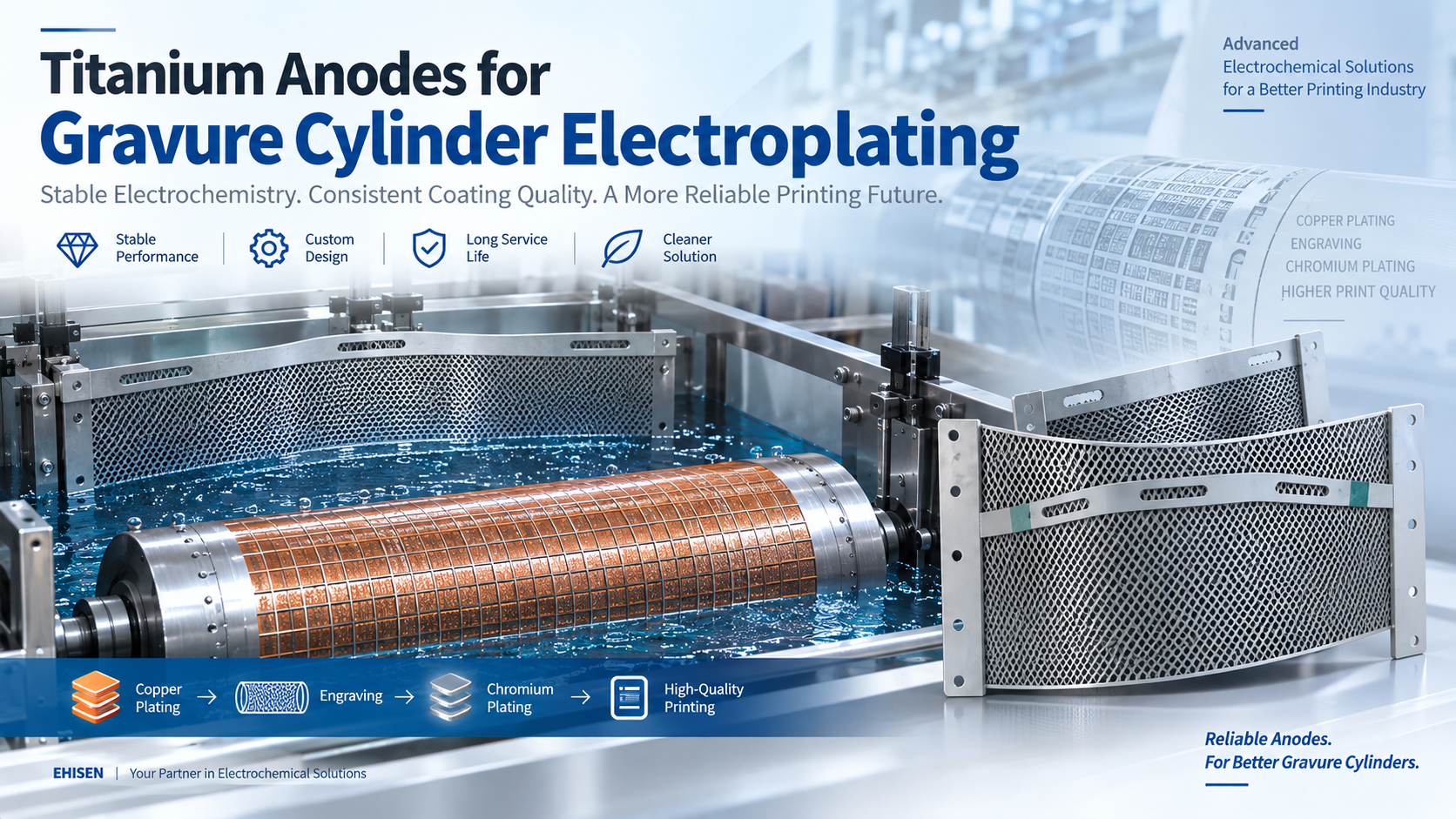
Titanium anodes are generally considered environmentally reliable electrodes when they are correctly designed, manufactured, and operated. Unlike soluble metal anodes, a titanium anode uses corrosion-resistant titanium as the substrate and a catalytic noble metal coating as the active layer. In most industrial electrochemical systems, its main environmental value is not only that it reduces electrode dissolution, sludge generation, and metal contamination risk, but also that it can support water treatment, disinfection, oxidation, and long-term process stability. However, the real environmental effect of a titanium anode depends on the coating type, electrolyte composition, current density, pH, temperature, and system design.

Introduction
When industrial buyers search for titanium anodes, they often focus on price, coating type, service life, and delivery time. But for many applications, especially water treatment, electroplating, electrochlorination, cathodic protection, EDI, and wastewater oxidation, another question is becoming more important:
What effect will this titanium anode have on the surrounding environment?
This is a practical question. An anode is not only a piece of metal placed in a tank or electrolyzer. It is part of an electrochemical reaction system. Once current passes through the electrode, the anode surface may promote oxygen evolution, chlorine evolution, oxidation of pollutants, generation of disinfectants, or other reactions depending on the electrolyte. Therefore, the environmental effect of a titanium anode should be analyzed from two sides.
The first side is the electrode material itself. Will the anode dissolve? Will it release harmful metal ions? Will it create sludge? Will the coating peel off and contaminate the solution?
The second side is the electrochemical reaction caused by the anode. Will it help disinfect water? Will it oxidize pollutants? Will it change pH or ORP? In chloride-containing solutions, will it generate active chlorine, chlorate, perchlorate, or other by-products?
A professional answer should not simply say “titanium anodes are environmentally friendly.” A better answer is:
A properly selected titanium anode can reduce electrode-related pollution and improve process stability, but its environmental performance must be evaluated together with the working medium, coating system, current density, and final application.
This is especially important for industrial buyers. A titanium anode used in seawater electrochlorination cannot be evaluated in exactly the same way as a titanium anode used in EDI water treatment, PCB electroplating, cathodic protection, or organic wastewater oxidation. The same base material may have different coating systems, different reaction pathways, and different environmental control points.
In this article, we will explain how titanium anodes work, whether they are harmful to the surrounding environment, how different coatings such as ruthenium-iridium, iridium-tantalum, and platinum affect environmental performance, and why titanium anodes are often preferred over lead or graphite anodes in modern electrochemical systems.

1. What Does a Titanium Anode Do in an Electrochemical System?
A titanium anode is an electrode used on the positive side of an electrochemical system. When current passes through the system, oxidation reactions occur at the anode surface. The exact reaction depends on the electrolyte, coating type, current density, temperature, and operating conditions.
In simple terms, the titanium anode has three main jobs.
First, it conducts current into the electrolyte. The anode must maintain stable electrical contact and allow current to pass evenly across the active surface. Poor conductivity or unstable contact can lead to hot spots, uneven reactions, and shortened electrode life.
Second, it provides a catalytic surface for electrochemical reactions. The titanium substrate itself is not usually the main catalytic surface. The active function comes from the surface coating, such as ruthenium-iridium oxide, iridium-tantalum oxide, or platinum. These coatings are selected because they can promote specific reactions more efficiently than bare titanium.
Third, it helps control the reaction pathway. In chloride-containing solutions, some coatings are more suitable for chlorine evolution. In oxygen evolution environments, other coatings are more stable. In high-purity or special electrochemical systems, platinum-coated titanium may be chosen for its high stability and conductivity.
Titanium Substrate: The Stable Support
Titanium is widely used as an anode substrate because it has strong corrosion resistance in many aqueous environments. This corrosion resistance is closely related to the formation of a thin, protective titanium oxide film on the surface. Scientific literature commonly attributes titanium’s corrosion resistance to this passive oxide layer, which helps protect the metal from continuous dissolution in many environments.
However, bare titanium is not always suitable as an anode for long-term electrolysis. Under anodic polarization, titanium can become passivated. This means its surface oxide layer may become electrically resistant, increasing voltage and reducing performance. That is why industrial titanium anodes are usually coated with catalytic noble metal oxides or platinum. The coating provides the active electrochemical surface, while the titanium provides mechanical strength, corrosion resistance, and dimensional stability.
Coating Layer: The Active Reaction Surface
The coating is the key part of the titanium anode. It determines many performance factors, including:
- Main reaction tendency
- Oxygen evolution or chlorine evolution efficiency
- Working voltage
- Service life
- Resistance to coating consumption
- Suitability for chloride, acidic, alkaline, or high-purity environments
- Environmental risk under improper operation
For example, a ruthenium-iridium coated titanium anode is often used in chloride-containing systems because it can support chlorine evolution effectively. An iridium-tantalum coated titanium anode is often used where oxygen evolution stability is more important. A platinum-coated titanium anode may be selected for special electrochemical systems that require high conductivity, clean operation, and strong chemical stability.
Therefore, when we discuss the environmental effect of a titanium anode, we should not only ask, “Is titanium safe?” We should also ask:
What coating is used? What reaction will happen on the anode surface? What is inside the electrolyte? What happens after long-term operation?

2. Is a Titanium Anode Harmful to the Surrounding Environment?
In normal industrial use, a properly designed titanium anode is not expected to be a major source of environmental pollution. Compared with many traditional soluble or consumable anodes, titanium anodes are designed to be dimensionally stable. The titanium substrate is not intended to dissolve during operation, and the noble metal coating is designed to work as a catalytic layer rather than as a sacrificial material.
This is one of the main environmental advantages of titanium anodes.
However, the answer depends on the full system. A titanium anode may still influence the environment in different ways:
- It may generate active oxidants in water.
- It may produce chlorine-based species in chloride-containing solutions.
- It may change pH or ORP near the electrode surface.
- It may slowly lose coating activity after long-term operation.
- It may create unwanted by-products if the process is not properly controlled.
So the more accurate answer is:
A titanium anode itself is usually a stable and low-dissolution electrode, but the environmental effect of the complete electrochemical process depends on the coating type, electrolyte composition, and operating parameters.
Environmental Effect of Different Coating Types
Different coating systems have different electrochemical characteristics. Below is a practical comparison for industrial buyers.
| Titanium Anode Type | Common Coating System | Main Electrochemical Tendency | Environmental Advantages | Possible Environmental Concerns | Suitable Control Points |
|---|---|---|---|---|---|
| Ruthenium-Iridium Coated Titanium Anode | Ru-Ir oxide coating, often used as MMO coating | Strong activity in chloride-containing electrolytes; commonly used where chlorine evolution or active chlorine generation is required | Helps generate disinfecting oxidants in saltwater, seawater, brine, and some wastewater systems; reduces the need for separate chemical dosing in some applications | In chloride media, active chlorine chemistry may lead to chlorate, perchlorate, chlorinated organics, or chloramine formation if the system is not controlled. Electrochemical oxidation studies have identified chlorine-related by-products as important control issues. (PMC) | Control current density, chloride concentration, pH, temperature, residence time, residual chlorine, and final discharge standards |
| Iridium-Tantalum Coated Titanium Anode | Ir-Ta oxide coating, usually designed for oxygen evolution environments | Stronger suitability for oxygen evolution and acidic or low-chloride conditions | Good stability in oxygen evolution systems; suitable for many environments where chlorine generation is not the main goal; helps reduce unnecessary chlorine chemistry in low-chloride systems | If used in a solution containing chloride, some chlorine-related reactions may still occur depending on voltage and conditions; coating life may shorten if used outside the intended environment | Confirm chloride level, pH, current density, temperature, target reaction, and whether oxygen evolution or chlorine evolution is expected |
| Platinum-Coated Titanium Anode | Metallic platinum coating on titanium substrate | High conductivity and high chemical stability; suitable for special electrochemical and precision applications | Clean electrode surface, good conductivity, low contamination risk when properly manufactured; useful in high-purity or special systems | Platinum is a precious metal resource, so poor design, overuse, or unnecessary coating thickness increases cost and resource consumption; coating damage may affect performance | Select proper platinum thickness, surface area, substrate structure, current density, and cleaning method |
| Bare Titanium Used Incorrectly as Anode | Titanium without catalytic coating | Passivation under anodic conditions | Low material cost but not suitable for many long-term electrolysis applications | Voltage may increase, performance may become unstable, and the system may lose efficiency | Avoid using bare titanium as a long-term functional anode unless the application is specifically designed for it |
Ruthenium-Iridium Coated Titanium Anodes
Ruthenium-iridium coated titanium anodes are widely used in chloride-containing environments. These include electrochlorination, seawater systems, sodium hypochlorite generation, some wastewater treatment systems, and many industrial electrolysis processes involving chloride ions.
From an environmental perspective, this coating type can be very useful because it can generate active chlorine species such as chlorine, hypochlorous acid, or hypochlorite depending on pH and operating conditions. These species can disinfect water, oxidize ammonia, control microorganisms, and reduce certain organic pollutants.
However, this same advantage is also the point that needs control. In chloride-containing water, electrochemical oxidation can form unwanted chlorine-related by-products under certain conditions. Research on electrochemical oxidation has discussed the formation of chlorate, perchlorate, and chlorinated organic by-products in chlorine-mediated systems.
Therefore, the environmental value of a ruthenium-iridium titanium anode depends on whether the system is properly designed. It is not enough to only choose a “chlorine evolution anode.” The buyer should also confirm:
- Chloride concentration
- Water composition
- Target disinfectant concentration
- pH range
- Current density
- Residence time
- Temperature
- Discharge requirement
- Whether by-product monitoring is needed
A well-designed ruthenium-iridium coated titanium anode can support efficient disinfection and oxidation. A poorly designed system may create excessive oxidants or unwanted by-products.
Iridium-Tantalum Coated Titanium Anodes
Iridium-tantalum coated titanium anodes are often selected for oxygen evolution environments. This coating type is commonly used when the electrolyte does not require strong chlorine evolution, or when oxygen evolution stability is more important than chlorine generation.
From an environmental point of view, iridium-tantalum coated titanium anodes may be a better choice in many low-chloride or non-chloride systems. They can help reduce unnecessary chlorine generation when the process target is oxygen evolution, acid regeneration, EDI-related electrode service, electroplating auxiliary reactions, or other oxygen evolution applications.
The role of tantalum oxide in such coating systems is usually related to improving coating stability. In many coating designs, tantalum oxide is not used mainly for catalytic activity, but for structural stability and corrosion resistance of the oxide layer.
This type of anode can be environmentally beneficial because it supports long-term operation with lower electrode dissolution risk. But it still requires correct application. If the actual solution contains chloride, fluoride, complexing agents, or aggressive organic compounds, the coating may face different stress conditions. The anode may still promote some chlorine-related reactions if the electrolyte and potential allow it.
For buyers, the key question is not only “Is Ir-Ta better than Ru-Ir?” The better question is:
Does the coating match the real reaction environment?
If the application is mainly oxygen evolution, iridium-tantalum coating may be more suitable. If the application requires chlorine evolution, ruthenium-iridium coating may be more efficient. If the application requires a highly stable and clean metallic surface, platinum-coated titanium may be considered.
Platinum-Coated Titanium Anodes
Platinum-coated titanium anodes are used in applications that require strong conductivity, high corrosion resistance, and stable electrochemical performance. The platinum layer acts as the active surface, while titanium provides the structural support.
From an environmental perspective, platinum-coated titanium anodes have several advantages. They are not designed to dissolve like sacrificial anodes. They can provide clean electrochemical performance in many controlled systems. They are also suitable for precision applications where contamination from electrode material must be minimized.
However, platinum is a precious metal resource. This means that environmental responsibility is not only about whether platinum dissolves during operation. It is also about whether the coating thickness and structure are properly selected. Over-designing the platinum layer increases material cost and resource use. Under-designing the coating may shorten service life and lead to early replacement.
Therefore, platinum-coated titanium anodes should be selected according to actual current density, electrolyte composition, temperature, target service life, and equipment design. A professional supplier should not simply recommend the thickest possible coating. The better approach is to balance performance, cost, and long-term reliability.
Are Noble Metal Oxide Coatings Safe?
In a finished titanium anode, the coating is bonded to the titanium surface through controlled coating and heat treatment or plating processes. It is designed to work as a solid catalytic layer. This is different from releasing raw chemical powders into the environment.
Still, production and application should be handled responsibly. Some raw metal oxide substances may have environmental hazard classifications in chemical databases. For example, iridium oxide is listed with aquatic long-term hazard information in PubChem. This does not mean a finished industrial titanium anode will automatically pollute water. It means raw materials, coating production, waste handling, and damaged electrodes should be managed professionally.
For industrial buyers, the practical environmental focus should be:
- Choose the correct coating for the electrolyte.
- Avoid excessive current density.
- Avoid dry running or reverse polarity.
- Avoid mechanical damage to the coating.
- Monitor voltage rise during operation.
- Replace or recoat the anode when coating failure begins.
- Treat spent electrodes as industrial materials, not ordinary waste.

3. Titanium Anode vs. Lead Anode and Graphite Anode: Which Is More Environmentally Friendly?
To understand the environmental value of titanium anodes, it is useful to compare them with traditional anode materials such as lead and graphite.
Lead anodes and graphite anodes have been used in many electrochemical industries for a long time. They may still be suitable for certain processes, but from an environmental and long-term operation perspective, titanium anodes often provide clear advantages.
Titanium Anode vs. Lead Anode
Lead anodes are used in some electrochemical and metallurgical industries because lead is conductive, relatively easy to process, and can form oxide layers under certain anodic conditions. However, lead is also a toxic metal. Environmental and public health authorities treat lead exposure as a serious issue. The U.S. Environmental Protection Agency has set the maximum contaminant level goal for lead in drinking water at zero because lead can be harmful even at low exposure levels. The World Health Organization also describes lead as a toxic metal whose widespread use has caused environmental contamination and public health problems globally.
In an electrochemical system, the environmental concern with lead anodes is not only the material name. The concern is that lead-based electrodes may corrode, form sludge, release lead-containing particles, or introduce lead into the process stream if conditions are not well controlled.
By comparison, titanium anodes are designed to be dimensionally stable. The titanium substrate is not intended to dissolve during normal operation, and the noble metal coating works as a catalytic surface. This can reduce the risk of heavy metal contamination from the electrode material itself.
For many modern industries, this is a strong reason to replace lead-based anodes with titanium anodes where technically and economically feasible.
Titanium Anode vs. Graphite Anode
Graphite anodes are another traditional option. Graphite has good conductivity and chemical resistance in some environments. It is also easier to machine than many metals. However, graphite can be consumed under strong anodic conditions, especially in aggressive electrochemical environments. It may also generate carbon particles, surface powdering, or electrode breakage during long-term operation.
In water treatment or electrolysis systems, graphite consumption may lead to several practical problems:
- Carbon particles entering the solution
- More frequent electrode replacement
- Changes in electrode geometry
- Higher maintenance workload
- Unstable current distribution after surface wear
- Possible increase in suspended solids or process contamination
Graphite electrodes may still be useful in some electrochemical applications. For example, research has studied graphite electrodes for certain ammonia oxidation pathways and by-product control. But for many industrial systems requiring long-term dimensional stability, titanium anodes can offer a cleaner and more stable solution.
Comparison Table
| Anode Material | Environmental Advantage | Environmental Risk | Maintenance Impact | Typical Buyer Concern |
|---|---|---|---|---|
| Titanium Anode | Low electrode dissolution, stable substrate, selectable catalytic coating, long service life, possible recoating | Wrong coating or poor operation may cause coating damage or unwanted electrochemical by-products | Lower replacement frequency when correctly designed | Higher initial cost, need correct technical selection |
| Lead Anode | Traditional use in some industries, mature processing | Lead toxicity, possible lead dissolution, sludge, heavy metal contamination risk | May require sludge control and stricter waste handling | Environmental compliance and contamination risk |
| Graphite Anode | Conductive, relatively simple material, useful in selected systems | Consumption, carbon particles, breakage, geometry change | More frequent inspection or replacement in harsh systems | Stability and contamination control |
| Stainless Steel Anode | Low initial cost, easy to source | May dissolve or release iron, chromium, nickel, or other alloy elements depending on conditions | May require frequent replacement in aggressive media | Not suitable for many anodic oxidation environments |
Which Is More Environmentally Friendly?
There is no universal answer for every electrochemical system, but in many applications, titanium anodes are more environmentally reliable than lead or graphite anodes because they reduce electrode consumption, heavy metal release risk, and solid waste generation.
The environmental benefit becomes stronger when the titanium anode is:
- Correctly coated
- Properly sized
- Used within recommended current density
- Matched to the electrolyte
- Monitored during operation
- Recoated or recycled when the active layer reaches end of life
In other words, titanium anodes are not environmentally reliable simply because they are made of titanium. They are environmentally reliable because they are designed as stable, application-matched electrochemical electrodes.

4. How Titanium Anodes Affect Water Quality and Help in Water Treatment and Disinfection
Titanium anodes can have a direct effect on water quality because they drive oxidation reactions at the electrode surface. This is why they are widely used in electrochemical water treatment, disinfection, wastewater oxidation, electrochlorination, and related systems.
However, the same anode can have different effects depending on the water chemistry. A titanium anode in high-chloride water behaves differently from a titanium anode in low-conductivity purified water. A titanium anode in acidic wastewater behaves differently from one in seawater. Therefore, water quality impact must be evaluated based on the complete system.
Main Water Quality Parameters Affected by Titanium Anodes
A titanium anode may affect the following water quality indicators:
ORP
ORP, or oxidation-reduction potential, usually increases when oxidants are generated. In disinfection systems, a higher ORP may indicate stronger oxidation ability. However, ORP alone does not tell the full story. It should be evaluated together with residual chlorine, pH, temperature, and target microorganisms or pollutants.
pH
Anodic and cathodic reactions may change local pH near the electrode surface. The bulk pH of the water depends on system design, buffering capacity, flow rate, and cathode reaction. In some systems, pH control is necessary to maintain disinfectant efficiency and prevent scaling or corrosion.
Residual Chlorine
In chloride-containing water, titanium anodes may generate chlorine, hypochlorous acid, or hypochlorite. These species can disinfect water and control microorganisms. But excessive residual chlorine may affect downstream equipment, discharge compliance, or product quality.
Conductivity
Electrochemical systems usually require sufficient conductivity. Conductivity affects voltage, energy consumption, and current distribution. Low-conductivity water may require special design because high voltage or unstable current distribution can reduce efficiency.
Chlorate and Perchlorate
In chloride-containing electrochemical oxidation systems, chlorate and perchlorate formation may become an important environmental concern. Research on electrochemical oxidation has shown that chlorine-mediated pathways can contribute to chlorate and perchlorate formation under certain conditions.
Organic By-products
If water contains organic matter and active chlorine is generated, chlorinated organic by-products may form. This is one reason why electrochemical water treatment must be designed around real water composition, not only theoretical salt concentration.
Metal Ions
A properly designed titanium anode is not intended to release significant metal ions from the substrate. This is an advantage compared with soluble metal anodes. But poor-quality coating, damaged surface, reverse polarity, or improper cleaning may increase risk of contamination.
How Titanium Anodes Help in Water Treatment
Titanium anodes can support water treatment in several ways.
First, they can generate oxidants directly in water. In chloride-containing water, this may include active chlorine species. In other systems, oxygen evolution and other oxidative pathways may contribute to pollutant transformation.
Second, they can reduce the need for transporting or storing some chemical oxidants. In electrochlorination systems, active chlorine can be generated on-site from chloride-containing water or brine. This can simplify chemical handling in certain applications.
Third, they can be used in modular electrochemical systems. Electrochemical oxidation has been discussed as a promising technology for decentralized wastewater treatment because of its modular design, high efficiency, and ease of automation.
Fourth, they can help treat difficult pollutants under suitable conditions. Electrochemical oxidation has been reviewed as a method for removing persistent pollutants from municipal and industrial wastewater, although real wastewater systems still require careful control of operating parameters and cost.
Titanium Anodes in Disinfection
Titanium anodes are especially important in electrochemical disinfection systems. When chloride is present, the anode can generate oxidizing chlorine species that attack microorganisms. Recent research has also studied mixed metal oxide anodes for electrochemical bacterial disinfection in wastewater treatment systems.
For industrial buyers, the important point is not only whether the anode can disinfect water. The important point is whether it can disinfect water safely, consistently, and within the required discharge or process limits.
A good titanium anode disinfection system should consider:
- Target microorganism
- Chloride concentration
- Required residual disinfectant
- Water pH
- Organic matter content
- Ammonia content
- Current density
- Flow rate
- Contact time
- Temperature
- By-product monitoring
- Downstream material compatibility
Water Treatment Benefit Does Not Mean No Risk
It is important to be honest: electrochemical water treatment is not automatically risk-free. The same oxidants that kill bacteria may also react with organic matter or nitrogen compounds. The same chlorine chemistry that disinfects water may also generate by-products if the process is not controlled.
This is why professional titanium anode selection should begin with water chemistry. If the buyer only provides size and quantity, the supplier may not be able to recommend the safest and most efficient coating.
Before choosing a titanium anode for water treatment, buyers should provide:
- Application
- Water source
- Chloride concentration
- pH
- Conductivity
- Temperature
- COD or organic matter level, if available
- Ammonia or nitrogen content, if relevant
- Target treatment result
- Flow rate
- Tank or reactor design
- Current and voltage range
- Required service life
- Discharge or process standard
With this information, the anode supplier can recommend whether ruthenium-iridium, iridium-tantalum, platinum, or another coating design is more suitable.

5. Can Titanium Anodes Be Recoated and Reused? How Long Service Life Reduces Industrial Waste, Operating Cost, and Carbon Footprint
One of the most important environmental advantages of titanium anodes is their potential for long service life and reuse of the titanium substrate.
In many applications, the titanium base does not need to be discarded when the active coating reaches the end of its life. If the substrate remains mechanically sound and chemically acceptable, the old coating can sometimes be removed or treated, and a new coating can be applied. This process is commonly called recoating.
Why Recoating Matters for the Environment
Recoating can reduce waste in several ways.
First, it reduces the need to manufacture a completely new titanium substrate. Titanium processing requires raw material, energy, machining, forming, welding, surface treatment, and inspection. If the substrate can be reused, part of this material and processing demand is avoided.
Second, recoating reduces the amount of industrial scrap generated from spent electrodes. Instead of discarding the entire electrode, the valuable titanium structure can continue to serve as the support for a new catalytic layer.
Third, recoating can reduce logistics and procurement waste. In large electrochemical systems, replacing complete anode assemblies may require new packaging, shipping, inventory, and installation work. Reusing the existing structure can help reduce these indirect environmental impacts.
Fourth, recoating supports a more circular material model. The active noble metal layer is renewed, while the titanium body remains in use for a longer period.
When Can a Titanium Anode Be Recoated?
Not every titanium anode can be recoated. A professional evaluation is needed. Recoating may be possible when:
- The titanium substrate is not seriously corroded.
- The shape is still stable.
- The mesh, plate, tube, rod, or custom structure is not cracked or deformed.
- The welded joints are still reliable.
- The electrical connection area is usable.
- The base material has not suffered deep pitting.
- The previous coating failure did not severely damage the substrate.
Recoating may not be recommended when:
- The titanium substrate is heavily pitted.
- The electrode is bent, cracked, or broken.
- The connection area is burned or severely corroded.
- The mesh has become too weak.
- The substrate thickness is no longer safe.
- The working environment caused deep chemical attack.
- The cost of repair is close to or higher than making a new electrode.
Therefore, buyers should not wait until the anode is completely destroyed before considering recoating. If the voltage rises abnormally, coating activity drops, or the surface shows obvious damage, the electrode should be inspected early.
Long Service Life Reduces Industrial Waste
A long-life titanium anode reduces environmental burden by reducing replacement frequency. Every replacement involves material use, manufacturing energy, packaging, transport, installation, downtime, and waste handling.
For industrial buyers, long service life also has direct economic value. A cheaper anode with poor coating stability may require frequent replacement, which increases total cost. A well-designed titanium anode may have a higher initial price, but it can reduce:
- Maintenance frequency
- Production interruption
- Emergency shutdown risk
- Labor cost
- Replacement inventory
- Waste disposal cost
- Process instability
- Quality problems caused by electrode degradation
This is why titanium anode procurement should not be based only on unit price. The more important question is total cost over the full operating period.
Energy Efficiency and Carbon Footprint
A titanium anode can also influence energy consumption. In an electrochemical system, voltage is affected by electrode material, coating activity, current density, electrode gap, electrolyte conductivity, temperature, and surface condition.
A high-quality catalytic coating can help maintain stable anode performance. If the coating is properly selected, the electrode can operate at a more suitable potential for the target reaction. If the coating is damaged, consumed, or mismatched, voltage may increase. Higher voltage usually means higher electricity consumption under the same current.
This matters because electricity cost is often one of the main operating costs in electrochemical systems. It also matters for carbon footprint, especially if the electricity source has carbon emissions.
However, it would be misleading to claim a fixed energy-saving percentage without testing data from the actual application. The real energy benefit depends on:
- Coating type
- Current density
- Electrolyte conductivity
- Electrode spacing
- Temperature
- Flow condition
- Fouling or scaling
- Cleaning method
- Power supply stability
- Target reaction
A professional supplier should avoid exaggerated claims. The more responsible approach is to help the buyer evaluate the actual working conditions and select the coating and structure that support stable voltage and long-term efficiency.
Economic Benefits for Industrial Buyers
Environmental value and economic value are closely connected in titanium anode applications.
A titanium anode that lasts longer, works more efficiently, and can be recoated may help reduce total operating cost. This does not mean it is always the cheapest option at the time of purchase. It means it may offer better lifetime value.
The main economic benefits include:
Lower replacement cost
Longer service life means fewer replacement cycles. This is especially important for systems where electrode replacement requires shutdown.
Lower maintenance cost
Stable electrodes reduce inspection and cleaning workload. They also reduce the risk of emergency repairs caused by sudden failure.
Lower process risk
Poor anodes may cause unstable voltage, uneven current distribution, coating peeling, contamination, or treatment failure. These problems can affect product quality or environmental compliance.
Lower waste handling cost
A dimensionally stable titanium anode produces less electrode-related waste than many consumable anodes. If recoating is possible, waste can be further reduced.
Better production planning
Predictable anode life helps buyers plan spare parts, maintenance schedules, and production shutdowns.
Better technical control
When the coating is matched to the actual electrolyte, the buyer can better control reaction efficiency, by-products, and operating cost.
Why Correct Design Is More Important Than Simply Choosing Titanium
Titanium alone does not guarantee environmental reliability. The coating, structure, and operating conditions matter just as much.
For example:
- A chlorine evolution coating used in a system where chlorine by-products must be minimized may not be ideal.
- An oxygen evolution coating used in a high-chloride system may have poor efficiency or shorter life.
- A platinum coating that is too thin may fail early.
- A platinum coating that is too thick may increase cost unnecessarily.
- A mesh structure may be suitable for one tank but not another.
- A plate anode may create uneven current distribution if the geometry is wrong.
- Poor surface preparation may reduce coating adhesion.
- Incorrect cleaning may damage the coating.
Therefore, the environmental and economic value of a titanium anode comes from the complete design, not only from the material name.
6. Conclusion: Titanium Anodes Are Environmentally Reliable When Correctly Designed and Used
Titanium anodes can have a positive effect on the surrounding environment when they are properly selected, manufactured, and operated. Their environmental advantages mainly come from the stable titanium substrate, catalytic noble metal coating, low electrode dissolution, long service life, and possible recoating or reuse.
Compared with lead anodes, titanium anodes can reduce the risk of toxic metal contamination. Compared with graphite anodes, they usually offer better dimensional stability and lower particle generation in many industrial electrochemical systems.
In water treatment and disinfection, titanium anodes can help generate oxidants, control microorganisms, and support pollutant oxidation. However, their environmental performance still depends on water chemistry, coating type, current density, pH, temperature, and system design. In chloride-containing water, active chlorine can be useful for disinfection, but by-products such as chlorate, perchlorate, or chlorinated organics should be controlled.
Therefore, a titanium anode is not environmentally reliable simply because it is made of titanium. It becomes reliable when the substrate, coating, structure, electrolyte, and operating conditions are correctly matched.
Before purchasing titanium anodes, buyers should provide key working conditions, including application, electrolyte composition, chloride concentration, pH, temperature, current density, voltage range, anode size, working area, required service life, and inspection requirements.
With this information, a professional titanium anode supplier can recommend the right coating system and structure, helping reduce material waste, improve system stability, lower maintenance cost, and support safer long-term operation.
When correctly designed and used, titanium anodes can be a more sustainable electrode choice for electroplating, water treatment, electrochlorination, EDI, cathodic protection, hydrogen production, and other industrial electrochemical systems.